
Surinam Toad Uses Fractal Fingertips as a Touch-Based Fovea to Hunt in Murky Waters
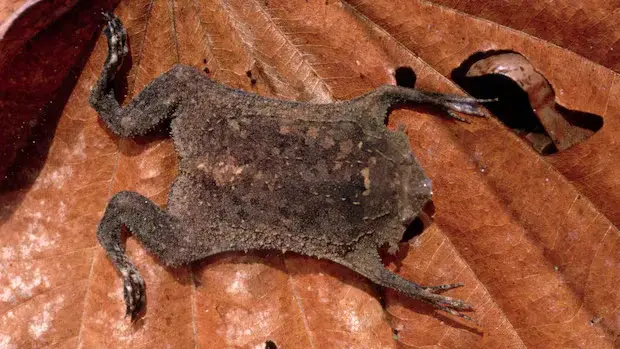
A new study reveals that the Surinam toad, or pipa frog, hunts prey using highly sensitive, fractal-like fingertips that function as a tactile fovea, compensating for poor vision in murky waters. This discovery suggests a shared evolutionary strategy between amphibians and mammals for prioritizing sensory input.
Key points
- Researchers at UCLA found that the Surinam toad detects prey through water vibrations sensed by its fingertips, not its eyes.
- The toad's fingers branch into 128 ultra-sensitive lobes, which contain 60% of the touch nerves on its forelimbs despite covering only 8% of the skin area.
- The brain dedicates a disproportionately large area to processing signals from these fingertips, mirroring the function of a visual fovea in mammals.
- This finding is the first demonstration of a fovea-like sensory structure in a non-mammalian nervous system, highlighting convergent evolution.
- The toad's unique reproductive strategy involves eggs embedding in the mother's back, from which fully formed young emerge.
Background
For nearly two centuries, scientists have been puzzled by the hunting efficiency of the Surinam toad, given its poor eyesight and the turbid environment of the Amazon basin. While previous observations noted its bizarre reproductive habits, where babies emerge from holes in the mother's back, the mechanism for its precise predation remained unclear. This new research builds on earlier studies of other non-model organisms, such as tentacled snakes, to understand how animals adapt sensory systems to their environments.
How outlets are covering it
CBC Radio emphasizes the toad's ability to 'see' with its fingertips, highlighting the sensitivity of the papillae on the lobes and comparing them to human fingertips. The Transmitter focuses on the neurological aspect, describing the fingertips as a 'fovea' in the optic tectum, a brain area homologous to the mammalian sensory cortex. While both sources agree on the fractal structure of the fingers, CBC notes the toad can suck prey without direct contact, whereas The Transmitter details the developmental changes in finger branching from juvenile to adult stages. Both outlets attribute the findings to Duncan Leitch at UCLA, but The Transmitter provides more detail on the evolutionary implications for non-mammalian nervous systems.
Why it matters
This discovery challenges the assumption that complex sensory processing, such as a fovea, is exclusive to mammals. It demonstrates that frogs and mammals, despite evolving separately for over 350 million years, arrived at similar solutions for processing high-resolution sensory data from small body parts. This insight may help scientists understand how vertebrates develop and utilize brain regions for specific sensory modalities, potentially informing broader research in neurobiology and evolutionary biology.
What to watch
Researchers plan to investigate how the development of the toad's fingertips, which change from four branches to 16 lobules as the frog matures, affects the representation in the central nervous system. They are also interested in whether the brain's response to these sensory inputs is pre-wired or develops in sync with the physical changes in the fingertips. Further studies may explore how other non-model organisms use similar sensory strategies to adapt to their environments.
Want the full story? Read the original reporting
Read on CBC