
Black Holes Are Messy Eaters: New Data Shows They Expel Nearly as Much Matter as They Swallow
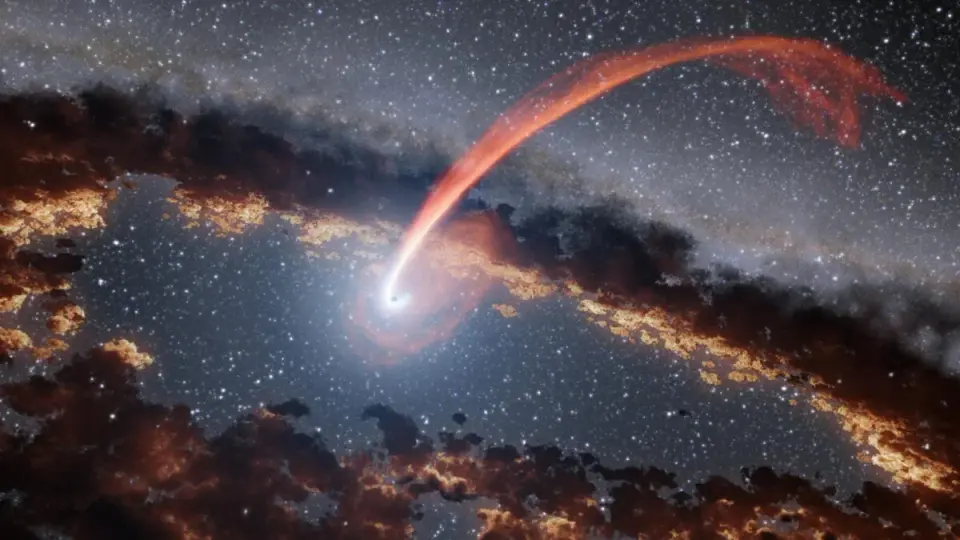
A new study reveals that black holes are not bottomless pits but complex digestive systems. By observing the 2023 eruption of Swift J1727.8−1613, researchers found that black holes expel massive amounts of gas through jets and winds, potentially returning as much matter to space as they consume.
Key points
- Researchers used the Very Large Telescope (VLT) to track the 2023 outburst of the black hole system Swift J1727.8−1613, creating a high-resolution 'movie' of its feeding process.
- The study found that the black hole did not consume all the material from its companion star; instead, it processed the matter and expelled a significant fraction back into space via powerful jets and winds.
- Even after the initial X-ray flare faded to one-hundredth of its peak brightness, the system continued to generate dense gas outflows, suggesting the 'digestive' process continues long after the initial meal.
- Lead author Noel Castro Segura of the University of Warwick stated that the expelled material could rival the amount ultimately consumed, challenging the view of black holes as efficient, bottomless gluttons.
- The findings suggest that black holes are inefficient eaters, which may alter our understanding of how binary star systems evolve in galaxies.
Background
This discovery builds on recent findings regarding how black holes sustain themselves. In July 2026, JWST observations of the galaxy NGC 4696 revealed a 'cosmic recycling' system where gas heated by black hole jets cools into filaments that fall back to feed the black hole. Additionally, earlier studies in 2026 identified 'little red dots' in JWST images as potentially young black holes enveloped in dense gas, further complicating the simple model of black holes as mere voids.
How outlets are covering it
Gizmodo and Space.com emphasize the 'indigestion' metaphor, highlighting that black holes are messy eaters that regurgitate matter. ScienceDaily focuses on the efficiency aspect, noting that black holes may be far less efficient than previously assumed. Wired.com, while covering a different black hole (NGC 4696), provides a complementary perspective on how black holes recycle gas through filaments, suggesting a self-sustaining cycle that prevents them from running out of fuel. All sources agree that black holes are complex systems rather than simple voids, but they differ in focus: some highlight the expulsion of matter (Gizmodo, Space, ScienceDaily), while others focus on the recycling of matter (Wired).
Why it matters
This research fundamentally changes our understanding of black hole accretion. If black holes expel as much matter as they consume, it implies they are less efficient at growing than previously thought. This has implications for the evolution of binary star systems and the growth of supermassive black holes in galaxies. It also suggests that the 'messy' outflows of black holes play a crucial role in redistributing matter and energy throughout the universe, potentially influencing star formation and galaxy evolution.
What to watch
Researchers will continue to monitor Swift J1727.8−1613 and other black hole systems to confirm the findings. The study of NGC 4696 by Julie Hlavacek-Larrondo and her team will likely lead to further observations using JWST and other telescopes to test if the 'cosmic recycling' system is universal. Future studies may also explore the role of magnetic fields in transferring angular momentum and the impact of black hole outflows on the surrounding interstellar medium.
- Even Black Holes Can Get Indigestion. Unsurprisingly, Their Farts Are ‘Massive’ Expulsions of Gas Gizmodo
- Astronomers watch a black hole's feeding frenzy end with a bad case of cosmic indigestion Space
- It’s Becoming Clear Why Black Holes Never Run Out of Fuel wired.com
- Black holes may spit out nearly as much matter as they swallow ScienceDaily
- Study Provides One of the Most Detailed Optical Records of a Black Hole Eruption Cycle AZoQuantum
Want the full story? Read the original reporting
Read on Gizmodo