
MTG-I2 Completes Final Assembly for Ariane 6 Launch in French Guiana
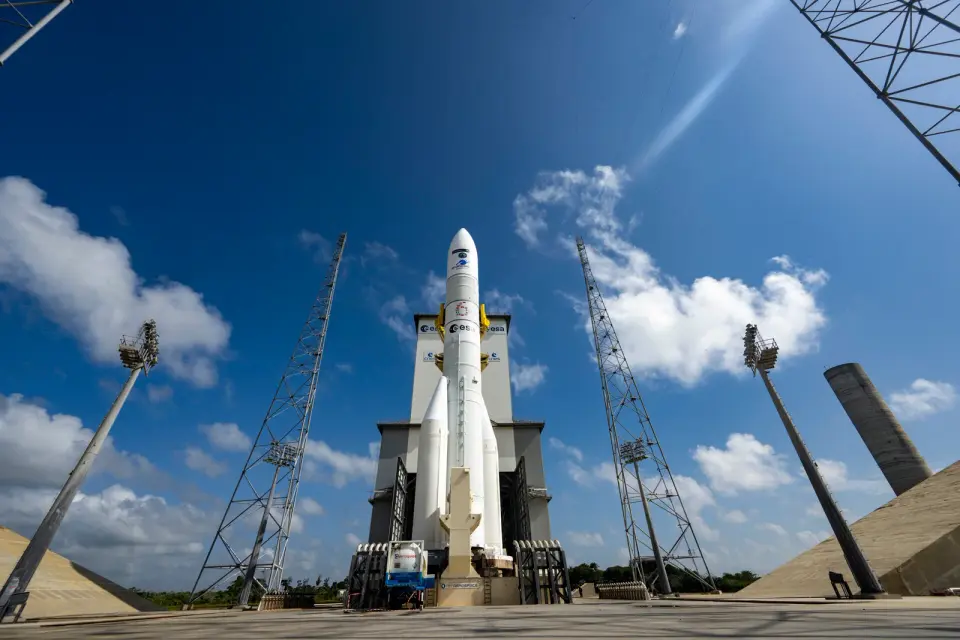
The Meteosat Third Generation Imager 2 (MTG-I2) satellite has been encapsulated in an Ariane 6 fairing at Europe’s Spaceport in French Guiana, preparing for a launch scheduled for August 27, 2026. This mission marks the ninth flight of the Ariane 6 rocket and the first to a geostationary transfer orbit. MTG-I2 will complete the initial Meteosat Third Generation constellation, providing high-resolution weather data for Europe and North Africa every 2.5 minutes to improve severe weather forecasting and disaster response.
Key points
- MTG-I2 was encapsulated in the Ariane 6 fairing and positioned on the launch pad at Europe’s Spaceport in Kourou, French Guiana, ahead of a scheduled launch on August 27, 2026.
- The satellite will complete the first full operational Meteosat Third Generation constellation, joining the previously launched MTG-I1 and MTG-S1 satellites.
- MTG-I2 is designed to provide high-resolution atmospheric imagery over Europe and North Africa every 2.5 minutes, significantly improving the speed and accuracy of severe weather warnings.
- This launch represents the ninth flight of the Ariane 6 rocket and its first mission to a geostationary transfer orbit, utilizing two P120C solid-propellant boosters.
- The satellite is expected to remain in orbit for at least 8.5 years, supporting weather forecasting, climate monitoring, and protection of weather-dependent economies such as agriculture and energy.
Background
This launch follows the successful deployment of the first Meteosat Third Generation imager (MTG-I1) in December 2022 and the sounder satellite MTG-S1. The European Space Agency has previously highlighted concerns regarding launch capacity by 2030, with Ariane 6 currently supporting approximately nine to ten launches annually. Recent decisions to shelve certain Ariane 6 upgrades due to cost pressures underscore the ongoing challenges in balancing European space access capabilities with budgetary constraints.
How outlets are covering it
The European Space Agency emphasizes the technical readiness of MTG-I2 and the significance of the Ariane 6’s first geostationary transfer orbit mission. EUMETSAT focuses on the operational benefits for weather forecasting, highlighting the rapid scan service that will provide imagery every 2.5 minutes to improve nowcasting of severe weather. Table.Briefings frames the satellite’s impact in terms of disaster response, noting that the increased frequency of high-resolution images aims to cut warning times for emergency services by half. Space.com provides a general overview of the launch but offers limited additional detail beyond the event itself.
Why it matters
The successful launch and operation of MTG-I2 will enhance Europe’s ability to predict and respond to extreme weather events, protecting critical infrastructure and economies dependent on weather conditions. It also demonstrates the capability of the Ariane 6 rocket to handle heavy payloads and reach geostationary orbits, a key milestone for European space autonomy. Improved weather forecasting can lead to better preparedness for severe storms, heavy rain, and other hazardous events, ultimately saving lives and reducing economic losses.
What to watch
Following the launch on August 27, 2026, MTG-I2 will undergo commissioning before being handed over to EUMETSAT for operational use. The satellite will begin providing high-resolution imagery every 2.5 minutes, contributing to the full operational Meteosat Third Generation constellation. Future developments may include expanded production of Ariane 6 to meet growing demand for launches, as well as continued efforts to address cost and capacity challenges in European space access.
- MTG-I2 ready for launch on Ariane 6 European Space Agency
- Watch live: MTG-I2 set for liftoff European Space Agency
- Watch powerful Ariane 6 rocket launch European weather satellite to orbit today Space
- Watch the launch of Meteosat Third Generation Imager 2 Eumetsat
- Disaster preparedness: New weather satellite aims to cut warning times for disaster response in half Table.Briefings
Want the full story? Read the original reporting
Read on European Space Agency