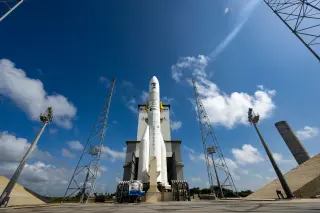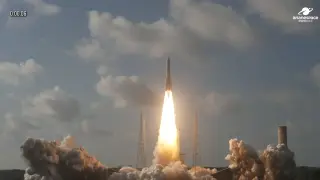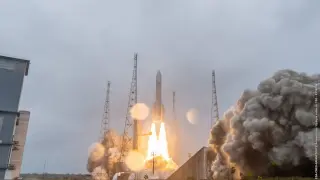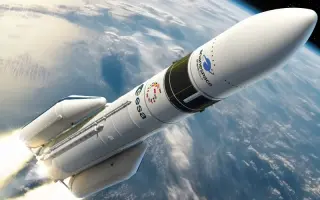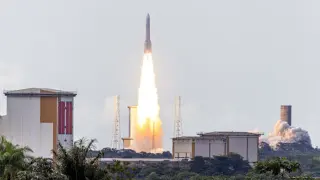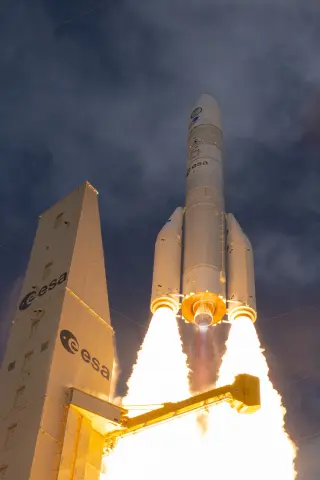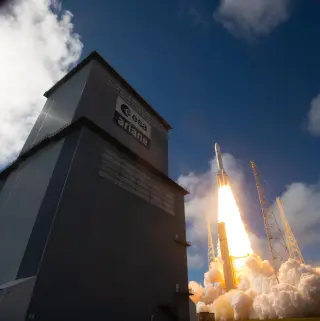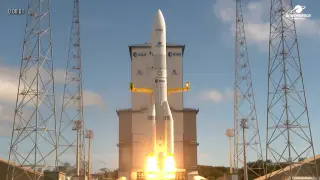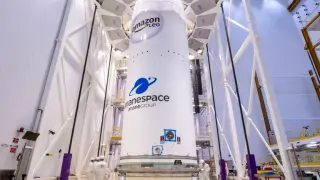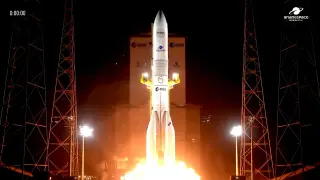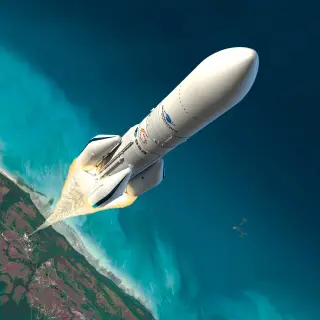
Europe’s Ariane 6 launched from French Guiana with four P160C-based boosters, each carrying 14 tonnes more propellant, delivering 36 Amazon Leo satellites in a single mission and setting a new European space cargo record while showing a 10–15% performance gain over earlier versions.
An Ariane 6 rocket from Europe’s Spaceport in Kourou launched on June 17 with 36 Amazon Leo broadband satellites—the heaviest payload ever lofted by an Ariane launcher and the 100th Amazon Leo satellite—advancing Amazon’s planned low‑Earth‑orbit megaconstellation. The upgraded four P160C solid-rocket boosters boosted the launcher’s capacity by more than two tons, with the 36 satellites weighing about 45,900 pounds (roughly 20,820 kg) in total. Deployment is expected about 289 miles (465 km) up, roughly 1 hour 51 minutes after liftoff. This was Ariane 6’s eighth flight and Amazon Leo’s 14th launch overall, though SpaceX’s Starlink remains far larger in total satellites.
Amazon has hundreds of Leo satellites built and idle in Florida while Ariane 6 is carrying out launches from French Guiana, including a 36-satellite payload on LE-03. So far this year only Ariane 6 has delivered for Amazon, as Blue Origin’s New Glenn and ULA’s Vulcan have yet to launch any Amazon satellites; a recent New Glenn test explosion and BE-4 engine issues further cloud those programs. Amazon emphasizes a diversified launch portfolio and says it remains on track to begin commercial service later this year, though only about 10% of its planned 3,236-satellite constellation has deployed to date.
Stoke Space completes proto-qualification of the Nova first-stage at Moses Lake with an eye to a late-2026 debut; NASA weighs Artemis III lander options (Blue Origin’s New Glenn, Vulcan, Falcon Heavy) after the pad incident; Isar Aerospace raises 270 million euros to scale Spectrum and reschedule its second launch; SpaceX readies for Friday’s IPO amid ongoing Starlink and Falcon 9 milestones; Ariane 6 upgrades with P160C boosters and there’s ongoing talk of offshore launch concepts and regulatory flexibilities for Amazon Leo.
Europe’s Ariane 6 rocket, VA268, launched from Kourou carrying 32 Amazon Leo satellites into low Earth orbit for Amazon’s Kuiper broadband project; the mission showcased the 64-version rocket’s capability on its seventh flight, part of a plan to deploy about 3,200 satellites over more than 80 launches, with 18 Ariane 6 missions booked so far.
Europe's Ariane 6 is slated to fly again on mission VA268 with four P120C boosters to deliver 32 Amazon Leo satellites to low Earth orbit. Liftoff is planned for 30 April 2026 within a 09:08-09:57 BST window, with a total mission duration of about 114 minutes from liftoff to final satellite separation. The four-booster configuration increases payload to about 21.6 tonnes to LEO (more than double the two-booster capacity), using a 20-meter fairing to house the satellites. ESA, ArianeGroup and Arianespace coordinate development and launch operations, with live broadcast starting 30 minutes before liftoff.
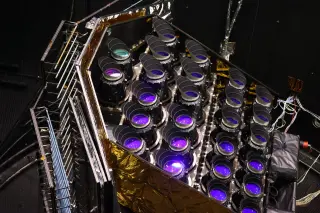
ESA's Plato spacecraft completed rigorous space-like testing in the Large Space Simulator, validating its cameras and thermal systems under extreme hot/cold conditions as it edges toward an early 2027 launch on Ariane 6 to hunt Earth-like exoplanets around Sun-like stars.
The Ariane 6 rocket successfully launched two EU Galileo satellites from French Guiana, marking a significant step in Europe's space independence by expanding its satellite constellation and reducing reliance on US and Russian launch services.
Europe's Ariane 6 rocket is set to launch its first pair of Galileo navigation satellites, marking a significant milestone for the vehicle's role in Europe's space capabilities, reducing reliance on external launch providers like SpaceX and Russia.
Two Galileo satellites were launched on December 17 from Europe's Spaceport in French Guiana aboard an Ariane 6 rocket, marking the first launch of Galileo on Ariane 6 and the 14th operational satellite launch for the program, which aims to enhance global navigation services.
Sentinel-1D, the last of the first-generation Sentinel-1 satellites, was successfully launched into orbit aboard an Ariane 6 rocket from French Guiana, completing the Copernicus Earth observation mission that provides critical radar data for environmental monitoring and disaster response.
Europe's Ariane 6 rocket is launching its fourth mission, carrying the Sentinel-1D satellite for the EU's Copernicus program, which provides critical radar imagery for various applications, marking its third successful launch after debuting in July 2024.
The Phoebus project by ESA and partners is developing innovative carbon-fiber reinforced plastic hydrogen tanks for the Ariane 6 rocket, with progress including the production of a 2600-liter tank and preparations for cryogenic testing in Germany, aiming to reduce rocket mass and improve space launch technology.
Ariane 6 successfully launched its third mission, beating Vulcan to this milestone, while China deployed its sixth batch of Guowang satellites using the Long March 5B. SpaceX launched its 100th mission of the year, including satellites for Amazon's Project Kuiper, highlighting its dominant role in commercial space launches. The Portuguese government approved a spaceport in the Azores, and China revealed its first marine rocket recovery ship. ULA's Vulcan rocket achieved its first national security launch, marking a key operational milestone. Additionally, NASA's Artemis II astronauts trained for nighttime launch procedures, and China continues expanding its satellite internet constellation.
Stargazers along the East Coast observed unusual spiral lights in the night sky, likely caused by the tumbling upper stage of the Ariane 6 rocket during its disposal, coinciding with the Perseid meteor shower and other rocket launches, creating a spectacular and rare visual display.