
Chang'e 7 Launch Delayed to 2027 Amid Typhoon; Mission Aims to Map Lunar South Pole Ice
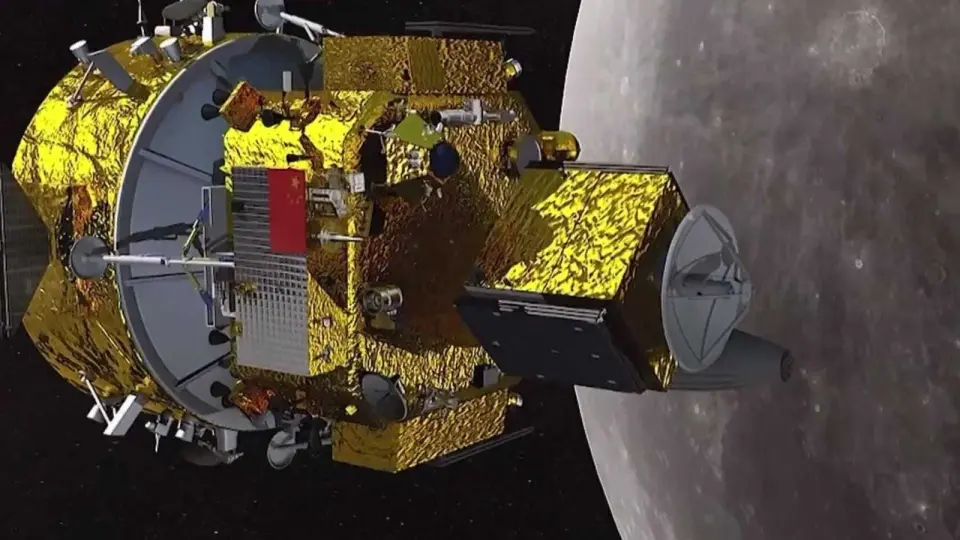
China’s Chang'e 7 lunar mission, designed to search for water ice at the Moon’s south pole, has been delayed until 2027 due to weather conditions at the Wenchang launch site. The mission, which includes an orbiter, lander, rover, and a novel hopping vehicle, aims to assess the feasibility of extracting lunar resources. It is part of a broader strategy to establish a human presence on the Moon by 2030 and includes international scientific payloads, including a U.S.-supported telescope.
Key points
- Launch delayed to 2027 due to Typhoon Narra at the Wenchang Space Launch Site.
- Mission targets Shackleton Crater near the lunar south pole to locate and characterize water ice.
- Includes a hopping vehicle capable of traversing permanently shadowed regions, a first for lunar missions.
- Carries international payloads, including a U.S.-supported telescope and instruments from Thailand, Italy, and others.
- Aims to provide data for China’s 2030 human landing goal and the International Lunar Research Station.
Background
China’s lunar program has advanced steadily since the 2000s, with Chang'e 6 recently returning samples containing water-rich asteroid signatures. The Chang'e 7 mission follows a 2025 Intuitive Machines attempt that failed to deploy a similar hopper. The mission also aligns with broader geopolitical tensions, as the U.S. and China compete for lunar resource access, with the U.S. pursuing the Artemis program and China advancing its own timeline for crewed landings.
How outlets are covering it
Space.com and Scientific American emphasize the scientific ambition and international collaboration of Chang'e 7, noting its potential to surpass U.S. lunar exploration in the short term. Ars Technica highlights the geopolitical implications, suggesting China may assert territorial claims or influence U.S. policy through its success. The Conversation focuses on the technical challenges of exploring permanently shadowed regions and contrasts China’s state-led approach with NASA’s commercial CLPS model. All sources agree on the mission’s significance but differ on its geopolitical impact, with Ars Technica viewing it as a potential provocation and others framing it as a scientific milestone.
Why it matters
Chang'e 7’s success could redefine the U.S.-China space race by providing critical data on lunar water ice, a key resource for future settlements. Its international collaboration model may set a precedent for global space cooperation, while its delay to 2027 could shift the timeline for China’s 2030 human landing goal. The mission also tests new technologies, such as hopping vehicles, that may influence future lunar exploration strategies.
What to watch
China will monitor weather conditions at Wenchang for a 2027 launch window. The Queqiao-2 relay satellite will support communications during the mission. If successful, Chang'e 7 will inform the design of Chang'e 8, planned for 2028, and the International Lunar Research Station. NASA’s Artemis IV mission is also targeted for 2028, creating a potential parallel timeline for crewed lunar landings.
- China's Chang'e 7 moon probe will launch this weekend on the most ambitious lunar mission in history Space
- China is launching a Moon mission to find water ice. It’s unlike anything NASA has done The Conversation
- The United States is about to wake up to the threat from China’s space program Ars Technica
- China is about to launch its most ambitious moon mission yet Scientific American
- China’s Chang’e-7 lunar ice-hunting mission set for Sunday launch SpaceNews
Want the full story? Read the original reporting
Read on Space