
Distant Star Hints at Clash of Baby Planets
TL;DR
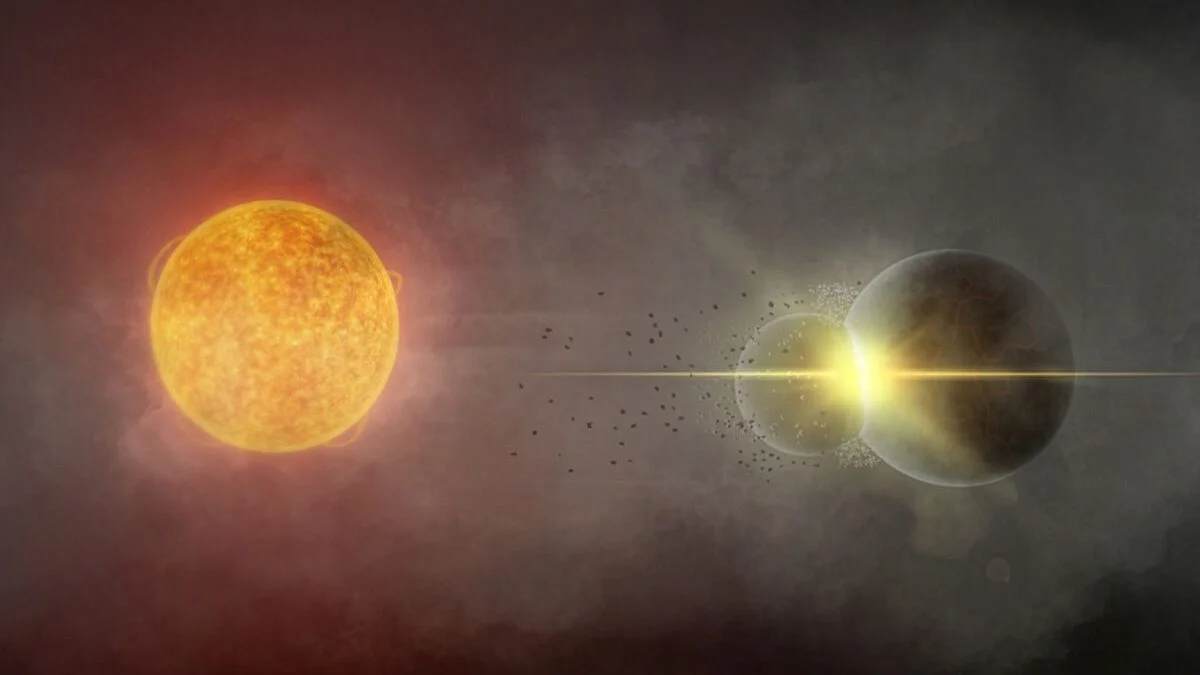
Astronomers studying Gaia-GIC-1, a Sun-like star about 11,600 light-years away, observed dramatic brightness dips (up to 25%) starting in 2016 with an opposite infrared brightening later, suggesting a hot dust cloud heated to ~900 K. Modeling indicates a collision between planetesimals near 1 AU, with dust mass around half that of Ceres, providing a rare glimpse into early planetary formation and a potential parallel to the Earth–Moon formation event.
Topics:sciencespace#earth-moon-formation#gaia-gic-1#infrared-observations#planetary-formation#planetesimal-collision#space
- 'Completely Bonkers': Astronomers Think They Saw Two Planets Collide ScienceAlert
- 2 planets collide 11,000 light-years from Earth in rare sight Yahoo
- 'Completely bonkers': Astronomers find evidence of a cataclysmic collision between exoplanets Space
- Scientists Spot Two Planets That Collided, Resulting in Carnage That Will Send Prickles Through Your Scalp Futurism
- Astronomers Just Watched Two Planets Smashing Into Each Other 11,000 Light-Years Away ZME Science
Want the full story? Read the original reporting
Read on ScienceAlert