
JWST Spots MoM-z14, the Universe’s Oldest Galaxy Yet (280 Million Years After the Big Bang)
TL;DR
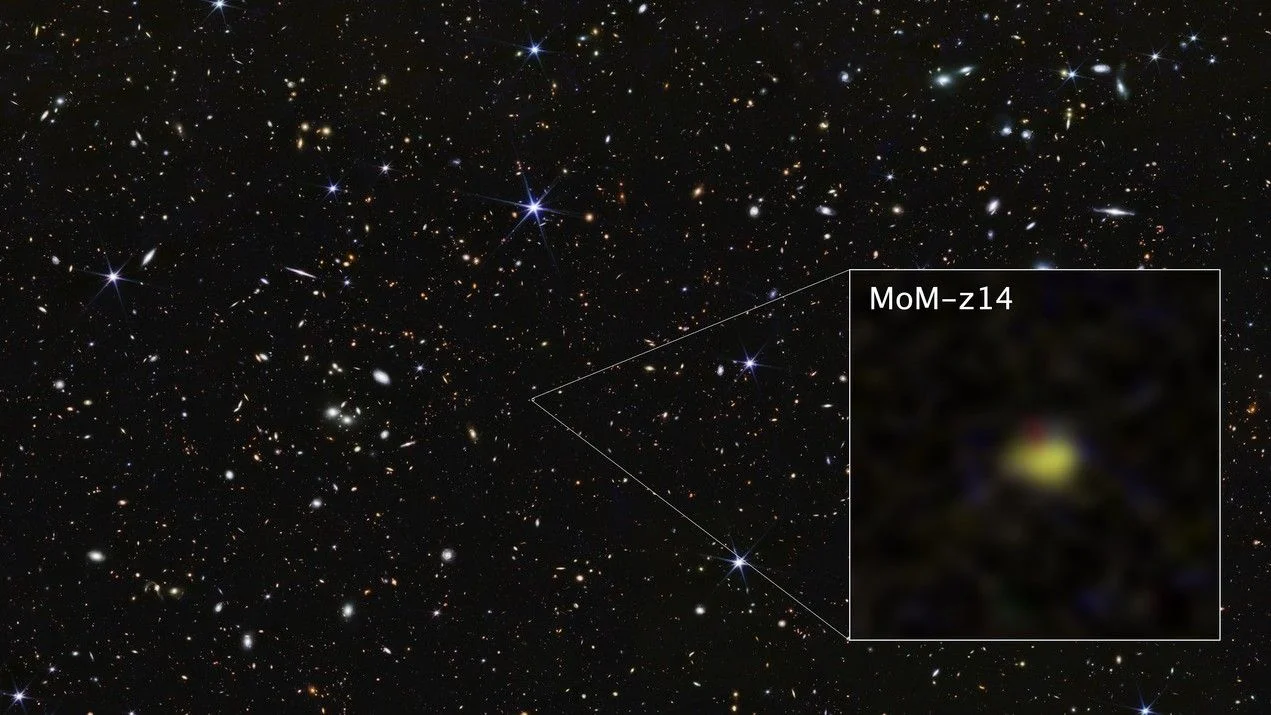
NASA’s James Webb Space Telescope confirmed MoM-z14 as the most distant spectroscopically confirmed galaxy to date, seen as it emitted light about 280 million years after the Big Bang (redshift z=14.44). The galaxy is compact (roughly 240 light-years across) with a mass similar to the Small Magellanic Cloud, and shows rapid star formation and nitrogen-rich composition, suggesting early, globular-cluster–like stellar activity. The finding, first reported in a 2025 preprint and later peer‑reviewed in early 2026, challenges existing models of early galaxy formation and signals more discoveries to come, including with the Nancy Grace Roman Space Telescope.
- James Webb telescope discovers closest galaxy to the Big Bang ever seen Live Science
- NASA Webb Pushes Boundaries of Observable Universe Closer to Big Bang NASA Science (.gov)
- Webb reveals five-galaxy merger just 800 million years after the Big Bang Phys.org
- Astronomers share new insights about the early universe via the Webb Space Telescope Engadget
- Webb has done it again. New-found galaxy at the dawn of time is challenging what we know about the Universe BBC Sky at Night Magazine
Want the full story? Read the original reporting
Read on Live Science