
Starship’s 74,400 kN Thrust Masks a Bigger Bet: The Chopstick Catch
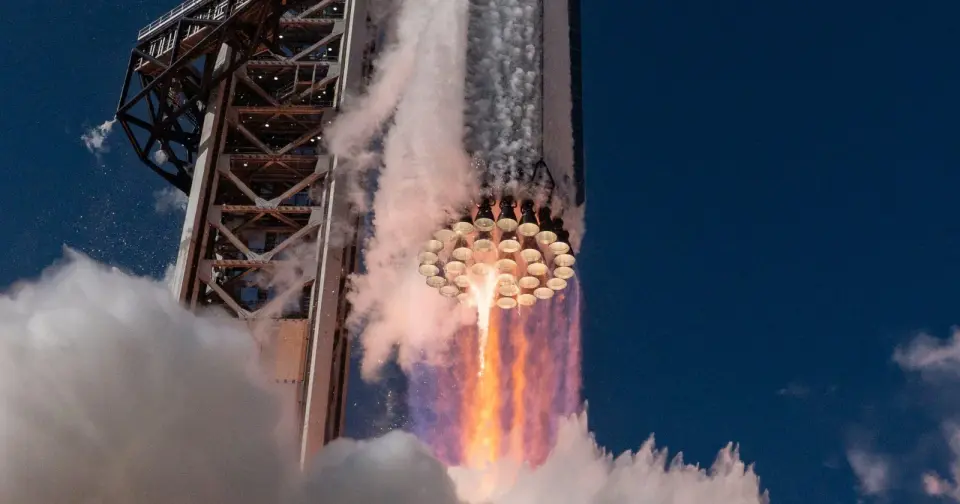
SpaceX’s Starship generates 74.4 million newtons of thrust at liftoff, roughly double the Saturn V, but its true innovation lies in its reusability. The 5,000-tonne vehicle is designed to be caught by tower arms and refueled within days, aiming to shift spaceflight economics from expendable hardware to high-cadency operations.
Key points
- Starship’s Super Heavy booster uses 33 Raptor 2 engines burning methane and oxygen to produce 74.4 million newtons of thrust, exceeding the Saturn V and NASA’s SLS.
- The vehicle consumes approximately 20 tonnes of propellant per second during the 166-second first stage burn, after which the booster separates and returns to the launch site.
- Instead of landing on legs, the booster is caught mid-air by the 'Mechazilla' arms, a technique first successfully demonstrated in October 2024 and repeated in March 2025.
- SpaceX targets a turnaround time of hours to days, aiming to fly the same booster multiple times per week to drastically reduce per-launch costs.
- As of May 2026, no caught booster has been re-flown; engineers are still resolving thermal fatigue and structural stress issues required for rapid refurbishment.
Background
Previous Starship tests, such as Flight 13 in July 2026, focused on deploying Starlink V3 satellites and testing heat shields, but did not yet demonstrate the full catch-and-refly cycle. The current engineering focus has shifted from raw thrust validation to the logistical and structural challenges of rapid reusability, which is the key to making orbital access affordable.
Why it matters
If SpaceX achieves rapid turnaround, spaceflight costs could drop by orders of magnitude, making missions to Mars, lunar bases, and orbital refueling economically viable. The shift from expendable rockets to reusable systems mirrors the economic model of commercial aviation, potentially transforming the entire space industry.
What to watch
The next few years will determine if caught boosters can be refurbished and launched within 24 hours. Success depends on solving thermal fatigue and structural stress issues, which are currently preventing the re-flight of any caught Super Heavy booster.
Want the full story? Read the original reporting
Read on Space Daily