
Webb telescope uncovers a black hole star among the early-universe 'little red dots'
TL;DR
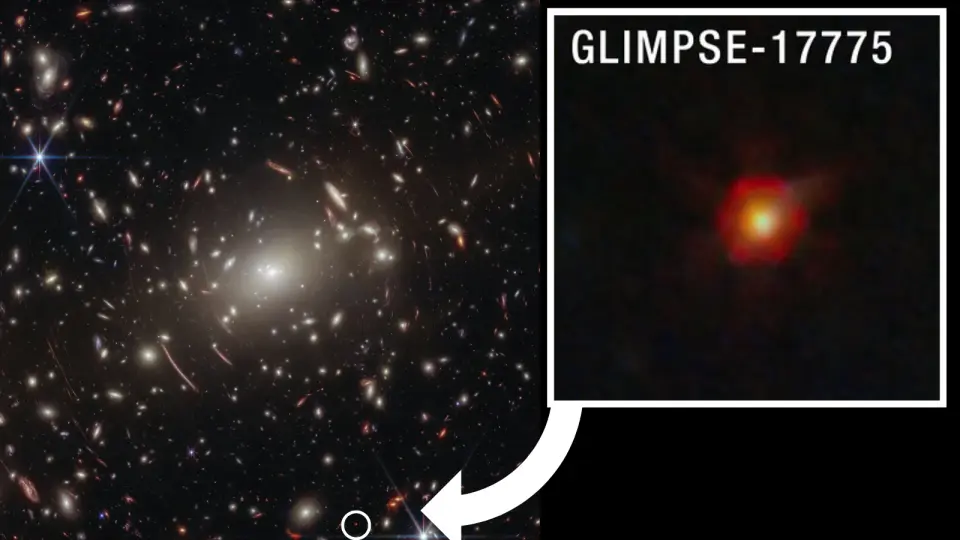
Astronomers using the James Webb Space Telescope have found deep spectral evidence that the little red dot GLIMPSE-17775, seen behind the gravitational lens Abell S1063, is a black hole star—an actively feeding supermassive black hole cocooned in dense gas. The spectrum shows unusual emission lines, an iron forest, and electron scattering consistent with a rapidly growing black hole in a cocoon, supporting the idea that many early-universe little red dots are such black-hole–driven systems and explaining their faint X-ray signals. This is the deepest spectrum to date for a little red dot, and researchers plan further follow-up to pin down the engines powering these sources.
Topics:sciencespace#abell-s1063#black-hole-star#glimpse-17775#james-webb-space-telescope#little-red-dots#space
- James Webb Space Telescope finds evidence the mysterious 'little red dots' are black hole stars Space
- NASA Webb Finds Strongest Evidence Yet for ‘Black Hole Stars’ NASA Science (.gov)
- Black hole feeding bursts may explain JWST's Little Red Dots in early universe Phys.org
- The discovery of two little red dots in transition into quasars Nature
- James Webb Reveals a Black Hole Star Inside a Little Red Dot Orbital Today
Want the full story? Read the original reporting
Read on Space