
Webb’s tiny red dots may be newborn black holes hidden in dense gas
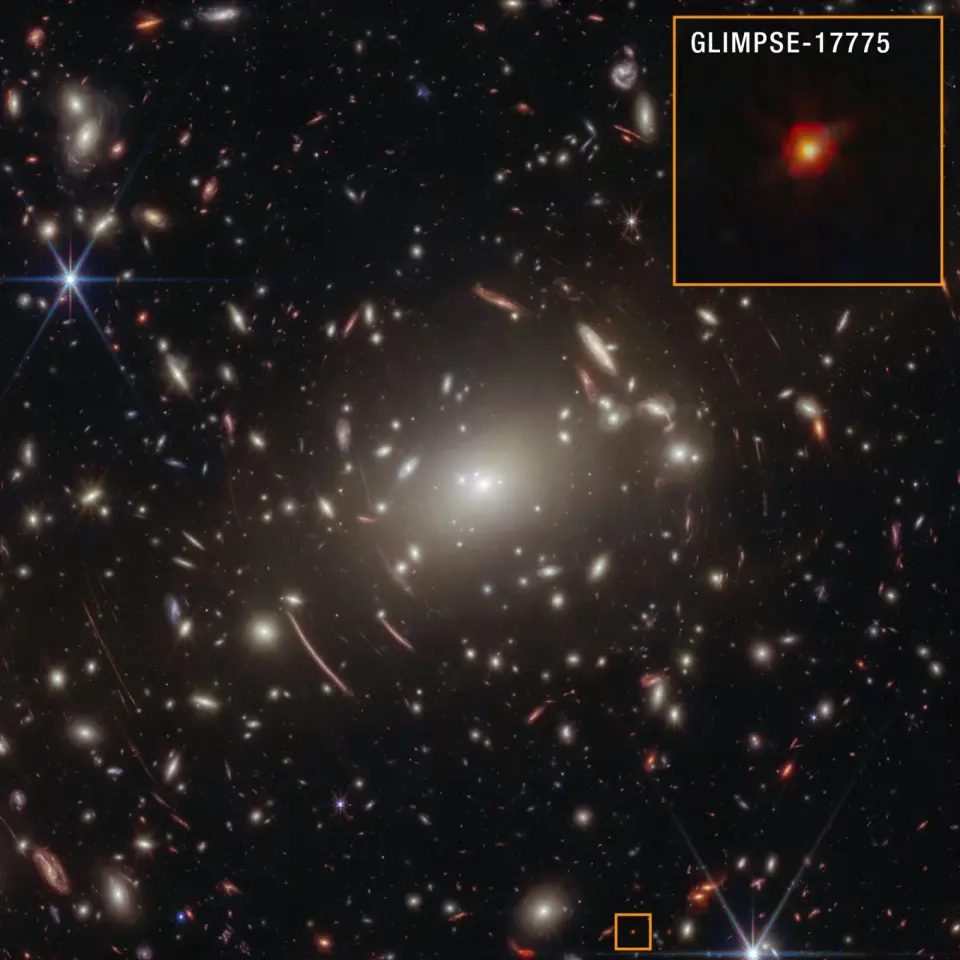
The James Webb Space Telescope’s deep images uncovered compact, distant “little red dots” whose light could be from either dense early galaxies or rapidly growing black holes. A leading interpretation is that many are “black hole stars”—young black holes enveloped by thick, hot gas that reprocesses accretion energy into a cool, star-like glow. One well-studied dot, GLIMPSE-17775 behind the Abell S1063 cluster, shows a spectrum with hydrogen, helium, and iron lines plus electron scattering—signatures consistent with a dense enveloping medium around a central engine. While this model explains several puzzling features and helps reconcile rapid early growth with galaxy formation, other dots may be obscured AGN or unusually dense stellar populations. Ongoing Webb and Chandra observations aim to test whether a population of black hole stars exists and how they evolve toward ordinary quasars.
- The James Webb Space Telescope found tiny “little red dots” that looked like impossibly compact galaxies — but astronomers now suspect many may be “black hole stars,” young black holes wrapped in gas so dense that the material falling into them produces Space Daily
- A mysterious “red dot” spotted in space: are we witnessing a cosmic birth? Futura, le média qui explore le monde
- How the Webb Telescope is Influencing Astrophysicists’ Theories Adafruit
- Backyard Black Holes Astrobites
- Black holes buried in mysterious 'little red dot' galaxies could blast cosmic ghosts at Earth Space
Want the full story? Read the original reporting
Read on Space Daily