
AI Struggles to Reproduce Einstein’s Relativity, Highlighting Limits of Current Models
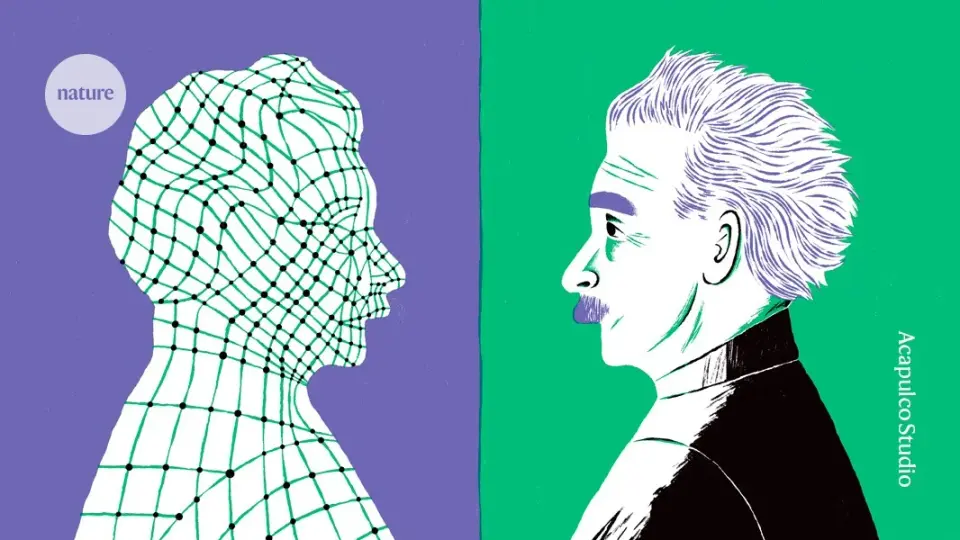
Researchers are testing whether AI can rediscover major scientific breakthroughs like Einstein’s general relativity. Early attempts show that while AI can mimic plausible physics, it lacks the creative leaps needed for true discovery. Experts argue that current models excel at pattern matching but fail at abductive reasoning, requiring new approaches to uncertainty and historical data training.
Key points
- Demis Hassabis proposed training AI on pre-1911 data to see if it could derive general relativity, a test for artificial general intelligence.
- Recent experiments, including those by Michael Hla and Nick Levine, show AI models trained on historical data often produce plausible but incorrect physics, lacking deep understanding.
- Experts like Tom Zahavy argue that AI struggles with abductive reasoning, the creative leap needed for paradigm shifts, unlike inductive pattern matching.
- A new perspective suggests AI can be useful in labs if equipped with rigorous uncertainty calibration to avoid misleading experimental outcomes.
- Training AI on historical data is difficult due to noisy, poorly dated sources, leading to accidental leakage of modern knowledge.
Background
This debate follows earlier discussions on AI's role in scientific discovery, including its success in disproving an 80-year-old mathematical conjecture. It also connects to ongoing efforts to test Einstein’s theories, such as recent quantum-scale experiments confirming the equivalence principle. The challenge of AI rediscovering relativity highlights the gap between statistical prediction and creative scientific insight.
How outlets are covering it
Nature emphasizes the fundamental limitation of current AI in making abductive leaps, citing experiments where models failed to infer correct physical laws from sparse data. In contrast, bioengineer.org focuses on a more pragmatic application: using AI as an uncertainty-calibrated optimizer in labs. While Nature highlights the gap between AI and human genius, bioengineer.org argues that AI can still accelerate discovery if it honestly quantifies its own uncertainty, shifting the focus from rediscovering past breakthroughs to optimizing future experiments.
Why it matters
The inability of AI to rediscover relativity underscores the limits of current large language models in achieving artificial general intelligence. It highlights that AI is better suited for incremental optimization and pattern recognition rather than transformative scientific breakthroughs. This has implications for how AI is integrated into scientific research, emphasizing the need for rigorous uncertainty calibration to prevent misleading experimental outcomes.
What to watch
Researchers are developing new methods to train AI on historical data more accurately and to integrate uncertainty calibration into experimental workflows. Future tests may focus on whether AI can make non-trivial discoveries within constrained timeframes, potentially bridging the gap between statistical prediction and creative scientific insight.
Want the full story? Read the original reporting
Read on Nature