
Byteification bridges gap between subword and byte-level AI models
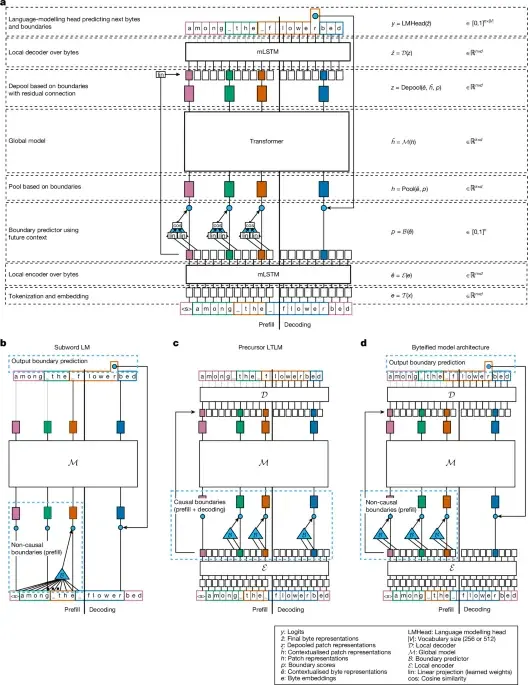
Researchers from the Allen Institute for AI (Ai2) have published a method called 'byteification' in Nature, which converts existing subword-based large language models (LLMs) into byte-level models with minimal additional training. This approach addresses the historical performance lag of byte-level models, which process text at the character level rather than as word fragments. By retrofitting models like Olmo, Qwen, and Llama, the new byteified versions achieve performance comparable to their subword counterparts while excelling in character-level reasoning tasks. The method requires less than 1% of a typical pre-training budget, offering a cost-effective path to developing models that handle scientific data, code, and diverse languages more accurately without the biases inherent in subword tokenization.
Key points
- Ai2 researchers introduced 'byteification,' a two-stage process to convert subword LLMs into byte-level models using minimal extra training.
- Byte-level models process raw text bytes, avoiding the information loss and English-centric bias associated with subword tokenization.
- New models, including Bolmo 7B, Bwen 8B, and Blama 8B, were created by byteifying Olmo, Qwen 3, and Llama 3, respectively.
- Byteified models outperform previous byte-level approaches and match subword models in most tasks, with significant gains in character understanding.
- The method allows for efficient inference speeds and compatibility with existing post-training tools, such as task arithmetic, without extra training costs.
Background
Previous coverage of AI bias and language processing has highlighted how models can exhibit gender-based biases in writing style (as seen in recent Johns Hopkins research) and how language learning impacts cognitive health. The development of byte-level models addresses fundamental limitations in how AI processes text, moving beyond the subword tokenization that has dominated the field. This shift aims to create more robust and versatile AI systems that can handle diverse data types, including scientific sequences and code, with greater precision.
How outlets are covering it
The primary source, Nature, emphasizes the technical breakthrough of byteification, highlighting its ability to close the performance gap between byte-level and subword models with minimal computational cost. It details the architectural changes, such as non-causal boundary prediction, that enable this efficiency. Ai2, the secondary source, frames the release as a major step for open-source AI, stressing the availability of new checkpoints and the potential for byte-level models to serve as a universal foundation for various data types, including images and audio. UA.NEWS provides a simplified overview, focusing on the practical benefit of byteification in correcting character-level errors, such as counting letters in words, which subword models often struggle with. While all sources agree on the significance of the development, Nature and Ai2 focus on the technical and open-source implications, whereas UA.NEWS highlights the immediate practical advantages for users.
Why it matters
This advancement removes a significant barrier to adopting byte-level language models, which have the potential to be more efficient, less biased, and better suited for technical and scientific applications. By enabling the conversion of existing models with minimal cost, byteification accelerates research and development in AI, potentially leading to more versatile and accurate systems. The open release of these models by Ai2 also promotes transparency and reproducibility in AI research, fostering a more collaborative and innovative ecosystem.
What to watch
Researchers and developers are expected to explore the potential of byteified models for various applications, including scientific data analysis, code generation, and multilingual tasks. Ai2 has released new checkpoints and Stage 1 models to facilitate further experimentation. Future work may focus on optimizing the efficiency-performance trade-off, exploring the use of byte-level models for non-text data, and investigating the long-term implications of this approach on AI development and deployment.
- Retrofitting language models to operate over bytes Nature
- Now in Nature: Retrofitting language models to operate over bytes | Ai2 Allen Institute for Artificial Intelligence
- Researchers introduce byteification for language models to work with characters — Nature UA.NEWS
Want the full story? Read the original reporting
Read on Nature