
Paper2Agent Framework Converts Static Research into Interactive AI Agents
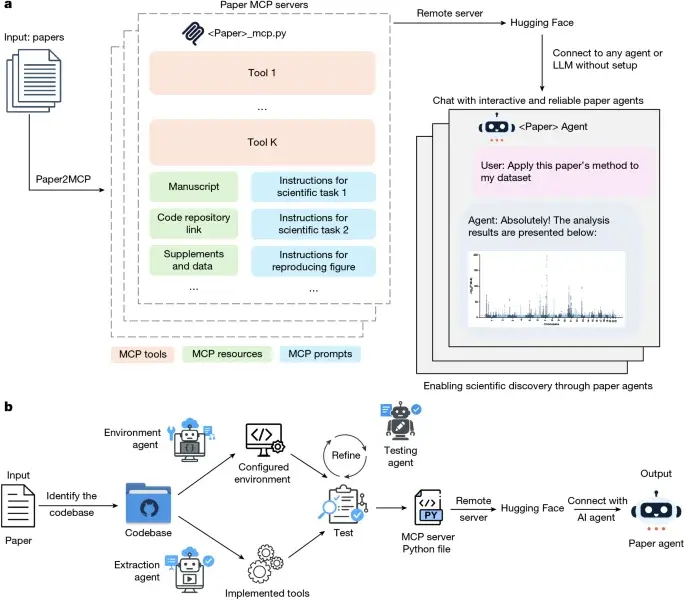
A new framework called Paper2Agent transforms static research papers into interactive AI agents capable of executing complex scientific tasks. By converting code and data into Model Context Protocol (MCP) servers, the system allows users to query research methods via natural language, significantly lowering technical barriers. Case studies show the system reproduces original results with high accuracy while enabling novel analyses, such as prioritizing causal genes for psoriasis. This shift moves scientific dissemination from passive reading to active, collaborative computation.
Key points
- Paper2Agent automates the conversion of research papers into AI agents using multiple specialized sub-agents for environment setup, code extraction, and validation.
- The framework utilizes Model Context Protocol (MCP) servers to expose tools, resources, and prompts, allowing large language models to interact with paper-specific workflows without manual coding.
- In benchmarks, the AlphaGenome agent achieved 98.7% accuracy on tutorial queries and 100% on novel queries, outperforming direct repository access and other AI systems.
- The system reduces technical barriers by allowing non-programmers to execute complex analyses, such as single-cell transcriptomics, through simple natural language prompts.
- Large-scale testing on 100 computational biology papers showed that 74% were successfully agentified, with most generated tools passing automated validation tests.
Background
The rise of AI in scientific writing has been rapid, with estimates suggesting nearly 90% of papers in late 2025 showed traces of AI assistance. However, previous AI tools primarily focused on text generation or literature retrieval, leaving the execution of research methods largely manual. Paper2Agent addresses this gap by moving beyond text analysis to the direct execution of code and data, a shift that aligns with broader industry trends toward integrating AI into the full research lifecycle rather than just the writing phase.
How outlets are covering it
The primary source, Nature, emphasizes the technical efficacy and reproducibility of Paper2Agent, highlighting its ability to validate tools against original codebases to prevent 'code hallucination.' In contrast, the secondary source, 36Kr, focuses on the commercial and ethical implications of AI in research. While 36Kr notes that general AI models are eroding the value of vertical 'paper writing' tools, it argues that the next frontier lies in verifiable, end-to-end research workflows. 36Kr warns that automation without traceability risks academic integrity, a concern that Paper2Agent addresses through its rigorous validation and transparency features, though the two sources differ in their focus on technical performance versus market viability and ethical boundaries.
Why it matters
This development could fundamentally change how scientific knowledge is disseminated and utilized. By making research methods executable and interactive, Paper2Agent reduces the time and expertise required to apply existing methods to new data. This could accelerate discovery in fields like genomics and transcriptomics, while also raising new questions about the reliability and accountability of AI-driven scientific conclusions.
What to watch
The framework is publicly available, and researchers are expected to begin testing its application across diverse scientific domains. Future developments may focus on expanding the range of agentifiable papers and improving the robustness of automated validation to handle more complex or poorly documented codebases. The industry will likely see a shift from AI as a writing assistant to AI as an active participant in experimental design and data analysis.
Want the full story? Read the original reporting
Read on Nature