
Wild Cockroaches Identified as Key Night Pollinators for Rare Amazonian Shrub
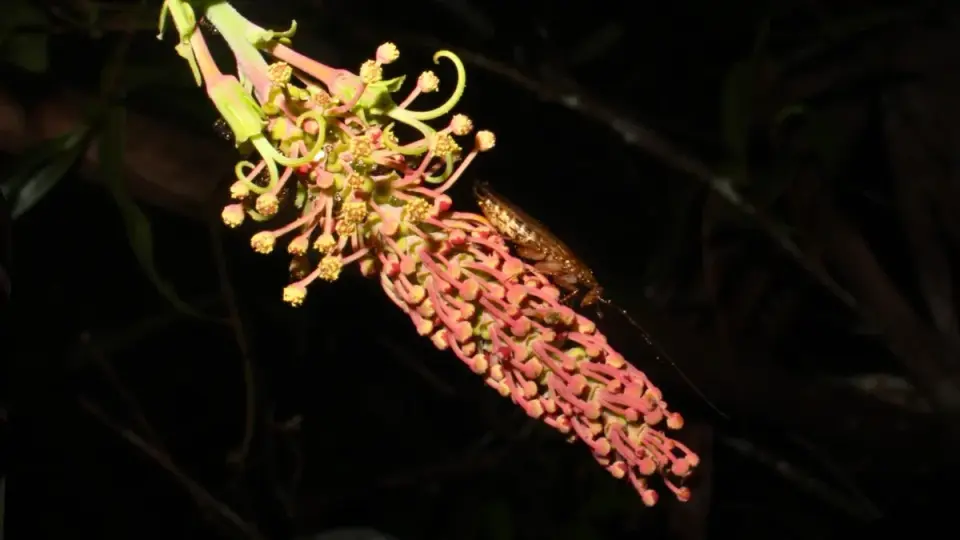
A new study reveals that wild cockroaches are the primary nocturnal pollinators of Mabea uleana, a rare shrub in the Brazilian Amazon. While the plant retains traits typical of bat-pollinated species, researchers found no bat visits. Instead, cockroaches transport pollen between plants at night, ensuring fruit production, while stingless bees act as secondary daytime pollinators.
Key points
- Researchers at Brazil's National Institute of Amazonian Research found that cockroaches are the main nocturnal pollinators of Mabea uleana, a shrub found only in the white-sand forests of Amazonas state.
- The study, published in the Brazilian Journal of Botany, is the first to examine the pollination of this specific species, noting that while it shares traits with bat-pollinated plants, no bats were observed visiting the flowers.
- Cockroaches visit the shrubs between 7:00 PM and 3:00 AM to drink nectar, picking up sticky pollen from male flowers and transferring it to female flowers on other plants, which is crucial for fruit set.
- Experiments showed that 93% of flowers pollinated with pollen from a different shrub produced fruit, compared to only 15% when self-pollinated, confirming the plant's self-incompatibility.
- Stingless bees, specifically Trigona almeidae, were identified as the primary daytime pollinators, providing a secondary reproductive pathway for the shrub.
Background
This discovery adds to the growing understanding of the complex ecological roles of insects in the Amazon. While previous studies on related Mabea species highlighted bats as primary pollinators, this new research highlights the importance of overlooked nocturnal insects in nutrient-poor campinarana ecosystems. The findings contrast with the common perception of cockroaches as pests, emphasizing that over 99% of cockroach species are wild and ecologically significant.
How outlets are covering it
ScienceAlert and Bioengineer.org both emphasize the novelty of cockroaches as pollinators, noting that only about 1% of species are household pests. Bioengineer.org provides detailed technical data on nectar volume and pollen viability, while ScienceAlert focuses on the behavioral mechanics of the cockroaches. UrduPoint offers a concise summary, highlighting the dual-phase pollination system involving both nocturnal cockroaches and diurnal bees. All sources agree that the study was conducted at a single site north of Manaus, but Bioengineer.org notes the specific environmental constraints of the campinarana habitat, which may limit the generalizability of the findings.
Why it matters
This study challenges the traditional focus on bees and bats in pollination ecology, highlighting the critical role of wild cockroaches in maintaining genetic diversity in rare plant species. Understanding these interactions is vital for conservation efforts in the Amazon, particularly in fragile ecosystems like the white-sand forests, where specialized pollination networks are essential for plant reproduction.
What to watch
Researchers plan to expand their study to other sites and species to determine if this pollination pattern is widespread in the Amazon. Further investigation into the specific cockroach species involved and their broader ecological impact is expected to follow.
Want the full story? Read the original reporting
Read on ScienceAlert