Tag

Scientific Research

All articles tagged with #scientific research

OpenAI's AI Claims to Disprove ETH and Solve Kakeya Conjecture, Sparking Academic Debate
technology29 days ago

OpenAI's AI Claims to Disprove ETH and Solve Kakeya Conjecture, Sparking Academic Debate

OpenAI announced three major AI-generated scientific breakthroughs on October 26, 2026, including a refutation of the Exponential Time Hypothesis, a proof of the all-dimensional Kakeya conjecture, and existence results for certain quantum field theories. The company frames these outputs as 'raw research data' for the scientific community to verify, marking a shift in how AI-generated discoveries are published and credited.


TikTok CEO Predicts AI-Driven Scientific Breakthroughs Within Three Years Amid Safety Concerns
technology1 month ago

TikTok CEO Predicts AI-Driven Scientific Breakthroughs Within Three Years Amid Safety Concerns

TikTok CEO Shou Zi Chew stated at a Singapore conference that AI will likely trigger major breakthroughs in physics, biotech, and chemistry within two to three years. He noted that while current AI capabilities are often overestimated in the short term, their long-term potential is underestimated. Chew warned that users are granting excessive permissions to AI agents, leading to unintended actions like unauthorized purchases. He also highlighted rising cybersecurity risks as AI lowers the cost of malicious attacks. ByteDance is expanding its AI research, including biomolecular modeling, to collaborate with scientists on drug discovery.

OpenAI’s Navier-Stokes Proof Sparks Crisis of Attribution and Trust in Mathematics
technology2 months ago

OpenAI’s Navier-Stokes Proof Sparks Crisis of Attribution and Trust in Mathematics

OpenAI’s announcement that it solved the Navier-Stokes existence and smoothness problem, a $1 million Millennium Prize challenge, has triggered a severe backlash among mathematicians. While the firm claims its internal model achieved the result independently, critics argue it leveraged human work without proper credit. The dispute has exposed deep anxieties about AI’s role in scientific discovery, leading to open letters from Fields Medalists and calls for stricter data privacy protocols, even as many researchers continue to rely on AI tools for efficiency.

Stanford's Paper2Agent Turns Static Research into Interactive AI Agents
technology2 months ago

Stanford's Paper2Agent Turns Static Research into Interactive AI Agents

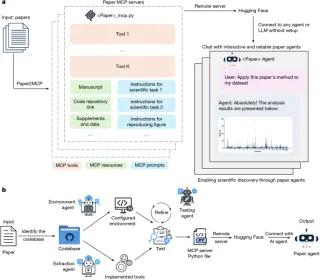
Stanford researchers have released Paper2Agent, an open-source framework that converts scientific papers into interactive AI agents. Published in Nature, the system transforms static documents into active 'virtual authors' that can reproduce analyses, apply methods to new data, and collaborate with other agents. By using Model Context Protocol (MCP) servers, the tool allows researchers to query complex studies via natural language without needing to manually configure code or data environments. Initial tests show the system can create functional agents in approximately 45 minutes at a cost of $14, significantly lowering barriers to scientific reproducibility and discovery.

Paper2Agent Converts Research Papers into Interactive AI Assistants
technology2 months ago

Paper2Agent Converts Research Papers into Interactive AI Assistants

A new AI system called Paper2Agent transforms static research papers into interactive agents that can answer questions and apply methods to new data. Developed by Stanford University researchers, the tool packages a paper’s text, code, and datasets onto a server, allowing scientists to query the work in plain language. In tests, the system created an agent for the AlphaGenome paper in 45 minutes for a cost of $14, outperforming other biomedical AI tools. The technology aims to make scientific knowledge more accessible and reproducible across disciplines.

Paper2Agent Framework Converts Static Research into Interactive AI Agents
technology2 months ago

Paper2Agent Framework Converts Static Research into Interactive AI Agents

A new framework called Paper2Agent transforms static research papers into interactive AI agents capable of executing complex scientific tasks. By converting code and data into Model Context Protocol (MCP) servers, the system allows users to query research methods via natural language, significantly lowering technical barriers. Case studies show the system reproduces original results with high accuracy while enabling novel analyses, such as prioritizing causal genes for psoriasis. This shift moves scientific dissemination from passive reading to active, collaborative computation.

AI Solves Millennium Math Problem, Sparking Credit Disputes and Existential Dread Among Mathematicians
technology2 months ago

AI Solves Millennium Math Problem, Sparking Credit Disputes and Existential Dread Among Mathematicians

OpenAI’s recent claim to have solved a $1 million Millennium Prize problem using tens of thousands of AI agents has triggered a crisis of confidence in the mathematical community. While the breakthrough accelerates discovery, it has exposed deep ethical fractures regarding credit, data provenance, and the future role of human experts.

AI accelerates discovery, yet human wisdom remains essential
technology6 months ago

AI accelerates discovery, yet human wisdom remains essential

Nature editors argue that AI agents can dramatically speed up research and drug discovery (as shown with Robin and Co-Scientist) but cannot replace humans: humans frame problems, guide experiments, validate results, and guard against AI errors, making human oversight and ethical considerations crucial as science increasingly relies on AI co-scientists.

Biological age tests overpromise; science isn’t ready for personal health use
health6 months ago

Biological age tests overpromise; science isn’t ready for personal health use

Tests that claim to reveal your biological age (often via epigenetic clocks) are booming, but scientists warn results vary widely, aren’t FDA-approved for personal health decisions, and can mislead individuals or worsen health disparities; these clocks are more reliable for population studies than for individual diagnosis or guidance.