
Kirigami-Inspired Parachutes Offer Precise, Lightweight Airdrop Solution
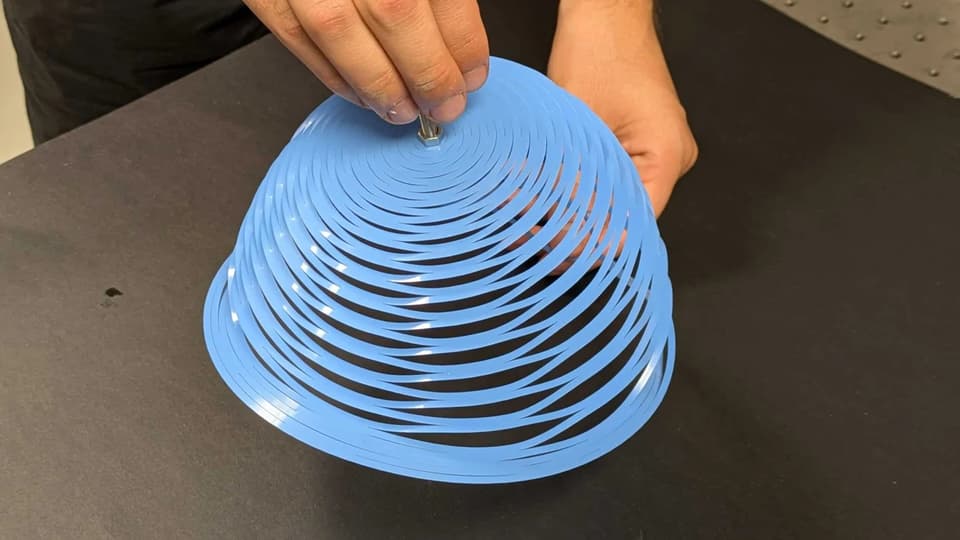
Researchers from Polytechnique Montréal and École Polytechnique have developed a new type of parachute using kirigami, the Japanese art of paper cutting. By laser-cutting specific patterns into thin Mylar discs, they created a device that folds into an inverted bell shape, allowing it to stabilize quickly and descend with high precision. This innovation addresses the common issue of conventional parachutes drifting off target due to wind, offering a lightweight and cost-effective alternative for humanitarian aid and rescue missions.
Key points
- The new parachute design is based on kirigami, a traditional Japanese paper-cutting technique documented since the 7th century.
- Researchers at Polytechnique Montréal and École Polytechnique used laser cutting to create patterns in Mylar sheets that transform into an inverted bell shape when weighted.
- Unlike conventional parachutes that rely on catching air, this design stabilizes instantly and follows a strict ballistic descent trajectory, regardless of the release angle.
- Testing in wind tunnels, labs, and via drone drops showed the kirigami parachute performs comparably to standard parachutes and is not size-dependent.
- The primary advantage of this design is its ability to minimize drift, ensuring that airdropped packages, such as medical supplies, land closer to their intended targets.
Background
While the archive contains recent coverage of art exhibitions and installations, such as the Lucas Museum of Narrative Art and Abramović's balloon installations, these do not provide direct background for this engineering breakthrough. The current story stands as a distinct development in aerospace and materials science, focusing on the application of traditional artistic techniques to modern engineering problems.
Why it matters
This innovation could significantly improve the accuracy of airdrops in disaster relief and military operations, where wind often causes conventional parachutes to drift far from their targets. By offering a lightweight, cheap, and stable alternative, kirigami-inspired parachutes may enhance the efficiency and safety of delivering critical supplies to remote or inaccessible areas.
What to watch
The research team will likely continue refining the design and testing it in more complex environmental conditions to ensure its reliability for real-world applications. Future developments may focus on scaling up the technology for larger payloads or integrating it with existing airdrop systems.
Want the full story? Read the original reporting
Read on ZME Science