
Hypershell Halo Targets Knee Pain with First Unified Hip-and-Knee Exoskeleton
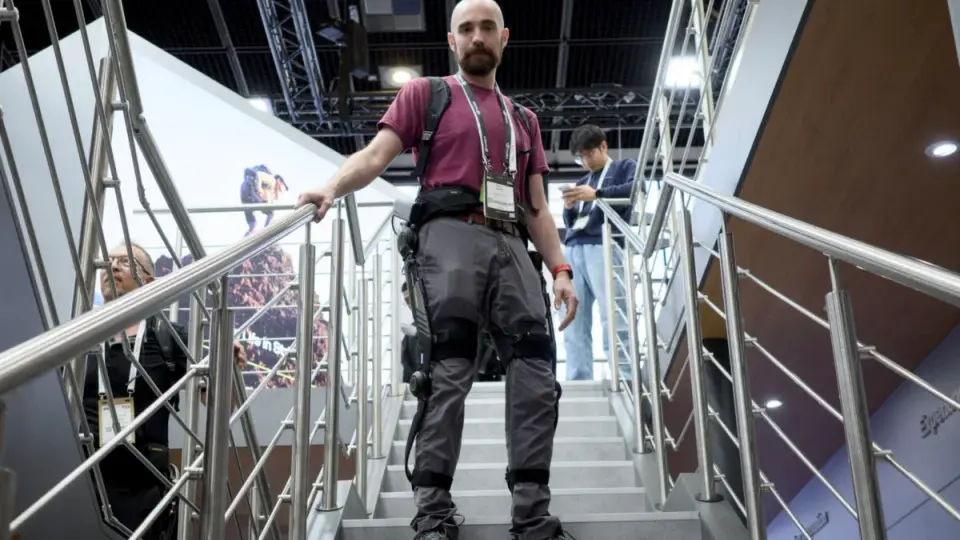
Hypershell has unveiled the Halo, a new exoskeleton designed to assist both hips and knees simultaneously, addressing a gap in previous models that focused primarily on hip support. Priced at $2,300, the device uses a unified four-motor architecture to reduce knee fatigue by up to 40% during squats and improve mobility for users with joint issues. It was showcased at IFA 2026 in Berlin, with pre-orders open now and shipping expected in November.
Key points
- The Hypershell Halo features a carbon-fiber and titanium frame weighing approximately 2.6 kg, with four motors producing up to 1,490 watts of combined power.
- Unlike previous models that only assisted hips, the Halo adds knee-level motors to create a 'Unified Architecture' that coordinates movement across the entire lower leg.
- The device includes a swappable 370-gram battery offering roughly 20 km of assisted walking and can be donned in about 20 seconds, even with a backpack on.
- Hypershell claims the system reduces muscle fatigue in the knees by up to 40% during squatting motions and provides cushioning during descents.
- The Halo is available for pre-order at $2,300, with shipping scheduled for November 2026 in the US, Canada, Europe, UK, and China.
Background
The exoskeleton market has seen a surge in consumer interest, particularly at IFA 2026, where multiple Chinese-based brands unveiled new models. Previous Hypershell devices, such as the Pro X and X Ultra S, were criticized for targeting only physically fit hikers and failing to address knee strain, which is often the primary limiting factor in long hikes. This new model aims to broaden the audience to include those with mobility issues or bad knees.
How outlets are covering it
Gizmodo highlights the Halo’s potential to assist users with bad knees, noting that previous models ignored this demographic. They praise the cushioning on descents but criticize the device’s bulky, 'cyborg-like' appearance and the time required for fitting. Yanko Design emphasizes the technical breakthrough of coordinating hip and knee motors into a single system, noting that earlier prototypes failed due to synchronization issues. They view the device as an 'overdue correction' for the industry. T3 focuses on the 'Unified Architecture' and motion capture testing, citing 10,000 hours of trials and specific range-of-motion metrics (198° lateral, 167° front-to-back). While Gizmodo and Yanko Design focus on the practical benefits for knee pain, T3 highlights the broader athletic capabilities demonstrated in stunt testing. All sources agree on the $2,300 price point and November shipping timeline.
Why it matters
The Hypershell Halo represents a shift in consumer exoskeletons from performance enhancement for fit athletes to assistive technology for individuals with joint pain or mobility limitations. By addressing knee strain, a common issue in hiking and daily life, the device could expand the market for wearable robotics beyond niche outdoor enthusiasts to a broader demographic seeking pain relief and mobility support.
What to watch
Pre-orders are currently open, with units expected to ship in November 2026. The real-world effectiveness of the 'HyperIntuition 2.0' AI system and the 'Shelly' smartwatch assistant will be tested by early adopters. Competitors like Dnsys and Ascentiz have also introduced knee-specific models, but the Halo is currently the most feature-rich option in its price bracket.
- This Hiking Exoskeleton May Actually Help Your Bad Knees, Finally Gizmodo
- Hypershell Halo Is A $2,299 Next-Gen Exoskeleton: Full Details Revealed Forbes
- Exoskeletons Always Ignored Your Knees, but Halo Doesn't Yanko Design
- Fed up carrying heavy camera gear? This AI exoskeleton wants to do the hard work Digital Camera World
- Hypershell's first full-leg exoskeleton moved me in ways I wasn't expecting t3.com
Want the full story? Read the original reporting
Read on Gizmodo