
Co-designed semiconductor and metasurface achieve 1,000x boost in light frequency conversion
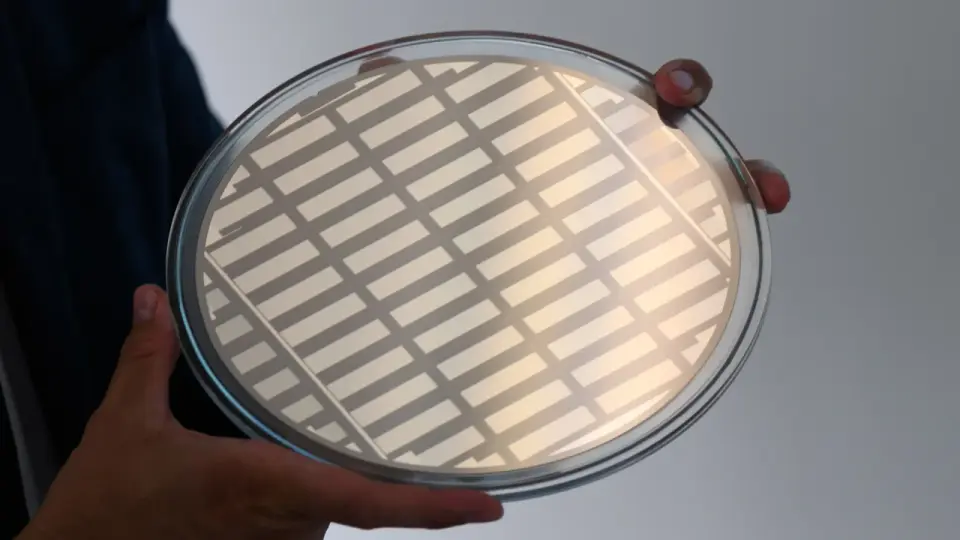
A new device combining engineered gallium arsenide quantum wells with a nanoscale metasurface achieves a 1,000x increase in nonlinear light conversion efficiency. This breakthrough enables compact, chip-scale frequency converters for telecommunications and quantum technologies, overcoming the size and efficiency limitations of traditional bulk crystals.
Key points
- The device achieves an effective nonlinear susceptibility of 14 nm V⁻¹, a 1,000x improvement over unpatterned wafers.
- It uses a GaAs/AlGaAs multi-quantum-well heterostructure to create strong electronic interactions between light and matter.
- A metasurface of nanopillars shapes electromagnetic fields, enabling efficient frequency conversion at near-infrared wavelengths.
- The design is compatible with existing semiconductor manufacturing processes, facilitating scalable integration into photonic chips.
- The technology could enable compact sources for entangled photon pairs, advancing quantum communication and computation.
Background
This development builds on the fundamental role of semiconductors in modern electronics, as detailed in our August 2026 explainer on transistors. While traditional nonlinear optical devices rely on bulk crystals like lithium niobate, which are difficult to miniaturize, this new approach uses planar nanofabrication to create compact, efficient components. The work addresses a longstanding challenge in photonics: achieving strong nonlinear responses without the need for long propagation distances or complex dispersion engineering, a problem that has hindered the miniaturization of optical devices for decades.
How outlets are covering it
All four sources agree on the core achievement: a 1,000x (three orders of magnitude) boost in nonlinear optical response. Interesting Engineering and Harvard SEAS emphasize the potential for miniaturizing photonic devices and their compatibility with existing manufacturing. Nature provides the technical specifics, noting the intrinsic susceptibility of 1.6 nm V⁻¹ in the quantum well alone, which is amplified to 14 nm V⁻¹ by the metasurface. Quantum Zeitgeist highlights the practical implications for free-space accessibility and the potential for scalable manufacturing, noting that the all-dielectric and semiconducting composition offers a high damage threshold. The sources differ in emphasis: Interesting Engineering and Harvard focus on the broader impact on telecommunications and quantum technologies, while Nature and Quantum Zeitgeist delve into the specific physics of the interband transitions and the guided-mode resonance that enables the enhancement.
Why it matters
This breakthrough could significantly reduce the size and cost of optical components used in telecommunications and quantum computing. By enabling efficient frequency conversion in a compact, chip-scale format, it paves the way for more advanced and accessible photonic technologies, potentially accelerating the development of quantum communication networks and high-speed fiber-optic networks. The compatibility with existing semiconductor manufacturing processes is a key factor that could facilitate rapid adoption and integration into current technological infrastructure.
What to watch
The researchers plan to further optimize the fabrication processes and expand the design space for both the heterostructure and metasurface to achieve even larger nonlinear responses. They also aim to explore the versatility of the metasurface design for spatially engineering nonlinear output by controlling propagation or geometric phase. The next steps will likely involve testing the device in more complex photonic circuits and exploring its application in other nonlinear processes, such as difference-frequency generation and entangled photon generation.
- New metasurface boosts light conversion in tiny semiconductor device by 1,000x Interesting Engineering
- New Device Design Could Miniaturize Photonics, Quantum Technologies Harvard School of Engineering and Applied Sciences
- Quantum-well metasurface for free-space-accessible enhanced nonlinear polarization Nature
- New nanostructure makes non-linear light conversion 72,000 times more efficient Phys.org
- Researchers Achieve 1.6 Nm V⁻¹ Nonlinearity In Quantum-well Structure Quantum Zeitgeist
Want the full story? Read the original reporting
Read on Interesting Engineering