Tag

Metasurfaces

All articles tagged with #metasurfaces

Quantum-well metasurface boosts free-space second-harmonic generation to giant levels
science1 month ago

Quantum-well metasurface boosts free-space second-harmonic generation to giant levels

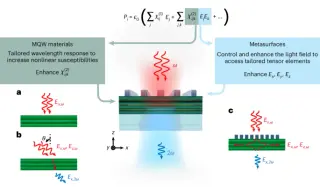
Researchers combine a GaAs/AlGaAs multi-quantum-well stack with a high-Q TiO2 metasurface to access and enhance second-order nonlinearities from near-infrared to visible. Engineered interband transitions yield an intrinsic χ(2) ≈ 1.6 nm/V at 1.57 μm, while coupling to a guided-mode resonance in the metasurface elevates the effective χ(2) to ~14 nm/V (≈17 nm/V after correcting for SH absorption), enabling free-space-accessible SHG with normal incidence. The device uses a 16-period MQW film (~595 nm) and a metasurface that provides polarization conversion and strong field overlap; the strongest SHG occurs at small incidence angles with a high-Q resonance (Q ~1125). This co-design demonstrates a scalable route to compact, efficient nonlinear photonic devices and could extend to other nonlinear processes.
Tiny On-Chip Valleytronics Circuit Turns Light Into Information
technology4 months ago

Tiny On-Chip Valleytronics Circuit Turns Light Into Information

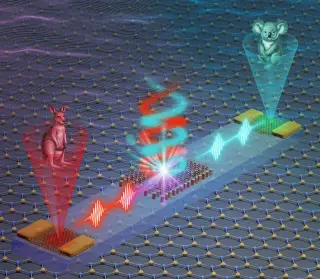
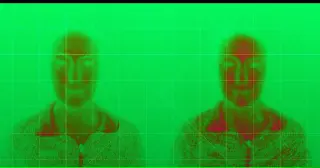
Monash University researchers have built a nanoscale, on-chip valleytronics circuit that can generate, direct, and read light-based signals in a single device, using ultra-thin materials and metasurfaces to manipulate photons via the valley degree of freedom; operating at room temperature, the chip demonstrated processing of two simultaneous images, highlighting potential for faster, energy-efficient photonic and quantum computing and communication.

Polar ID Goes Subdisplay: Metalenz Puts Face Unlock Behind the Screen
technology5 months ago

Polar ID Goes Subdisplay: Metalenz Puts Face Unlock Behind the Screen

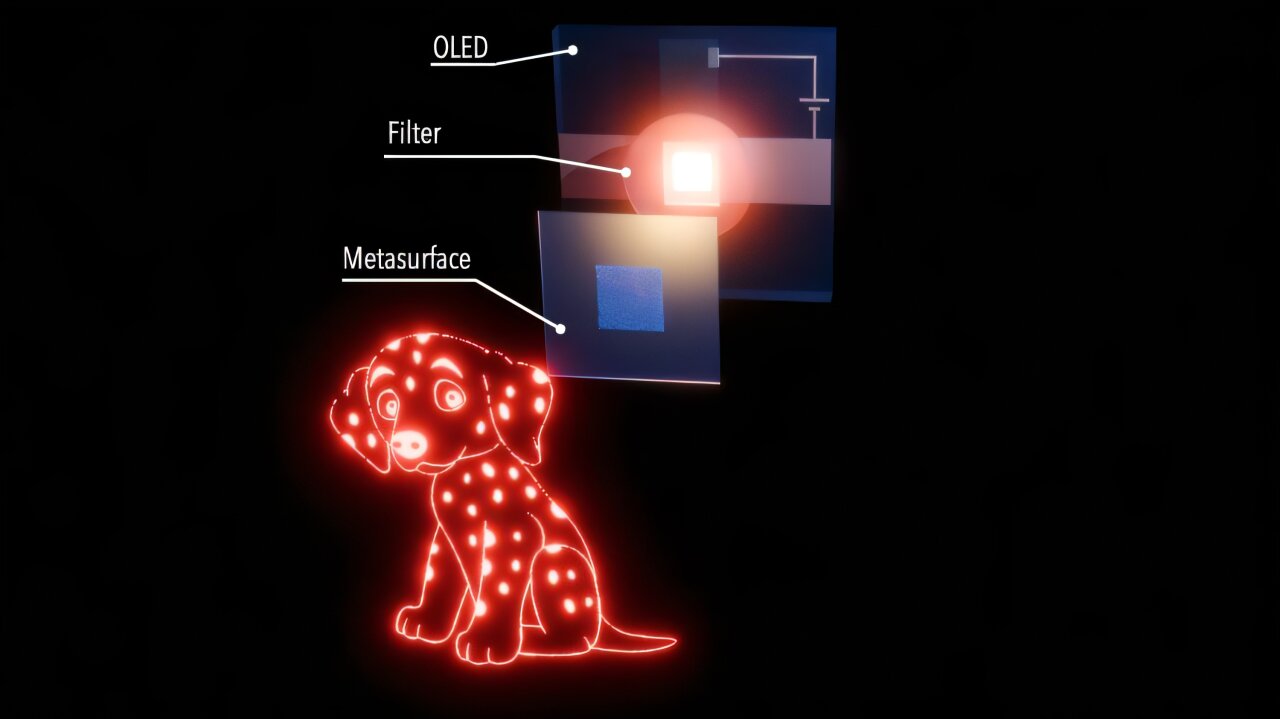
Metalenz’s Polar ID uses polarization data captured by metasurface optics to distinguish real faces from masks, enabling biometric authentication that can operate beneath an OLED display. The system promises a notch-free, secure Face ID-like solution for laptops and smartphones, resistant to high-quality masks, with mass production planned for 2027; the under-display version is expected to arrive around 2028 after closer collaboration with display makers.

Laser-Powered Metajets Hint at 20-Year Alpha Centauri Trip
space-and-astronomy5 months ago

Laser-Powered Metajets Hint at 20-Year Alpha Centauri Trip

Texas A&M researchers report a lab demonstration of micron-scale metajets with metasurfaces that can be steered in three dimensions by laser light; they say the concept could be scaled to propel larger spacecraft, potentially enabling a 20-year journey to Alpha Centauri, though real-world feasibility and space testing remain to be proven.

Laser-Propelled Metajets Could Shorten Alpha Centauri Trip to 20 Years
space5 months ago

Laser-Propelled Metajets Could Shorten Alpha Centauri Trip to 20 Years

Texas A&M researchers demonstrated micron-scale metajets that use metasurfaces to move in three dimensions when illuminated by laser light, enabling 3D maneuverability that could, in theory, scale to propel larger craft. While the approach could cut a trip to Alpha Centauri to about 20 years, feasibility remains uncertain as tests to date occurred in fluid environments and microgravity space tests are planned to validate practicality and scaling.

Micron-scale Metajets Open Door to 3D Light Propulsion
space5 months ago

Micron-scale Metajets Open Door to 3D Light Propulsion

Texas A&M researchers demonstrated micron-scale metajets—metasurface-based devices that transfer momentum from light to lift and steer objects in 3D without contact—marking a scalable path for light-propulsion and potential interstellar missions to Alpha Centauri, contingent on sufficient optical power and funding; space-testing is the next step after fluid experiments that offset gravity.

Metasurface holograms unlock ultra-dense single-atom tweezer arrays
science8 months ago

Metasurface holograms unlock ultra-dense single-atom tweezer arrays

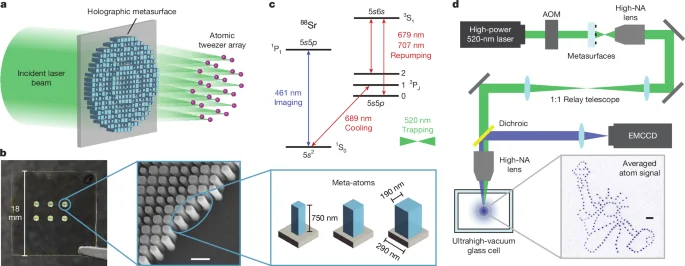
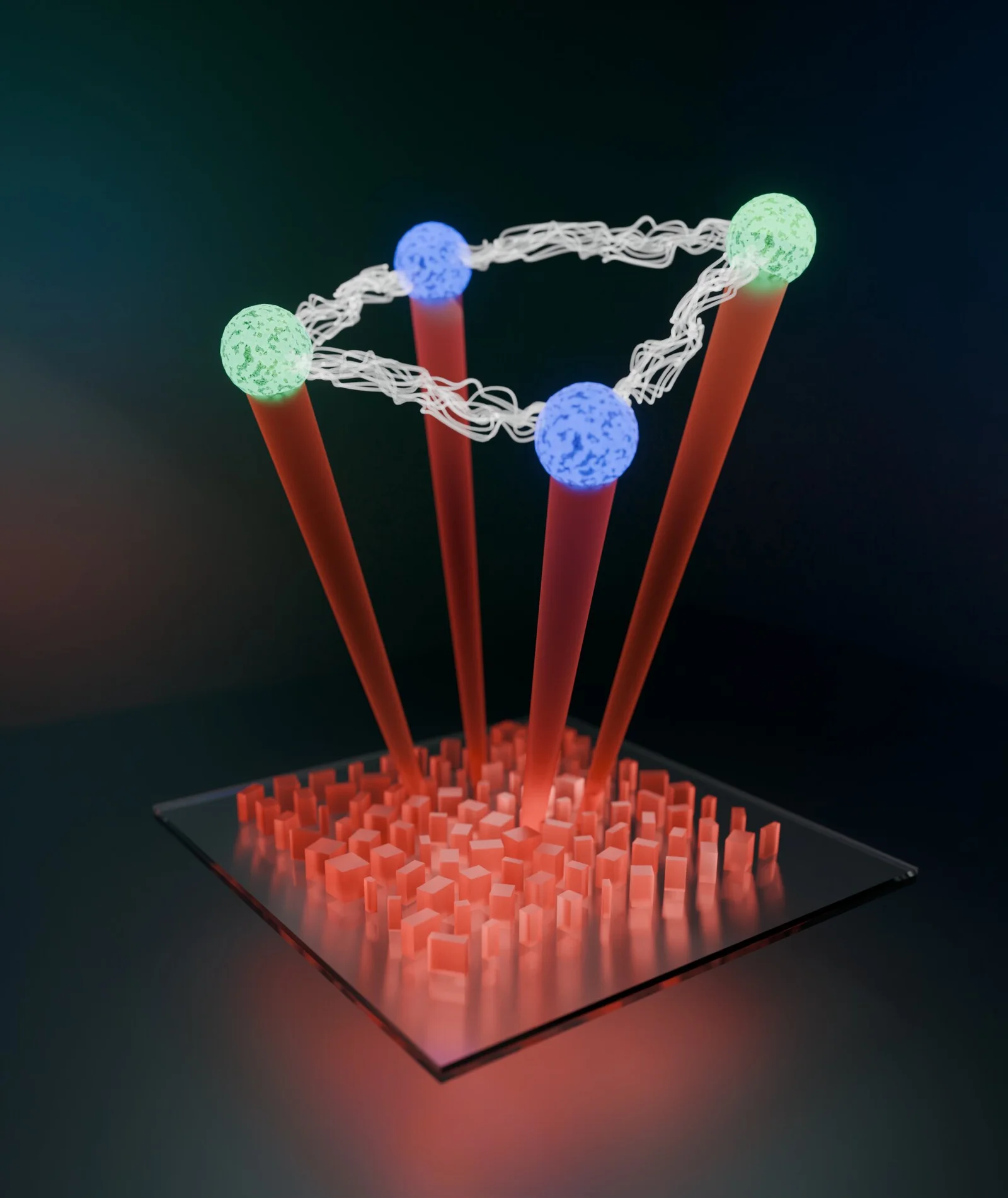
Researchers demonstrate trapping of single strontium atoms in two‑dimensional metasurface‑generated optical tweezer arrays, achieving arbitrary geometries with trap spacings as small as 1.5 μm and over 100 traps, with high uniformity in depth and frequency. The metasurfaces (silicon-rich silicon nitride and TiO2) use subwavelength pixels to scale far beyond current limits, enabling a 360,000‑trap array and a path toward scalable neutral-atom quantum technologies.

Advances in Meta-Optical Technologies for Ultrafast Light Control and Future Applications
nanophotonics1 year ago

Advances in Meta-Optical Technologies for Ultrafast Light Control and Future Applications

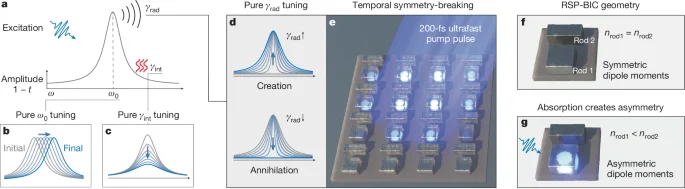
The article reports an experimental demonstration of ultrafast optical control of resonances in symmetry-broken metasurfaces by tuning the radiative loss parameter γrad through selective optical pumping, leveraging restored symmetry-protected bound states in the continuum (RSP-BICs) to achieve dynamic on-off switching of high-Q resonances on subpicosecond timescales, with potential applications in active nanophotonics and ultrafast optical devices.

"Breakthrough All-Optical Tech Shrinks Night Vision Devices"
technology2 years ago

"Breakthrough All-Optical Tech Shrinks Night Vision Devices"

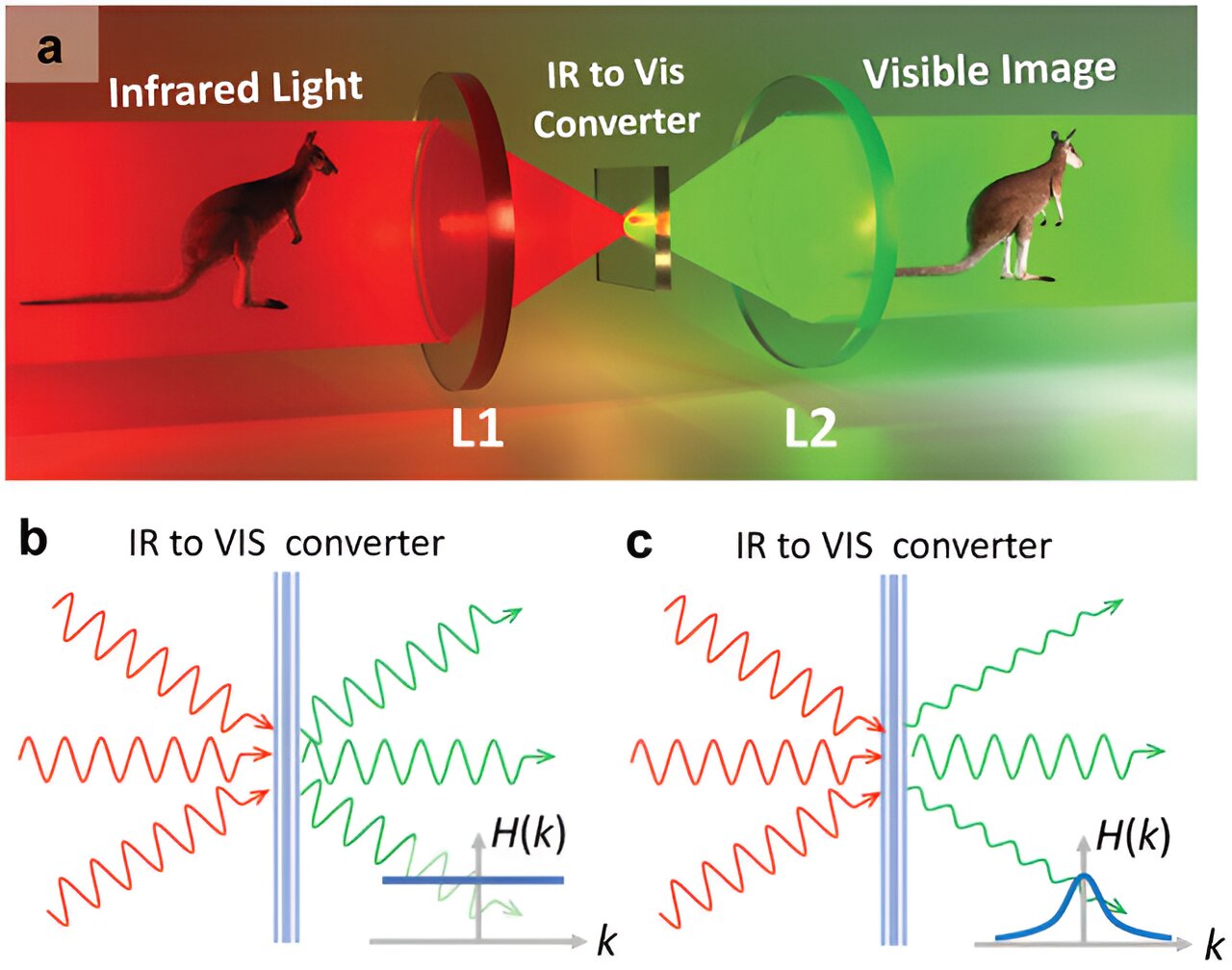
Researchers from TMOS have developed a new, ultra-thin infrared filter using lithium niobate metasurfaces that can be applied to everyday eyewear, potentially revolutionizing night vision technology by making it lightweight and accessible for consumer use. This innovation allows users to see both infrared and visible light simultaneously, promising applications in safer driving, nighttime activities, and various industries.

"Michelangelo's David Successfully Recognized by Compact Facial-Recognition System"
technology2 years ago

"Michelangelo's David Successfully Recognized by Compact Facial-Recognition System"

Scientists have developed a new compact facial recognition system that uses flatter, simpler optics and requires less energy than existing 3D imaging systems in smartphones. The system, tested on a replica of Michelangelo's David, employs metasurfaces and a photonic crystal surface-emitting laser to generate customizable and versatile light patterns, making it more energy-efficient and suitable for integration into a single chip. The new system recognized the face as well as existing smartphone facial recognition while using 5-10 times less power.

"Breakthrough: Light Slowed 10,000 Times in Groundbreaking Experiment"
science-and-technology2 years ago

"Breakthrough: Light Slowed 10,000 Times in Groundbreaking Experiment"

Scientists from Guangxi University and the Chinese Academy of Sciences have developed a new method to slow down light by more than 10,000 times using a synthetic 2D structure called a metasurface, made from thin layers of silicon. This breakthrough in light manipulation could have significant implications for computing and optical communication, offering better control over how light travels and reducing energy loss compared to existing methods.