Tag

Photonics

All articles tagged with #photonics

Chip-Scale Nanolaser Promises Faster, Greener Computing
technology13 days ago

Chip-Scale Nanolaser Promises Faster, Greener Computing

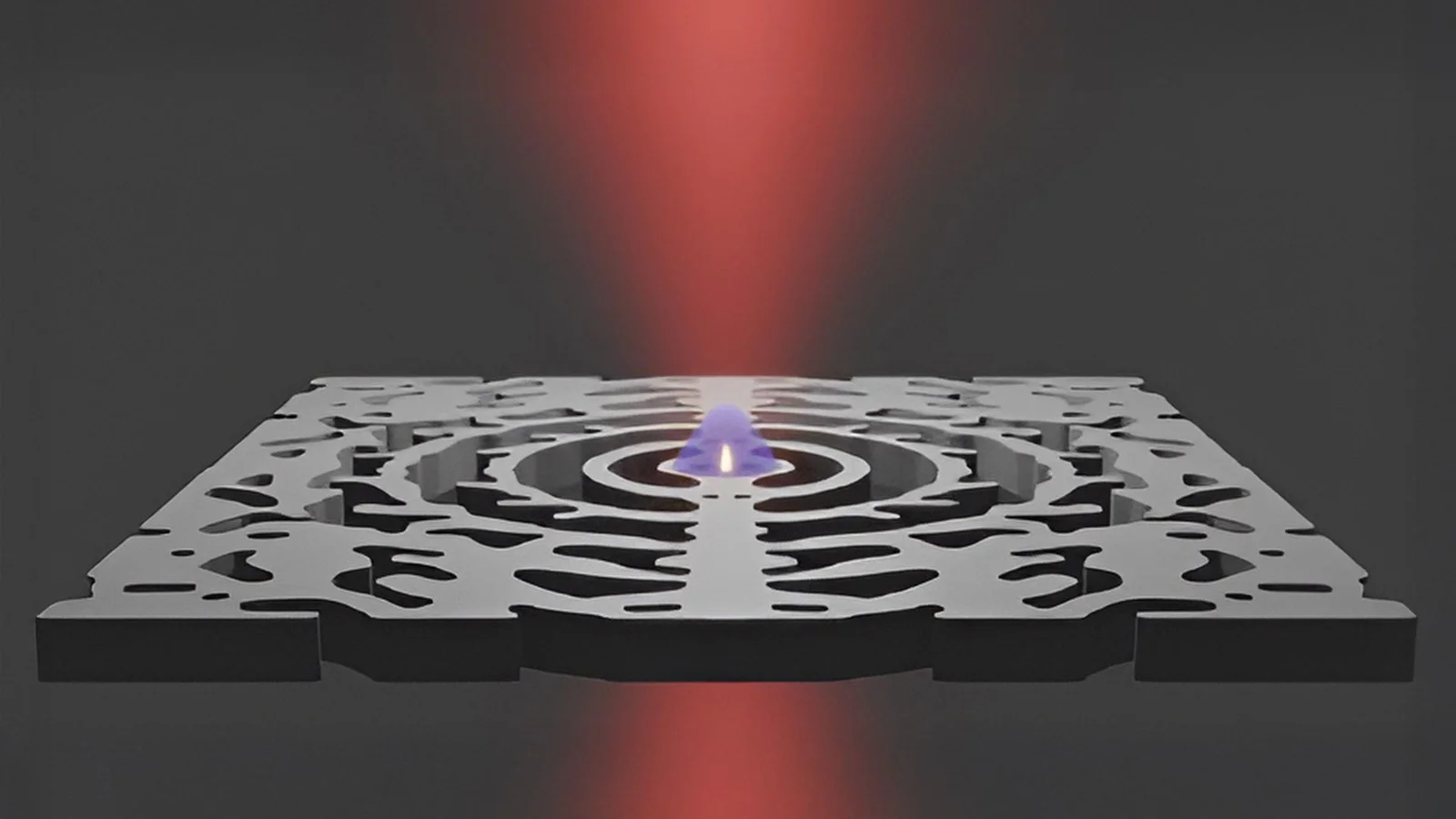
DTU researchers have built a nanolaser inside a semiconductor membrane that concentrates light and electrons in a tiny nanocavity, enabling on-chip data transfer with photons instead of electricity. The technology could dramatically boost speeds and halve energy use once thousands of such sources are integrated on future chips; it currently operates at room temperature using light, with electrical powering and large-scale integration as next challenges. If resolved in 5–10 years, it could impact consumer devices, data centers, and high-precision sensors.

Researchers Reveal Rich 48-Dimensional Topology Inside Entangled Photons
physics20 days ago

Researchers Reveal Rich 48-Dimensional Topology Inside Entangled Photons

Researchers at the University of the Witwatersrand and collaborators demonstrated that entangled photons carry a hidden, high-dimensional topology—up to 48 dimensions—with over 17,000 distinct signatures. This topology arises from a single property of light, its orbital angular momentum, enabling a new high-dimensional encoding scheme for quantum information. Because OAM spans many values, the resulting topology can be very rich, and the effect can be observed using standard SPDC lab setups, potentially improving the robustness of future quantum technologies.

Nvidia bets on light-speed AI data centers with a $4B photonics push
tech1 month ago

Nvidia bets on light-speed AI data centers with a $4B photonics push

Nvidia is plowing $4 billion into photonics suppliers Lumentum and Coherent to connect the GPUs inside AI data centers with optical tech like lasers and transceivers, building on its Mellanox effort to boost NVLink. The multiyear deals include multibillion‑dollar purchase commitments and capacity rights for advanced laser and optical networking components, aiming to improve energy efficiency, bandwidth, and latency as AI workloads grow. The move underscores photonics as a key lever for future AI infrastructure amid broader interest from DARPA and rivals like AMD.

Photons Hit Quantized Hall Drift, Echoing Quantum Hall Effect
science1 month ago

Photons Hit Quantized Hall Drift, Echoing Quantum Hall Effect

Researchers demonstrated a quantized transverse drift of light that mirrors the electronic quantum Hall effect, using a frequency-encoded photonic Chern insulator. The photon steps depend only on fundamental constants, potentially establishing an optical standard for ultra-precise measurements and strengthening quantum photonic technologies; the result, published in Physical Review X, could impact metrology and sensor development.

Two-Timescale Photonic Chips Forge New Colors On Demand
technology1 month ago

Two-Timescale Photonic Chips Forge New Colors On Demand

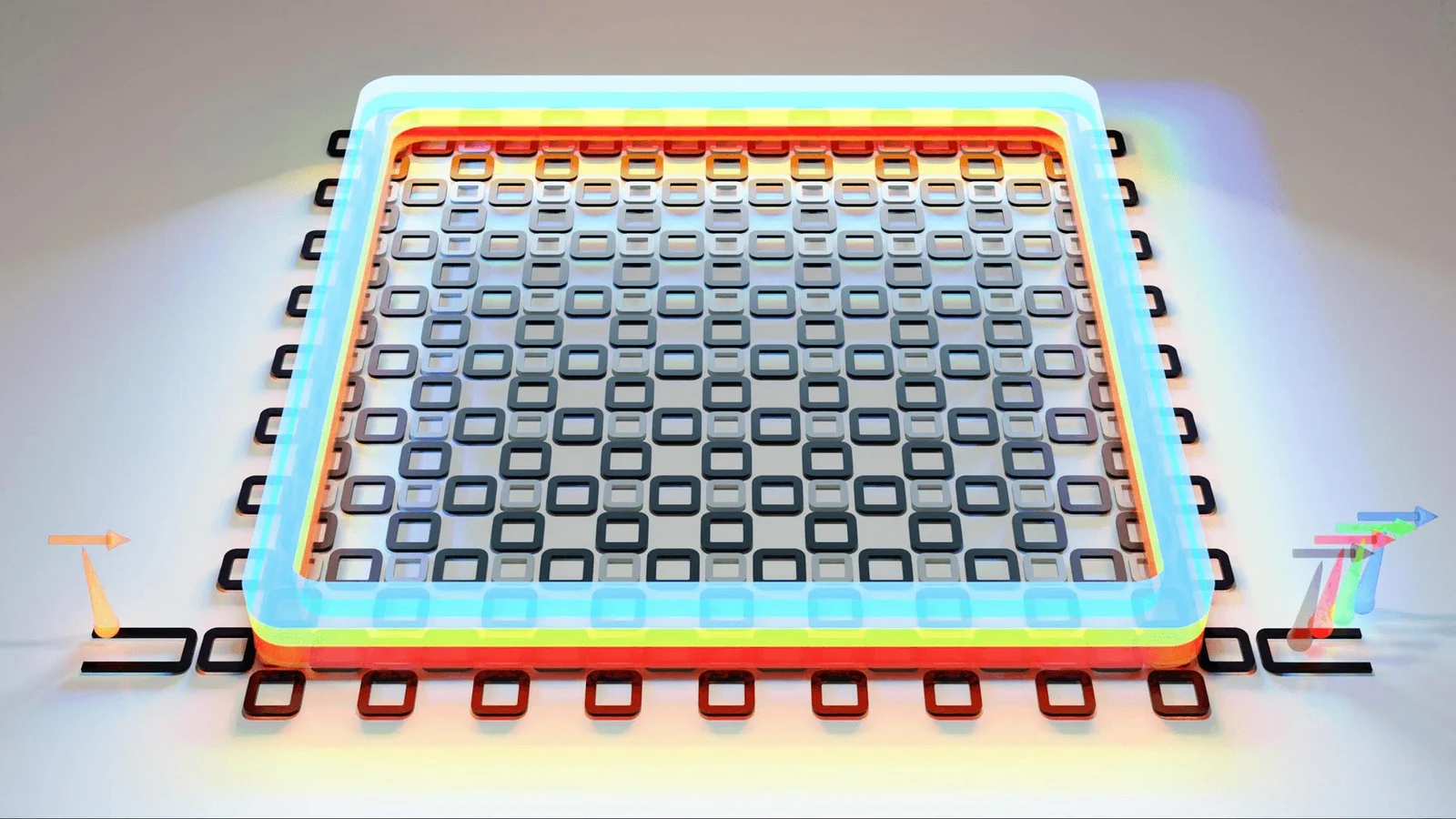
Researchers at JQI designed a chip consisting of an array of resonators that exploit two distinct light-circulation timescales to passively satisfy frequency-phase matching, enabling second-, third-, and fourth-harmonic generation from a 190 THz input without active tuning. The on-chip generation of new colors (red, green, blue) eliminates the need for additional lasers or heaters and could impact metrology and nonlinear optical computing by providing compact, scalable light sources.

Room-Temperature Light Ising Machine Tackles Tough Optimization Problems
physics-and-chemistry2 months ago

Room-Temperature Light Ising Machine Tackles Tough Optimization Problems

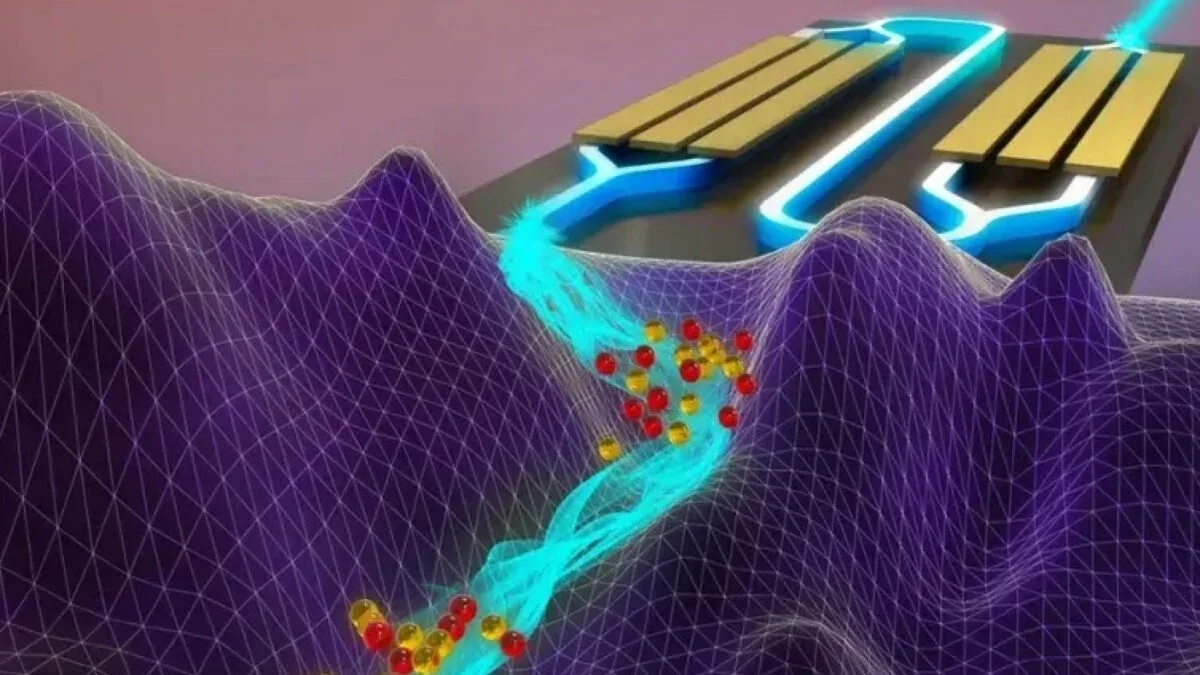
A Queen’s University team demonstrated a light-based Ising machine built from standard telecom components that runs at room temperature and processes billions of operations per second to solve optimization tasks (like routing or protein folding) by guiding light pulses toward low-energy configurations; it’s practical for specific problems but not a general-purpose computer, with pilots planned with industry partners.

Electromagnetic Time Mirrors Demonstrated in Breakthrough Experiment
science2 months ago

Electromagnetic Time Mirrors Demonstrated in Breakthrough Experiment

Researchers at City University of New York demonstrated temporal reflection by abruptly shifting a metamaterial's impedance, creating a time-reversed copy of an electromagnetic signal inside a fixed system— the first experimentally observed time mirror. Published in Nature Physics, the result confirms a long-theorized effect in time-varying photonic media and hints at future applications in encryption and adaptive antennas, though practical scaling and energy constraints remain hurdles; time itself remains unaffected outside the device.

science1 year ago

MIT's Photonic Processor Revolutionizes AI with Light-Speed Efficiency

MIT researchers have developed a new photonic neural network processor that uses light to perform calculations, potentially overcoming limitations of traditional electronic computing. This new system, which incorporates nonlinear optical function units (NOFUs), allows all neural network processing to occur on the chip, achieving high accuracy and ultra-low latency. The photonic chip, fabricated with standard semiconductor tools, could be manufactured at scale, offering a faster alternative to electronic processors for machine learning tasks.

Scientists Capture First-Ever Image of a Single Photon
science1 year ago

Scientists Capture First-Ever Image of a Single Photon

Researchers at the University of Birmingham have captured the first image of an individual photon, revealing it as a lemon-shaped particle. This breakthrough, published in Physical Review Letters, was achieved by simplifying complex equations using imaginary numbers, allowing scientists to model photon properties emitted from nanoparticles. This advancement could significantly impact fields like quantum computing, photovoltaics, and artificial photosynthesis by enhancing our understanding of light-matter interactions at the quantum level.

Photon Pair Generation Triggered by Quantum Optical Delay
science1 year ago

Photon Pair Generation Triggered by Quantum Optical Delay

A Canadian research team has discovered a gain-induced group delay in spontaneous parametric down-conversion (SPDC), a process where a photon splits into two entangled photons. This delay, dependent on the intensity of incoming light, could impact applications requiring precise photon timing, such as quantum sensors and computers. The study, published in Physical Review Letters, used theoretical models and experiments to identify this delay, which poses challenges for quantum interference circuits but can be compensated in bulk optics.

Revolutionary 8-Photon Chip Miniaturizes Quantum Computing
technology1 year ago

Revolutionary 8-Photon Chip Miniaturizes Quantum Computing

South Korean researchers at the Electronics and Telecommunications Research Institute (ETRI) have developed a photonic quantum circuit chip capable of controlling up to eight photons, marking a significant advancement in quantum computing. This chip enables complex quantum phenomena like multipartite entanglement and has achieved record-breaking 6-qubit entanglement. The research, in collaboration with KAIST and the University of Trento, aims to further scale up to 16 and 32-qubit chips, contributing to the development of universal quantum computers.

"Light-Speed Transfer: Electron Spin Transport from Earth to Mars"
science-and-technology2 years ago

"Light-Speed Transfer: Electron Spin Transport from Earth to Mars"

Scientists have developed a method to transfer spin information from electrons to photons using electrical pulses, enabling the transmission of polarized light signals over long distances at high speeds. This breakthrough in spintronics meets crucial criteria for practical applications and could revolutionize optical telecommunications, potentially enabling rapid communication between Earth and Mars, as well as advancing technologies such as optical quantum communication, neuromorphic computing, and ultrafast optical transmitters.

"Major Breakthrough: Scientists Achieve Key Milestone in Quantum Internet Development"
technology2 years ago

"Major Breakthrough: Scientists Achieve Key Milestone in Quantum Internet Development"

Scientists have achieved a significant breakthrough by building a network of "quantum memories" at room temperature, marking a crucial step towards the development of a quantum internet. This quantum memory technology, which stores and retrieves photonic qubits at the quantum level, is essential for the next generation of the World Wide Web. Quantum communications are inherently secure and faster than classical communications, and the successful development of quantum memory at room temperature brings us closer to realizing the potential of quantum computing and quantum networks.

"Efficient Room Temperature Operation of Germanium-Silicon Single-Photon Avalanche Diode"
science-and-technology2 years ago

"Efficient Room Temperature Operation of Germanium-Silicon Single-Photon Avalanche Diode"

Researchers have achieved room temperature operation of a germanium-on-silicon single-photon avalanche diode (SPAD), a key component in photonics and quantum applications. This advancement is significant as it enables the practical integration of SPADs into various technologies, such as quantum communication and imaging systems, without the need for cryogenic cooling. The development opens up new possibilities for high-performance photon detection and imaging at room temperature, paving the way for more widespread and accessible applications in the field of photonics.

"Breakthrough: Light Slowed 10,000 Times in Groundbreaking Experiment"
science-and-technology2 years ago

"Breakthrough: Light Slowed 10,000 Times in Groundbreaking Experiment"

Scientists from Guangxi University and the Chinese Academy of Sciences have developed a new method to slow down light by more than 10,000 times using a synthetic 2D structure called a metasurface, made from thin layers of silicon. This breakthrough in light manipulation could have significant implications for computing and optical communication, offering better control over how light travels and reducing energy loss compared to existing methods.