
Nikon disqualifies AI-enhanced microscopy video, crowning new winner
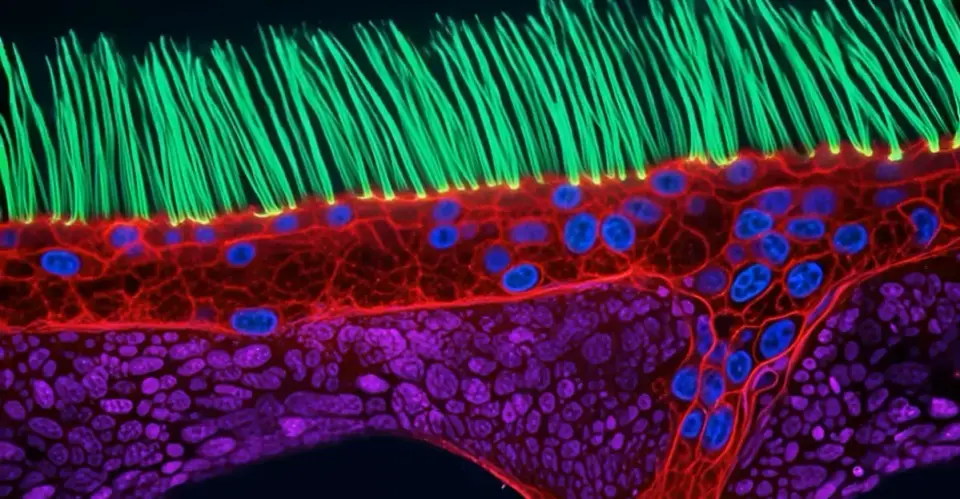
Nikon has disqualified the original winner of its 2026 Small World in Motion contest after determining that Dr. Ning Xu’s video of cilia in a child’s airway used generative AI for post-processing, violating competition rules. Nguyen Nam Nhat of Vietnam has been named the new winner for a video of a roundworm and a single-celled organism. Nikon stated it will revise its rules and evaluation procedures for future entries to address the rapid evolution of imaging and AI technologies.
Key points
- Nikon disqualified Dr. Ning Xu’s video, which depicted cilia in the airway of a child with primary ciliary dyskinesia (PCD), for non-compliance with rules regarding generative AI.
- Dr. Xu admitted to using an unsupervised neural network for AI-assisted post-processing to visualize features in reconstructed grayscale images, though he denied generating the experimental footage or motion itself.
- Nguyen Nam Nhat of Vietnam is the new first-place winner, featuring a video of a roundworm and a single-celled organism called Dileptus.
- Nikon stated the disqualification is based solely on eligibility rules and is not a judgment of the entrant’s professional reputation or scientific contributions.
- The company announced plans to revisit its competition rules and evaluation procedures to address challenges posed by advancing AI and imaging technologies.
Background
The Nikon Small World in Motion contest, launched in 2011 as a spinoff of the company’s long-running photomicrography competition, aims to showcase the beauty and complexity of microscopic life through moving images. In September 2026, Dr. Xu’s entry was initially announced as the winner, capturing cilia in a child’s airway at 100x magnification. This incident follows broader debates in 2026 regarding the use of AI in photography, including cases where parents used AI to generate school portraits to bypass traditional photographers.
How outlets are covering it
The Verge and Ars Technica reported the disqualification as a rule violation, emphasizing Nikon’s statement that the decision was not a judgment of Dr. Xu’s professional reputation. BBC highlighted the scientific backlash, noting that experts like Dr. Robert Hirst of the University of Leicester immediately recognized the video as fabricated due to structural abnormalities in the cilia that did not match real PCD patient samples. Gizmodo added that the video contained an AI-identifying SynthID watermark and that the red, blue, and purple structures appeared altered beyond recognition or entirely fabricated. While Nikon focused on eligibility, scientists emphasized the impact on PCD patients and the integrity of scientific data, with developmental biologist Melanie White noting that fabricating pixels is a fundamental difference from traditional image enhancement.
Why it matters
This incident highlights the growing tension between scientific integrity and the rapid advancement of AI in imaging. It underscores the need for clear guidelines on the use of generative AI in scientific competitions and research, as fabricated or altered images can mislead the scientific community and impact patient care. Nikon’s decision to revise its rules signals a broader industry response to ensure that scientific imaging remains grounded in accurate measurements and data.
What to watch
Nikon is expected to update its competition rules and evaluation procedures for future entries to address the use of AI in microscopy. The scientific community may continue to debate the ethical implications of AI-assisted post-processing in research, potentially leading to new standards for disclosing AI use in scientific imaging. Dr. Xu’s entry has been removed from Nikon’s website, and the updated rankings now feature Nguyen Nam Nhat as the winner.
- Nikon microscopic video competition winner disqualified for using generative AI The Verge
- Prize-winning image which sparked backlash was AI-generated, Nikon rules BBC
- Contest-Winning Microscope Video Thrown Out for Using Generative AI Gizmodo
- Big Controversy Upends a Contest About Microscopic Videos The New York Times
- Winning Nikon Small World in Motion video disqualified for AI use Ars Technica
Want the full story? Read the original reporting
Read on The Verge