
Cowboy Space Unveils 'Big Iron' Rocket for 20,000-Satellite AI Constellation
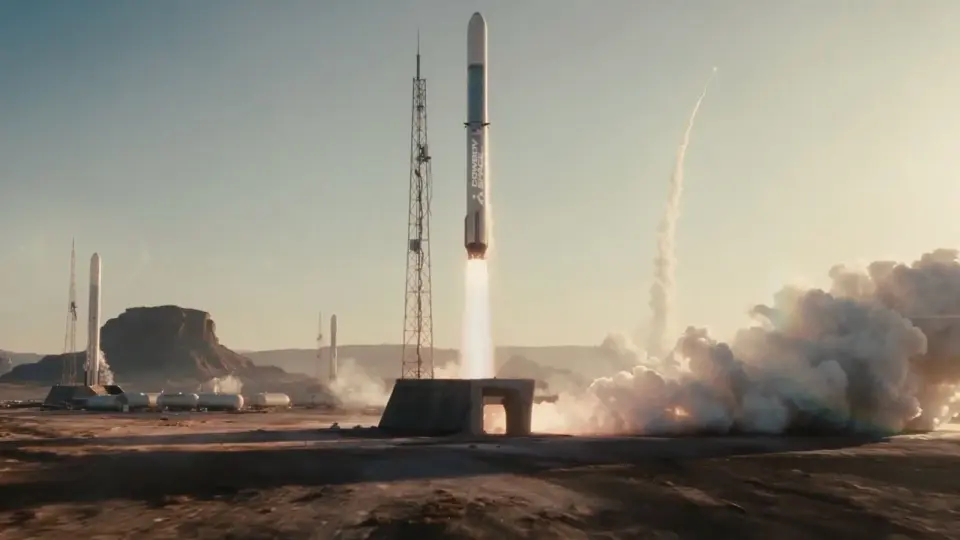
Cowboy Space, led by Robinhood co-founder Baiju Bhatt, has unveiled its 'Big Iron' launch vehicle, designed to deploy 20,000 AI data center satellites into low Earth orbit. The stainless-steel rocket, standing 282 feet tall, features a reusable first stage and an upper stage that remains in orbit as a megawatt-class compute platform. The company aims for its first launch in December 2028, targeting a constellation called 'Stampede' to address growing demand for orbital AI infrastructure.
Key points
- The 'Big Iron' rocket is a two-stage vehicle where the upper stage transforms into a data center satellite, carrying five racks of NVIDIA Vera Rubin GPUs.
- Each satellite will provide approximately 1 megawatt of compute power, significantly larger than SpaceX's planned 'Starmind' satellites, which offer 250 kilowatts.
- The company plans to build 20,000 satellites, requiring thousands of annual launches to maintain the constellation, with launch complexes dubbed 'Trailheads' featuring four active mounts each.
- Cowboy Space is also offering a commercial launch service called 'Big Iron Express' for external payloads, including military and commercial customers.
- The first flight is targeted for December 2028, with the company currently testing its 'Clydesdale' engines at NASA's Stennis Space Center.
Background
This development follows recent moves by SpaceX and Google to test orbital AI computing. In September 2026, Google launched an experimental satellite to process AI queries from orbit, while SpaceX has been shifting focus to its Starship rocket. Cowboy Space, founded in 2024 as Aetherflux, has already launched a power-beaming demonstration satellite, Reason-1, on SpaceX's Transporter-18 mission in October 2026.
How outlets are covering it
SpaceNews and Axios emphasize the strategic importance of Cowboy Space's move in filling a gap in medium-lift launch capacity, particularly as SpaceX prepares to retire its Falcon 9 rocket. Axios highlights the potential for military contracts, with COO Joseph Yaffe noting discussions with government officials. Payload Space focuses on the technical efficiency of the design, noting how the rocket's skin doubles as a radiator and ammonia propellant serves as coolant. All sources agree on the ambitious timeline and the scale of the 'Stampede' constellation, though some note the challenges of achieving such frequent launches.
Why it matters
The launch of 'Big Iron' represents a significant shift in the space industry, moving from traditional satellite deployment to integrated orbital data centers. This could reduce latency and energy costs for AI processing, while also addressing the growing demand for launch capacity. The move by Cowboy Space, backed by a prominent tech figure, signals a new era of competition in orbital infrastructure.
What to watch
Cowboy Space aims to launch 'Big Iron' for the first time in December 2028. The company is currently testing its Clydesdale engines and expects to begin regular launches multiple times per day to build the 'Stampede' constellation. The next step will be to secure FCC approval for the 20,000-satellite constellation and to finalize commercial and military contracts for 'Big Iron Express'.
- Cowboy Space unveils 'Big Iron' rocket to launch 20,000 AI data centers Space
- Cowboy Space unveils launch vehicle for deploying its orbital data center constellation SpaceNews
- Cowboy Space debuts new 'Big Iron' rocket Axios
- Cowboy Space Reveals Big Iron Data Center Rocket Payload Space
- Cowboy Space Details 'Big Iron' Launcher Plans Aviation Week
Want the full story? Read the original reporting
Read on Space