
HPE Supercomputer to Test AI and HPC on Lunar Rover FLIP
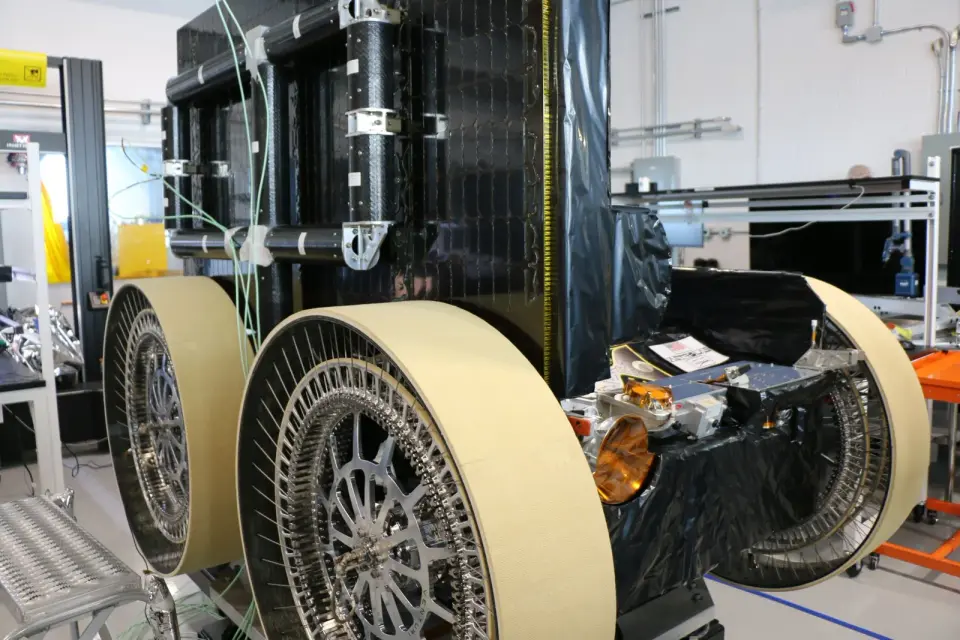
Astrolab’s FLIP rover, carrying Hewlett Packard Enterprise’s Spaceborne Computer-4, is set to launch to the Moon’s south pole later in 2026. This mission marks the first deployment of high-performance computing and artificial intelligence on the lunar surface. The rover, part of NASA’s Commercial Lunar Payload Services program, will test autonomous navigation and data processing capabilities in extreme conditions, aiming to reduce reliance on Earth-based control due to communication delays.
Key points
- The FLIP rover, weighing approximately 480 kg, will land near the lunar south pole via the Griffin-1 lander.
- HPE’s Spaceborne Computer-4 features a 64-bit CPU, GPU, and 1TB of storage, designed for low power and fanless operation.
- The mission will test Large Language Models (LLMs) and LiDAR processing to enable autonomous decision-making and navigation.
- The rover is designed to survive 150 hours of lunar night and extreme temperature swings between 80°C and -200°C.
- This is the first time HPE’s supercomputer technology will operate on the Moon, following previous tests on the International Space Station.
Background
This mission follows NASA’s selection of Astrolab and Lunar Outpost for Artemis program rovers in October 2026. HPE has previously tested its Spaceborne Computer series on the ISS, including running Meta’s Llama 3.2 model in 2025. The FLIP rover serves as a proof-of-concept for technologies that may support future crewed missions and permanent lunar infrastructure.
How outlets are covering it
Space.com emphasizes the historic nature of the first supercomputer and AI experiments on the Moon. The Register highlights the technical challenges, noting that the specific silicon powering the computer remains undisclosed due to mission risks, and details the use of standard Kioxia SSDs protected by software RAID. MIT Technology Review focuses on the potential for autonomous decision-making, citing HPE’s chief scientist on the dangers of communication delays, while Techzine Global underscores the broader goal of converting data into actionable insights at the site of discovery for future lunar bases.
Why it matters
Successful deployment of AI and HPC on the Moon could revolutionize space exploration by enabling real-time autonomous operations, reducing the need for constant Earth-based control. This technology is critical for future missions to Mars and beyond, where communication delays are significantly longer, and for establishing sustainable lunar infrastructure under the Artemis program.
What to watch
The FLIP rover is scheduled to launch later in 2026 aboard a SpaceX Falcon Heavy rocket. Upon landing, it will conduct a series of AI and HPC experiments, including LLM tests and LiDAR data processing, over a planned 10-day mission. HPE expects the computer to operate for the life of the mission, with results informing future space-hardened hardware designs.
- A supercomputer is about to launch to the moon for the 1st time, aboard a rover named FLIP Space
- HPE to launch AI straight to the Moon The Register
- Astrolab’s upcoming rover will run the first LLMs on the moon MIT Technology Review
- HPE, Astrolab team up to launch first high-performance computer to moon's surface this year The Business Journals
- HPE Spaceborne Computer-4 brings HPC to the Moon Techzine Global
Want the full story? Read the original reporting
Read on Space