
Nepal-China flood toll climbs to 752 as rescue teams drill into buried hydropower tunnels
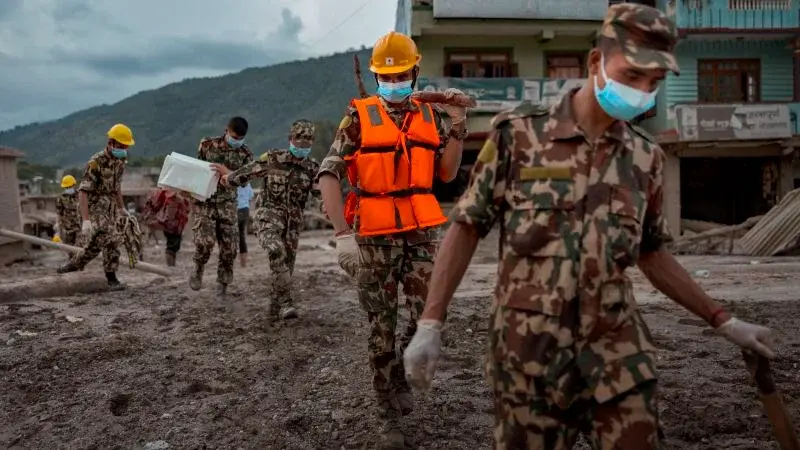
Catastrophic flooding on the Nepal-China border, triggered by a massive glacial collapse, has killed at least 752 people and left over 3,000 missing. Rescue efforts focus on hydropower tunnels where hundreds of workers remain trapped, while new barrier lakes and rising river levels threaten further disaster.
Key points
- Death toll reaches 752, with 2,502 missing in Nepal and 546 missing in China's Tibet region.
- Over 930 workers remain unaccounted for at hydropower projects, particularly at the Trishuli-3A site.
- A new barrier lake formed by a landslide near Gyirong Port forced evacuations of rescue personnel.
- The US increased humanitarian aid to $3.6 million, including food for 10,000 households.
- Authorities warn of secondary flooding risks as river levels rise and debris dams form.
Background
The disaster began on Wednesday when a glacier collapsed on Langtang Lirung mountain, sending a torrent of ice, water, and rock down 7,000 feet. This event, described by scientists as equivalent to a 5.2-magnitude earthquake, caused flash floods that swept through towns like Rasuwa and Devighat. Previous reports indicated the death toll had already exceeded 600, with international aid pledges reaching $229 million. The current situation marks the fifth day of rescue operations, with the focus shifting from immediate evacuation to retrieving trapped workers and managing new geological hazards.
How outlets are covering it
CNN emphasizes the human toll, highlighting families of missing engineers and the logistical challenges of tunnel rescues, noting that 930 workers are unaccounted for. BBC focuses on the international dimension, detailing the breakdown of missing foreigners from 23 countries, including 18 Americans and 15 British nationals, and noting concerns about China's censorship of footage. CBS News provides a survivor account from a California couple, describing the flood as a 'tsunami' of dark water that they narrowly escaped. All outlets agree on the severity of the disaster but differ in emphasis: CNN on local rescue efforts, BBC on diplomatic and missing persons data, and CBS on individual survival stories.
Why it matters
The disaster highlights the increasing risks of living downstream of glaciers in a warming climate. The scale of the destruction, including the burial of infrastructure and the formation of barrier lakes, poses long-term threats to regional stability and water security. The high number of missing foreigners underscores the vulnerability of tourism and pilgrimage routes in the Himalayas. Effective international coordination and rapid response are critical to preventing disease outbreaks and managing the ongoing humanitarian crisis.
What to watch
Rescue teams plan to enlarge holes in the Trishuli-3A tunnel to access trapped workers, with Chinese and Indian experts assisting. Authorities are monitoring the new barrier lake near Gyirong Port for potential breaches. The US and other nations will continue to provide aid, focusing on clean water and food distribution. Nepal's foreign minister has stated that the country remains on high alert for additional flood risks, with continuous monitoring of river systems.
- Nepal-China flooding latest: Rescuers search for missing workers in hydropower tunnels CNN
- Nepal floods latest: Girl, 5, reunited with parents after dramatic rescue from flash flood debris BBC
- Pilgrims to Flood-Stricken Nepal Sought the Divine at Sacred Mountain The New York Times
- Rescuers race to find thousands missing after Nepal-China glacier collapse Reuters
- California couple recounts surviving deadly Nepal flood: "I knew I was going to die" CBS News
Want the full story? Read the original reporting
Read on CNN