
Merz Defies 'Disaster' Label as CDU Faces Historic Low in State Elections
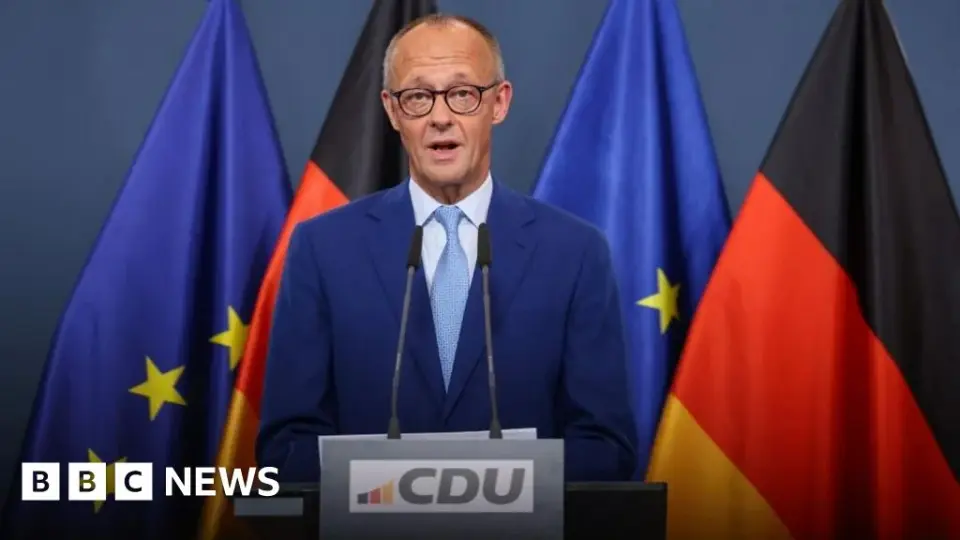
German Chancellor Friedrich Merz vowed to remain in office despite exit polls showing his Christian Democratic Union (CDU) party suffering a historic defeat in Mecklenburg-Vorpommern and trailing in Berlin. The far-right Alternative for Germany (AfD) is projected to win the most votes in Mecklenburg-Vorpommern, while the left-wing Die Linke leads in Berlin. Merz called the results a 'disaster' but insisted on pushing through economic reforms, framing them as a counter to 'authoritarian poison.'
Key points
- In Mecklenburg-Vorpommern, exit polls show the AfD winning 38% of the vote, while the CDU falls below the 5% threshold needed for parliamentary representation, marking its worst state election result since 1951.
- In Berlin, the left-wing Die Linke party leads with 26%, followed by the CDU and the Greens, with the AfD projected to finish fourth at 13.5%.
- Chancellor Merz described the Mecklenburg-Vorpommern result as a 'disaster' but stated he would continue his coalition government's plans for economic, tax, and welfare reforms.
- Merz's approval ratings have dropped to approximately 14%, and rumors of a mid-term 'chancellor swap' have intensified following the CDU's loss in Saxony-Anhalt two weeks prior.
- AfD co-leader Alice Weidel declared the party the 'new people's party in Germany' and called Merz 'strongly damaged,' while SPD leader Manuela Schwesig campaigned against the AfD's rise in Mecklenburg-Vorpommern.
Background
These elections occurred just two weeks after the AfD achieved a historic 44% victory in Saxony-Anhalt, which significantly weakened Merz's political standing. Previous coverage indicated that Merz had skipped the UN General Assembly to hold crisis meetings with his party, and that his approval ratings had already plummeted due to struggles in passing reforms with his coalition partners. The current results in Berlin and Mecklenburg-Vorpommern represent a continuation of this downward trend for the CDU, with the party facing potential exclusion from the Mecklenburg-Vorpommern parliament for the first time in decades.
How outlets are covering it
BBC and CNN both report that Merz called the Mecklenburg-Vorpommern result a 'disaster' and vowed to stay in office, emphasizing his commitment to reforms. CNN provides more detail on the AfD's reaction, quoting co-leader Alice Weidel as calling Merz 'strongly damaged' and the AfD the 'new people's party.' Al Jazeera focuses on the pre-election context, noting Merz's crisis meetings and the tight race in Berlin between the CDU and Die Linke, while highlighting the AfD's potential to govern in Saxony-Anhalt. All sources agree on the CDU's poor performance and the AfD's surge, but CNN and BBC emphasize Merz's defiance, while Al Jazeera emphasizes the pre-election uncertainty and the potential for a CDU leadership shake-up.
Why it matters
The results signal a potential shift in German politics, with the far-right AfD gaining significant ground in eastern states and the left-wing Die Linke gaining in Berlin. The CDU's historic low in Mecklenburg-Vorpommern and its trailing position in Berlin could lead to a leadership crisis for Merz and potentially impact the federal government's ability to pass reforms. The AfD's success in these states could also influence the 2029 federal elections, as the party sees these victories as a step towards national rule.
What to watch
Merz will continue to push through his coalition government's reforms, despite the poor election results. The CDU may face internal pressure to replace Merz as chancellor, and the AfD may use these results to build momentum for the 2029 federal elections. The SPD and Die Linke may also use these results to pressure the CDU and potentially influence the federal government's policies.
- German Chancellor Merz vows to stay on despite 'disaster' state election exit polls BBC
- Germany: Voting underway in two key state elections dw.com
- Germany’s AfD set to win north-eastern state in dire night for governing party, polls show CNN
- Germany’s Berlin, Mecklenburg-Western Pomerania states head to polls Al Jazeera
- Germans Are Voting Again, Amid a Far-Right Surge. Here’s What to Watch. The New York Times
Want the full story? Read the original reporting
Read on BBC