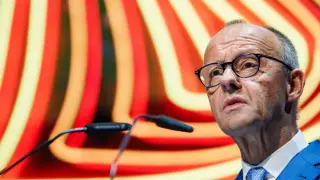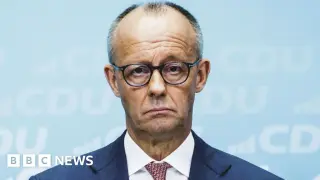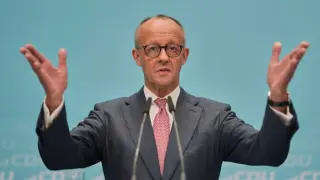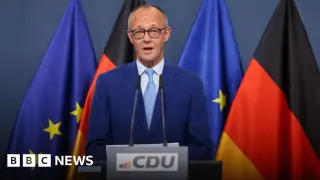
Germany’s CDU chief Friedrich Merz faces a growing leadership crisis as a surrogacy row involving Jens Spahn and a bungled cabinet shake-up fuel internal dissent ahead of September state elections, threatening his grip on power.
Germany plans to require a doctor's certificate on the first day of illness and end phone-based sick notes, returning to pre-pandemic rules as Chancellor Merz says sick days are too high. The move is part of broader economic reforms but drew opposition from medical groups and some SPD members who warn it could overwhelm doctors' waiting rooms and complicate absences; Labour Minister Bas says she will study the impact and seek workable solutions.
Projections put the CDU first in Rhineland-Palatinate (about 30.6%), with the SPD second (≈25.7%), and the AfD achieving its strongest western-state result at ~20%; Greens and FDP trail; four parties enter parliament, making a CDU-SPD grand coalition likely and Gordon Schnieder the likely next state premier.
At the CDU’s Stuttgart congress, Angela Merkel was warmly welcomed, signaling a cautious return to Merkelism, while Friedrich Merz adopts a centrist stance and appears to broker unity—keeping a wary eye on the AfD and other internal tensions as the party prioritizes governing power over open conflict with Merkel’s legacy.
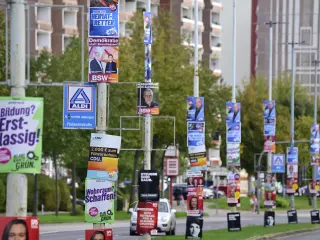
As a crowded year of state elections approaches, Merz’s CDU is trying to blunt the AfD’s rise in eastern Germany, notably in Saxony-Anhalt where veteran premier Haseloff steps down and Sven Schulze takes the lead ahead of the Sept. 6 vote to prevent the far-right from potentially winning a governing majority.
In North Rhine-Westphalia, the CDU is projected to win the local elections, with the AfD making significant gains, reflecting shifting political dynamics in Germany. The Green Party suffered heavy losses, and the SPD remains disappointed with its performance. The election results are seen as a potential indicator of national political trends, with concerns over the rise of the far-right and implications for the governing coalition.
In North Rhine-Westphalia, the CDU is set to win the local elections, while the far-right AfD is gaining significant ground, reflecting broader political shifts and testing Merz’s government. The elections also saw a tragic incident where an elderly man died at a polling station. The results are seen as a barometer for national politics, especially concerning immigration and security issues.
Friedrich Merz, leader of Germany's Christian Democratic Union (CDU), is poised for a potential comeback as Germany's next chancellor, following a decade-long absence from politics. With the collapse of Chancellor Olaf Scholz's coalition, snap elections are set for February. Merz, known for his straightforward rhetoric, faces criticism for controversial remarks but remains a strong contender despite lower personal approval ratings compared to his party. His corporate background and wealth are seen as potential drawbacks, yet his determination and ambition are likened to former chancellor Gerhard Schröder.
Germany will hold early elections on February 23 following the collapse of its center-left coalition government. The decision was announced by leaders of the Social Democratic Party (SPD) and the Christian Democratic Union (CDU), the latter being the largest opposition group.
Germany's major political parties have agreed to hold a federal election on February 23, 2025, following the collapse of Chancellor Olaf Scholz's coalition government. Scholz plans to hold a vote of confidence on December 16. The CDU, led by Friedrich Merz, is currently leading in polls and may form the next government, potentially in coalition with the SPD or Greens. The political uncertainty comes amid global tensions, including U.S. policy shifts under Donald Trump and the ongoing war in Ukraine.
Germany's traffic light coalition has collapsed, prompting potential snap elections. Chancellor Olaf Scholz aims to delay a confidence vote until January, while opposition leader Friedrich Merz pushes for immediate elections. The situation raises concerns across Europe, with implications for Germany's economic and political stability. The CDU may form a new coalition, possibly leading to a shift to the right. The political uncertainty in Germany, a key EU player, could impact European stability and governance.
Berlin held a partial rerun of the 2021 German federal election due to mishaps in the original vote, resulting in slight gains for the CDU and AfD, and modest losses for the ruling coalition parties. The overall pecking order of major parties remained unchanged, with the SPD leading. The rerun, affecting around a fifth of Berlin constituencies, will not alter Chancellor Olaf Scholz's center-left coalition, but could impact the makeup of the Bundestag. The rerun served as a litmus test for the governing coalition's popularity, with concerns raised about the timing and logistical challenges of the rerun.
German Chancellor Olaf Scholz's center-left coalition suffered a significant defeat in local elections, with the conservative CDU and far-right AfD making gains. This outcome could hinder crucial reforms both in Germany and at the European Union level, as internal divisions within the coalition have already led to compromises on climate transition measures. A weakened German government may struggle to rally other EU member states around compromise proposals, potentially stalling important discussions on energy price reform and rewriting fiscal rules.
The center-right Christian Democrats (CDU) in the eastern German state of Thuringia are facing criticism for joining forces with the far-right Alternative for Germany (AfD) and the neoliberal Free Democrats (FDP) to pass new tax legislation. Rival parties accused the CDU of crossing a line by working with the AfD, which is being investigated for extremist tendencies. The CDU's actions have been condemned by other parties, who accuse them of breaking taboos and making a pact with the far-right. CDU leader Friedrich Merz defended his colleagues, stating that the party's "firewall" against the far-right would be maintained.
The leader of Germany's centre-right Christian Democratic Union (CDU), Friedrich Merz, has stated that his party is open to cooperating with the far-right Alternative für Deutschland (AfD) at a local political level, sparking backlash from within the CDU and raising concerns about the firewall between conservatives and the far right. While Merz ruled out a national coalition with the AfD, he argued that democratic votes should be respected at the local level. The AfD has recently gained ground, winning district council and mayoral posts, and polls show them at 20-22% of the vote. Merz's comments have been criticized by CDU members, with the mayor of Berlin stating that the CDU cannot work with a party based on hatred and division.