
Alpine Plant Confirms Darwin's 150-Year-Old Carnivory Hypothesis
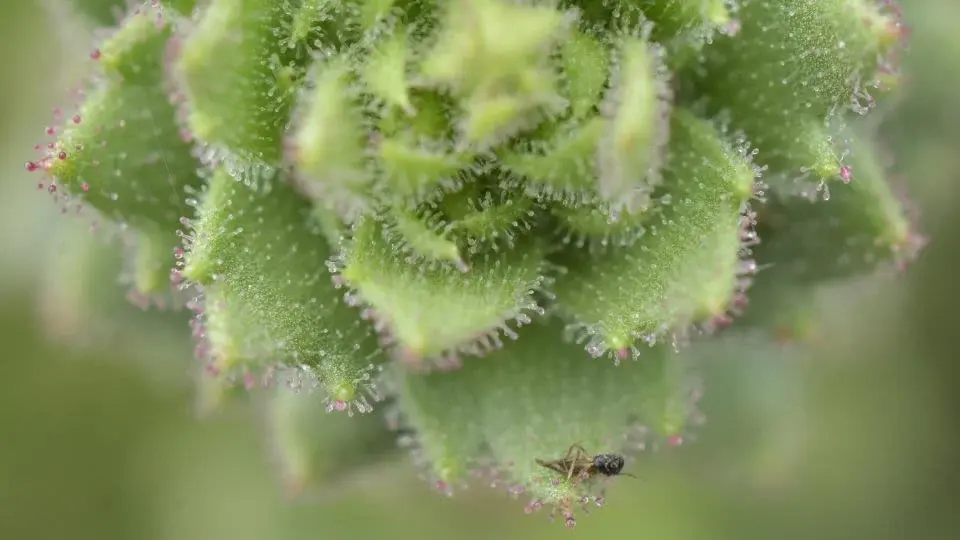
A new study confirms that Saxifraga candelabrum, an alpine plant in China, is carnivorous, validating Charles Darwin's 1875 hypothesis. Researchers used isotope labeling and enzyme analysis to prove the plant lures, traps, and digests insects for nitrogen. This discovery suggests carnivory is more widespread among flowering plants than previously believed.
Key points
- Darwin proposed in 1875 that Saxifraga species were carnivorous but could not prove it due to limited technology.
- The study focuses on Saxifraga candelabrum, which grows at 2,500 to 3,300 meters altitude in China's Qinghai-Tibet Plateau and Hengduan Mountains.
- Researchers confirmed carnivory by showing the plant attracts gnats with odors, traps them with sticky glandular hairs, and digests them using the enzyme phosphatase.
- Isotope labeling with nitrogen-15 demonstrated that nutrients from insect prey are transferred directly into the plant's tissues.
- Genomic analysis revealed shared genes for carnivory across six independent plant lineages, suggesting the trait is more common than thought.
Background
This finding resolves a long-standing debate in botany. Darwin had observed sticky hairs on Saxifraga plants similar to those of known carnivorous plants like sundews, but his 1875 feeding experiments failed to prove digestion. Previous archive coverage from August 2026 highlighted this study as a major confirmation of Darwin's insight, noting that while most carnivorous plants thrive in wetlands, this species survives in nutrient-poor alpine rock crevices.
How outlets are covering it
CNN and Yahoo emphasized the historical vindication of Darwin, noting that his 1875 hypothesis was finally proven 150 years later. The New York Times highlighted Darwin's personal fascination with carnivorous plants, contrasting his success with this discovery to his earlier failure to identify the pollinator for a specific orchid. The Nature journal provided the technical details, focusing on the multidisciplinary evidence including enzymatic assays and genomic convergence. Susan Myers, a botanist not involved in the study, praised the isotope tracing as 'brilliant,' while Hang Sun, the senior author, noted that carnivory is likely far more widespread among angiosperms than previously recognized.
Why it matters
This discovery expands the known range of carnivorous plants beyond typical wetland habitats to high-altitude, nutrient-poor environments. It provides a genetic framework to identify other potential carnivorous species that may have been overlooked, suggesting that the evolutionary strategy of eating insects is more common in the plant kingdom than current estimates of 750 species indicate.
What to watch
Researchers plan to use the identified genomic signatures to scan other plant families for hidden carnivorous traits. The study also suggests that many species previously classified as merely 'protocarnivorous' (trapping insects without digesting them) may actually possess undiscovered digestive capabilities, potentially leading to the discovery of new carnivorous lineages in the future.
- Scientists identify an insect-eating plant, proving Charles Darwin right after 150 years Yahoo News New Zealand
- Identification of carnivory in the flowering plant Saxifraga via multidisciplinary evidence Nature
- Darwin proposed that a type of plant was carnivorous. Scientists finally proved him right CNN
- Darwin Was Right: These Plants Are Carnivores The New York Times
- 'Darwin’s hypothesis provided an important inspiration': Scientists bolster 150-year-old Darwinian theory with a carnivorous plant in China Live Science
Want the full story? Read the original reporting
Read on Yahoo News New Zealand