
Nobel Prize in Medicine Awards Optogenetics Pioneers for Brain Mapping
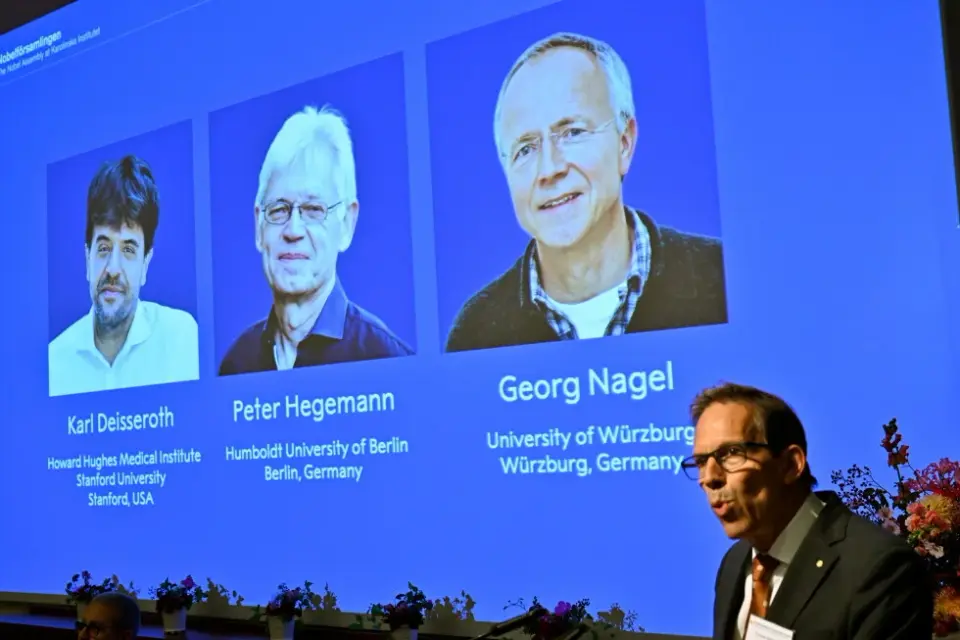
The 2026 Nobel Prize in Physiology or Medicine was awarded to Karl Deisseroth, Peter Hegemann, and Georg Nagel for the development of optogenetics. This technique uses light to control nerve cells, allowing scientists to map brain functions and study neurological disorders.
Key points
- Karl Deisseroth, Peter Hegemann, and Georg Nagel won the 2026 Nobel Prize in Physiology or Medicine for their work on optogenetics.
- The technique uses light-sensitive proteins from algae to activate or silence specific neurons in the brain.
- Hegemann and Nagel discovered the protein channelrhodopsin in algae, while Deisseroth adapted it for use in nerve cells.
- The prize money is 12 million Swedish krona, split equally among the three laureates.
- Optogenetics has enabled researchers to identify neural circuits governing behaviors, memories, and psychiatric disorders.
Background
The 2026 Nobel Prize in Physiology or Medicine was announced on October 5, 2026, at the Karolinska Institute in Stockholm. This award follows the 2025 prize, which recognized research into the immune system. The current laureates are part of a broader trend in neuroscience research, with previous awards often highlighting breakthroughs in understanding brain function and disease mechanisms.
How outlets are covering it
AP News, CNN, and The New York Times all confirm the award to Deisseroth, Hegemann, and Nagel for optogenetics. CNN emphasizes the technique's potential for treating neurological and psychiatric disorders, while The New York Times highlights its application in restoring vision for patients with retinitis pigmentosa. WBUR notes Deisseroth's Boston roots and his immediate reaction to the news, while AP and CNN detail his late-night discovery of the award. All sources agree on the prize amount and the scientific basis of the work.
Why it matters
The development of optogenetics has revolutionized neuroscience by providing a precise tool to study and control neural activity. This advancement has the potential to lead to new treatments for conditions such as depression, anxiety, schizophrenia, Alzheimer's disease, and Parkinson's disease, as well as restoring vision in patients with retinitis pigmentosa.
What to watch
The remaining Nobel Prizes for physics, chemistry, literature, and peace will be awarded later this week, with the Nobel Memorial Prize in Economic Science to follow on October 12. Researchers will continue to explore the applications of optogenetics in treating various neurological and psychiatric disorders.
- Nobel medicine prize goes to 3 scientists for research into brain activity AP News
- Nobel Prize in medicine awarded to three scientists for their work ‘concerning light-gated ion channels and optogenetics’ CNN
- Boston native among 3 scientists to win Nobel medicine prize for research into brain activity wbur.org
- Nobel Prize in Physiology or Medicine Is Awarded for Discoveries in Neuroscience The New York Times
- German and US scientists win Nobel medicine prize for work on optogenetics reuters.com
Want the full story? Read the original reporting
Read on AP News