
Near-Total Lunar Eclipse Casts Red Hue Across Americas
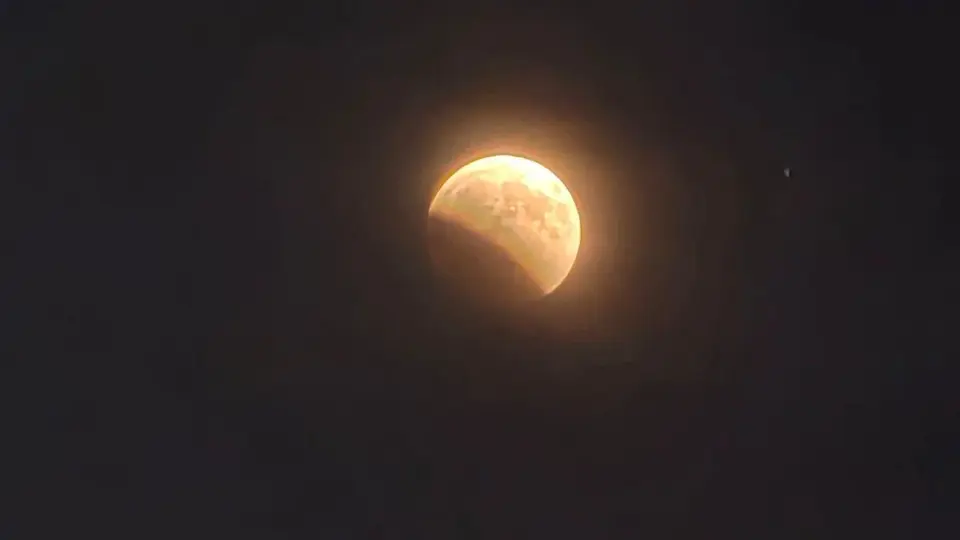
A near-total lunar eclipse occurred on August 28, 2026, visible across the Americas. Earth's shadow covered approximately 96% of the Moon, creating a 'blood moon' effect with rust-red hues. The event lasted several hours, peaking around midnight Eastern Time, and was visible to the naked eye without special equipment. This was a partial eclipse, not a total one, with the next total lunar eclipse expected in 2028.
Key points
- The Moon was 96% covered by Earth's umbra during the eclipse's peak.
- The event was visible across North and South America, including Utah, Maine, and Washington.
- The Moon appeared rust-red or copper-colored due to Earth's shadow.
- The eclipse began in the evening and lasted until early morning hours.
- The next total lunar eclipse is not expected until 2028.
Background
This event followed a partial solar eclipse visible in Maine just 15.5 days earlier. The August full Moon, known as the 'Sturgeon Moon' in Native American traditions, aligned with the eclipse. Previous coverage noted the eclipse's visibility across the Americas and its distinction from a total lunar eclipse.
How outlets are covering it
KUTV emphasized the visibility in Utah, noting the eclipse was visible in Salt Lake City from 7:59 p.m. to 1:01 a.m. WMTW highlighted cloud cover in Maine but noted a photographer captured the 'blood moon' in Kennebunkport. The Washington Post focused on the stunning visual impact, describing the Moon as bathed in eerie red light. Space.com provided general information on the next lunar eclipse but did not detail this specific event's local impacts.
Why it matters
The near-total lunar eclipse offered a rare astronomical spectacle for skywatchers across the Americas, demonstrating Earth's shadow and atmospheric effects on the Moon. It served as a precursor to the next total lunar eclipse in 2028 and highlighted the visibility of celestial events to the naked eye.
What to watch
The next total lunar eclipse is expected in 2028. Skywatchers may continue to observe the Moon's phases, with four more full moons remaining in 2026.
- PHOTOS: Near-total lunar eclipse darkens moon over Utah KUTV
- When is the next lunar eclipse? Space
- PHOTOS: Moon appears orange due to partial lunar eclipse KCCI
- Maine photographer captures near-total lunar eclipse over Kennebunkport WMTW
- See photos of last night’s stunning partial lunar eclipse The Washington Post
Want the full story? Read the original reporting
Read on KUTV