
Chrome introduces two-tier warnings to distinguish suspicious from dangerous sites
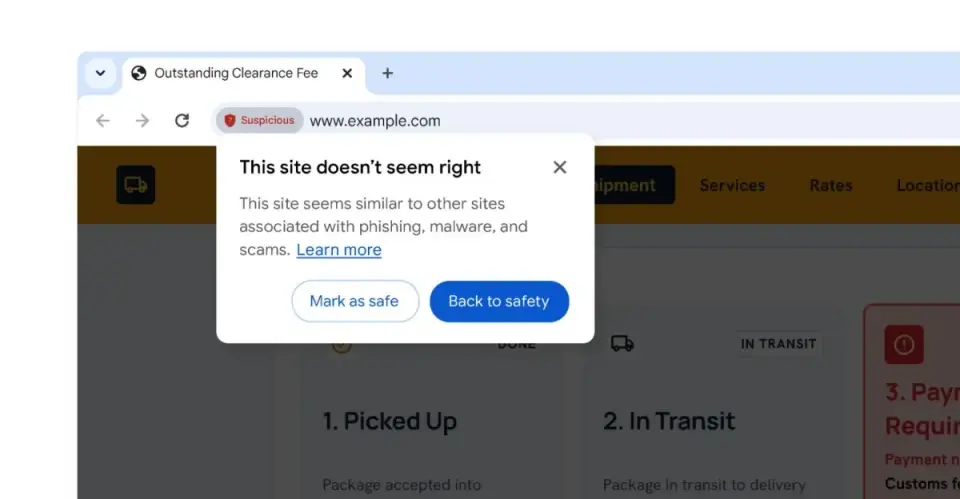
Google has updated Chrome’s Enhanced Protection mode to include a new two-tier warning system for websites. This update distinguishes between 'suspicious' sites, which carry a lower confidence risk and allow users to proceed if they are certain the site is safe, and 'dangerous' sites, which trigger a full-screen block. The change aims to reduce false positives while maintaining strict protection against high-risk malware and phishing attempts.
Key points
- The new feature is available only when Chrome’s Enhanced Protection mode is enabled.
- Suspicious site warnings appear as a pop-up with a darkened background, allowing users to mark the site as safe if they are confident it is legitimate.
- Dangerous site warnings remain a full-screen red interstitial that blocks access entirely, indicating a high confidence verdict of malicious intent.
- Google expanded its Gemini-powered scam detection to all Enhanced Protection users, moving from on-device to server-side analysis for broader threat coverage.
- The update includes new defenses against 'ClickFix' social engineering attacks, where users are tricked into copying and executing malicious commands in their terminal.
Background
This development follows a 2024 update where Google introduced a similar two-tier warning system for file downloads. In 2025, Google reported that over one billion Chrome users had enabled Enhanced Protection. The current update builds on these previous security enhancements, aiming to make Enhanced Protection users ten times safer from phishing and social engineering compared to Standard Protection users.
How outlets are covering it
The Verge highlights the user-facing distinction between the two warning types, emphasizing the visual differences and the ability for users to override 'suspicious' warnings. Google’s official blog post focuses on the technical improvements, detailing the shift to server-side Gemini models for scam detection and the new protection against ClickFix attacks. While The Verge notes the potential for false positives in the 'suspicious' category, Google frames this as a necessary trade-off to expand the volume of protective warnings without compromising the integrity of high-confidence 'dangerous' blocks.
Why it matters
This update improves the balance between security and usability for Chrome users. By differentiating between low-confidence and high-confidence threats, Google allows users to navigate potentially risky sites with more agency while maintaining strict barriers against confirmed malicious content. The integration of Gemini AI also signals a broader trend in using artificial intelligence to enhance real-time threat detection in web browsers.
What to watch
Users should ensure their Chrome browsers are updated and that Enhanced Protection mode is enabled to receive these new warnings. Google may continue to refine the Gemini-based detection models and expand the range of social engineering tactics covered by the ClickFix protection. Users are advised to remain cautious of any warning that asks them to manually execute commands to 'fix' browser issues, as this is a common scam tactic.
- Chrome will now show a warning before you visit ‘suspicious’ sites The Verge
- Our latest defenses against evolving web scams blog.google
- Google says Chrome’s Safe Browsing Enhanced Protection mode makes users 10x safer 9to5Google
- Google can now monitor your clipboard in Chrome to check if you copied unsafe content Neowin
- Chrome can now share your clipboard data with Google servers (for your own good) Android Authority
Want the full story? Read the original reporting
Read on The Verge