
NVIDIA Confirms DLSS 5 Launches Sept 3, Locked to RTX 50-Series with 50-60% Performance Hit
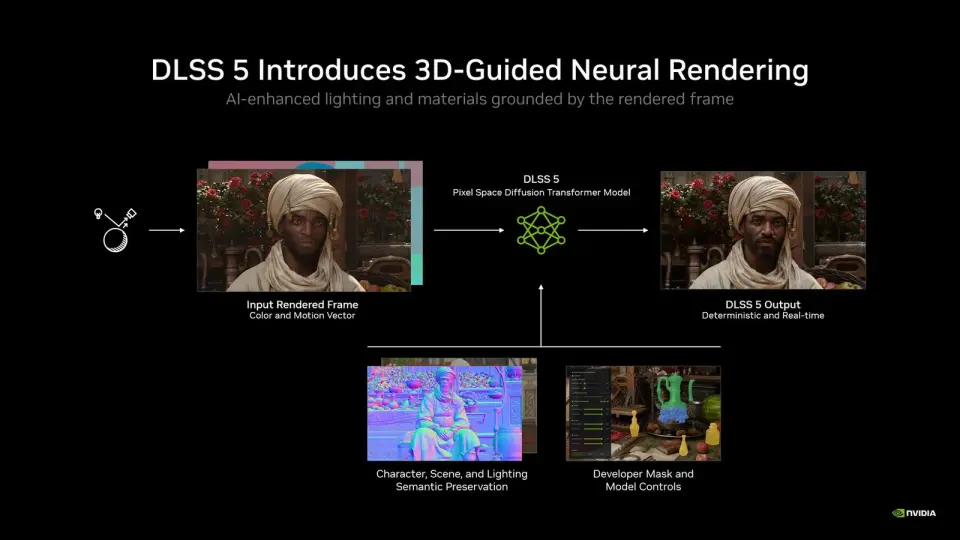
NVIDIA has officially confirmed that its DLSS 5 neural rendering technology will launch on September 3 alongside the release of NBA 2K27. The feature is exclusively available for GeForce RTX 50-series 'Blackwell' GPUs, with no support planned for older architectures. While the technology offers significant visual improvements, it imposes a substantial performance penalty, reducing frame rates by 50 to 60 percent on average. Modders have successfully bypassed hardware restrictions for RTX 40-series cards, but performance drops remain severe on older generations.
Key points
- NVIDIA confirmed at a Gamescom briefing that DLSS 5 is exclusive to RTX 50-series GPUs, stating 'It's RTX 50-series only.'
- The technology launches on September 3, coinciding with the release of NBA 2K27.
- DLSS 5 relies on fifth-generation Tensor cores and FP8 support, which are absent in older architectures.
- Modders have patched the technology for RTX 40-series cards, resulting in a 36-39 percent performance drop in Control.
- RTX 30-series cards experience catastrophic performance failures due to a lack of native FP8 support.
Background
NVIDIA unveiled DLSS 5 in March 2026, describing it as its largest and most complex model to date. Recent leaks of the DLSS 5 DLL from early NBA 2K27 builds revealed a 148-million-parameter neural network optimized for Blackwell hardware. Previous reports indicated that while the technology delivers high frame rates on RTX 50-series cards, it imposes a significant performance cost, with NVIDIA acknowledging a 50-60 percent average penalty due to multi-frame generation requirements.
How outlets are covering it
TechPowerUp and Tom's Hardware emphasize the official exclusivity of DLSS 5 to RTX 50-series hardware, noting that NVIDIA has explicitly ruled out support for older generations. Kotaku highlights the severe performance impact, citing NVIDIA's admission that the technology cuts framerates by 50 to 60 percent, even on top-end GPUs. While TechPowerUp notes that modders have achieved limited success with RTX 40-series cards, Kotaku frames the performance hit as a major drawback, questioning the utility of the technology given the current performance costs. All sources agree that the technology is currently limited to Blackwell hardware, with no official path for broader compatibility.
Why it matters
The exclusive launch of DLSS 5 reinforces NVIDIA's strategy of locking advanced AI-driven features to its latest hardware generation, potentially driving upgrades among consumers. The significant performance penalty raises questions about the practicality of the technology for current users, while the lack of support for older cards may frustrate owners of RTX 40-series GPUs who have already invested in recent hardware. The controversy surrounding DLSS 5 highlights the tension between visual fidelity and performance in AI-enhanced gaming technologies.
What to watch
NVIDIA is expected to release further optimizations for DLSS 5 in the coming months, potentially improving performance on RTX 50-series hardware. The company has not announced plans to extend support to older architectures, but modders may continue to develop workarounds for RTX 40-series cards. The long-term impact of DLSS 5 on the gaming industry will depend on how quickly performance penalties are mitigated and whether developers adopt the technology in other titles beyond NBA 2K27.
- DLSS 5 Officially Goes Live September 3 With NBA 2K27, Exclusive to RTX 50-series "Blackwell" GPUs TechPowerUp
- DLSS 5 Launches In NBA 2K27 September 3rd. Plus DLSS Comes To STAR WARS Zero Company™, Onimusha: Way of the Sword & The Blood of Dawnwalker NVIDIA
- NVIDIA DLSS 5 Technical Preview Review - Neural Rendering is Here TechPowerUp
- Nvidia's controversial DLSS 5 will launch September 3 with NBA2K27, company shares first benchmarks — available on all RTX 50 series GPUs, laptops, and GeForce NOW Tom's Hardware
- Nvidia Confirms AI-Slop Filter DLSS 5 Will Cut Your Framerate In Half Kotaku
Want the full story? Read the original reporting
Read on TechPowerUp