
Nepal-China Flood Toll Surpasses 800 as Barrier Lake Threatens Renewed Disaster
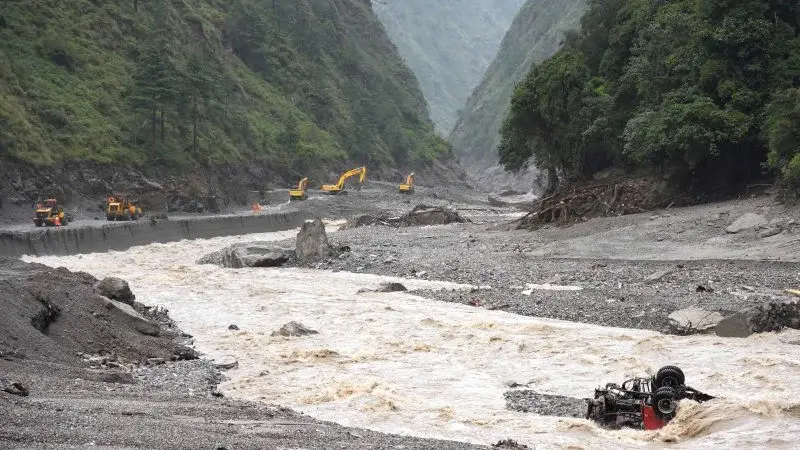
A catastrophic glacial collapse on the Nepal-China border has triggered massive flash floods, killing over 800 people and leaving more than 3,000 missing. Rescue operations are hampered by poor weather, difficult terrain, and the threat of a newly formed barrier lake that could trigger secondary flooding. International aid is flowing in, but identifying the dead and rescuing survivors trapped in hydropower tunnels remains a critical challenge.
Key points
- The death toll has risen to 800, with 788 confirmed in Nepal and 16 in China, while over 3,000 remain missing.
- A barrier lake formed by the landslide is being closely monitored; it briefly overflowed, forcing a suspension of rescue efforts in Tibet before operations resumed.
- More than 100 workers are believed to be trapped in hydropower tunnels, with specialized Indian and Chinese teams assisting in rescue efforts.
- International aid is significant, with the US providing $3.6 million, the UK pledging $6.8 million, and the EU offering $2.3 million.
- The disaster was caused by a magnitude 5.2 seismic event from a glacial collapse, highlighting growing risks from climate change in the Himalayas.
Background
This disaster follows a series of escalating reports since late August 2026, when initial tolls were reported at 469, then 626, and now over 800. The event is part of a broader trend of increasing natural disasters in the Himalayas due to climate change and rapid infrastructure development. Previous coverage highlighted the challenges of rescue operations and the formation of barrier lakes, which are now central to the ongoing crisis.
How outlets are covering it
CNN emphasizes the human toll and the urgency of the 'golden window' for rescue, highlighting the plight of missing individuals like Pratik Gautam and the emotional impact on families. BBC focuses on the logistical challenges, including the suspension of rescue efforts due to the barrier lake and the release of a list of missing foreign nationals. CBS News provides a broader overview, including the total death toll, international aid, and the specific challenges of rescuing workers trapped in hydropower tunnels. All sources agree on the severity of the disaster but differ in their emphasis: CNN on individual stories, BBC on operational updates, and CBS on the broader humanitarian and geopolitical response.
Why it matters
The disaster underscores the vulnerability of the Himalayan region to climate change and the risks associated with rapid infrastructure development. The potential for secondary flooding from barrier lakes highlights the need for improved monitoring and international cooperation. The large number of missing foreign nationals has drawn global attention and prompted significant international aid, while the challenges in identifying the dead and rescuing survivors raise questions about disaster preparedness and response in the region.
What to watch
Rescue operations will continue, but the threat of secondary flooding from the barrier lake remains a major concern. Authorities are monitoring water levels and may suspend operations if necessary. International aid is expected to increase, and efforts to identify the dead and rescue trapped workers will continue. The disaster may lead to increased scrutiny of infrastructure projects in the Himalayas and calls for better disaster preparedness and response mechanisms.
- ‘No sign of survivors’ at Chinese border crossing as Nepal flooding death toll passes 600 CNN
- Nepal floods latest: Death toll jumps to 616 as search for survivors enters fourth day - follow live BBC
- Nepal flood death toll surpasses 600, with more than 3,000 missing, as poor weather hampers rescues CBS News
- The Himalayas are unpredictable. But countries are building there like never before CNN
- Disaster Experts Say Nepal Glacier Collapse Was Difficult to Predict The New York Times
Want the full story? Read the original reporting
Read on CNN