
Nepal rescues two workers from flooded hydropower tunnel nine days after disaster
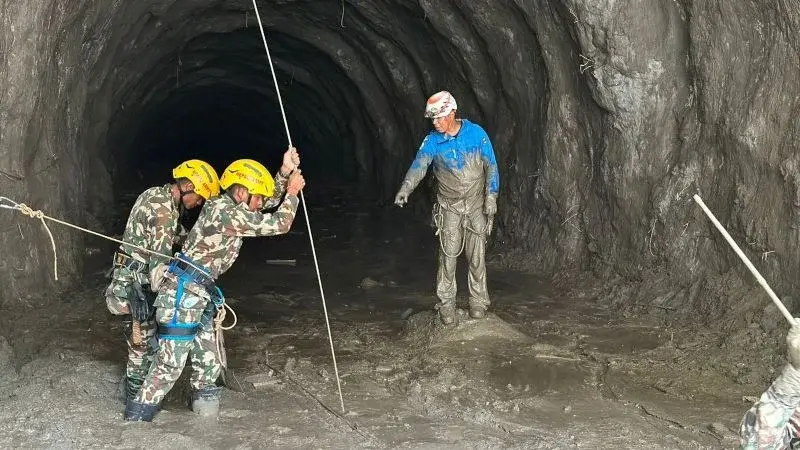
Two workers were rescued alive from the Trishuli 3A hydropower tunnel in Nepal nine days after flash floods buried the site. The men, Sanjay Shah and Kabir Maharjan, were pulled from a depth of 170 meters and flown to Kathmandu. While over 1,200 people have died and 5,000 remain missing, rescue efforts continue in tunnels where air pockets may have allowed survival.
Key points
- Sanjay Shah and Kabir Maharjan were rescued from the Trishuli 3A tunnel nine days after the flood.
- The men were found 170 meters deep and are in stable condition in Kathmandu.
- Shah stated he remained to help others escape, delaying his own exit.
- Over 1,259 people have died and more than 5,000 are missing in the floods.
- Rescue teams are focusing on tunnels where air pockets may have sustained trapped workers.
Background
The current rescue follows earlier reports from September 2026 regarding the Trishuli 3A tunnel. Previous coverage noted that while two workers were saved, dozens remained missing in the main tunnel. The broader disaster, triggered by a glacier collapse on the Nepal-Tibet border, has devastated hydropower projects along the Bhote Koshi and Trishuli rivers. Recent local incidents, including the arrest of looters targeting flood victims, have highlighted the chaotic aftermath in affected districts.
How outlets are covering it
CNN and The Guardian both confirm the rescue of two men from the Trishuli 3A tunnel nine days after the disaster. The Guardian provides specific details on the rescue depth (170 meters) and quotes Sanjay Shah, who explained he stayed to help others, delaying his own escape. CNN’s source appears to be a technical error page rather than a news article, so its content cannot be synthesized. The Guardian emphasizes the ongoing hope for more rescues, citing communication minister Bikram Timilsina, and notes that over 270 people have been rescued across various projects. Both sources agree on the scale of the disaster, with over 1,200 deaths and 5,000 missing, but only The Guardian offers detailed operational context and survivor accounts.
Why it matters
The rescue highlights the extreme difficulty of recovery efforts in Nepal’s mountainous terrain, where hydropower tunnels are buried under mud and debris. The survival of workers after nine days suggests that air pockets in tunnels may offer a window for rescue, influencing ongoing operations. The disaster has exposed vulnerabilities in infrastructure and emergency response, with families of missing workers gathering in Kathmandu for news. The focus on hydropower projects underscores the economic and human cost of climate-related disasters in the Himalayas.
What to watch
Rescue teams will continue clearing debris from tunnel entrances, particularly at the Trishuli 3A and Rasuwagadhi hydropower plants, where authorities believe trapped workers may still be alive. Officials are monitoring air pockets and listening for voices from within tunnels. Families of the missing are expected to remain at hospitals and electricity offices in Kathmandu, awaiting updates. Long-term recovery will involve assessing damage to hydropower infrastructure and addressing the humanitarian crisis in flood-affected districts.
- Two men rescued from flood-stricken Nepali power plant where scores feared trapped CNN
- Live updates: Rescues underway as two workers pulled alive more than a week after Nepal-China floods CNN
- China-Nepal disaster: 2 more trapped workers rescued from flooded hydropower tunnels South China Morning Post
- How engineers in a WhatsApp group are guiding Nepal's tunnel rescue efforts Reuters
- Nepal-Tibet flash flood: Two workers pulled alive from hydropower tunnel nine days after disaster The Guardian
Want the full story? Read the original reporting
Read on CNN