
Egyptian Officials Unveil 4,400-Year-Old Tomb of Royal Scribe at Saqqara
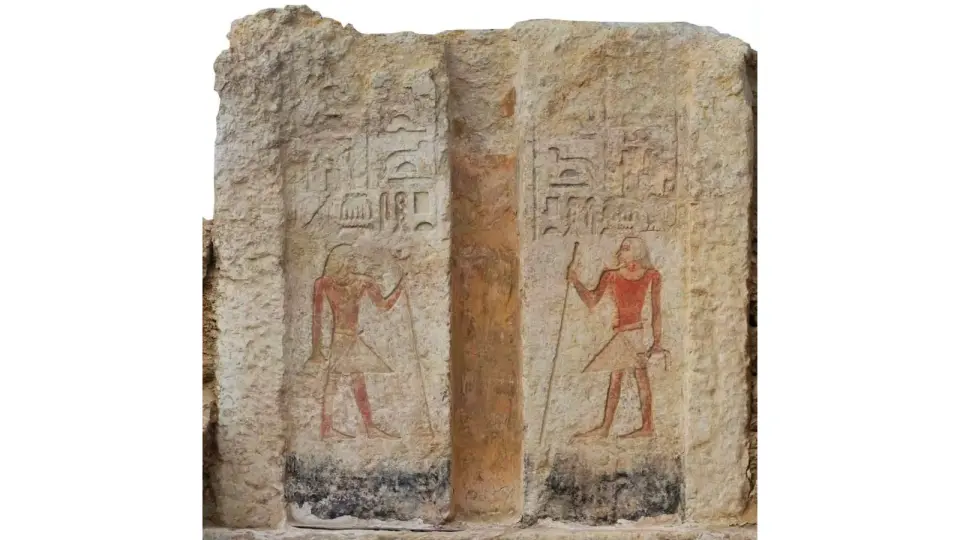
Egyptian authorities announced the discovery of a decorated Old Kingdom tomb at Saqqara belonging to Sekhentio-Ptah, a high-ranking official and royal scribe. The site, located in the Bubasteion necropolis, contains a false door, alabaster funerary tools, and over 100 ushabti figurines. The find, dating to the late Fifth or early Sixth Dynasty, offers new insights into royal administration and burial practices.
Key points
- The tomb of Sekhentio-Ptah was unearthed in Sector A of the Bubasteion necropolis at Saqqara, approximately 20 miles south of Cairo.
- Hieroglyphic inscriptions identify the owner as a 'Keeper of the Secrets of Royal Decrees,' 'Overseer of Royal Documents,' and 'Priest of the goddess Maat.'
- The burial chamber includes a false door, an offering table, a purification basin, and a wooden falcon statue, all in their original positions.
- Archaeologists recovered more than 100 faience ushabti figurines, three sealed stone sarcophagi, and remains of cartonnage from interconnected burial shafts.
- The discovery is part of the first excavation season at the site, which is part of a Ptolemaic and Roman temple complex dedicated to the goddess Bastet.
Background
Saqqara has been a major archaeological site since the 19th century, serving as the necropolis for the ancient capital of Memphis. Recent excavations in 2025 and 2026 have revealed other Old Kingdom tombs, including one belonging to a royal doctor. The current find adds to a growing body of evidence regarding the bureaucratic structure of the Old Kingdom, a period spanning roughly 2649 to 2150 B.C. that is famous for the construction of the Giza pyramids.
How outlets are covering it
Live Science and The Jerusalem Post emphasize the bureaucratic nature of Sekhentio-Ptah's title, noting that 'Keeper of the Secrets' likely referred to access to confidential royal documents rather than mystical powers. Smithsonian Magazine highlights the broader context of Saqqara as a multi-era burial site, noting that the new finds help researchers understand how the necropolis was used from the Old Kingdom through the Roman era. La Brújula Verde focuses on a separate but concurrent discovery at Saqqara: the tomb of a judge named Iunmin, whose paint remains intact after 4,400 years, illustrating the site's continued potential for new finds even in heavily excavated areas.
Why it matters
The discovery provides concrete evidence of the administrative hierarchy in Old Kingdom Egypt, clarifying the roles of royal scribes and chamberlains. The preservation of funerary tools and ushabti figurines offers valuable data on burial rituals and beliefs about the afterlife during the late Fifth and early Sixth Dynasties.
What to watch
Researchers will continue to analyze the inscriptions and artifacts to further understand the administrative structure of the Old Kingdom. Conservation efforts are underway to protect the alabaster tools and painted surfaces. The Egyptian Ministry of Tourism and Antiquities is also working on infrastructure improvements at Saqqara to accommodate increased tourism.
- Ancient Egyptian tomb holding the king's 'keeper of secrets' unearthed at Saqqara Live Science
- Archaeologists Discover a 4,000-Year-Old Tomb With a False Door at Egypt's Ancient Saqqara Necropolis Smithsonian Magazine
- Remains of tomb belonging to ancient Egyptian priest unearthed at necropolis The Jerusalem Post
- A Judge Who Worked 150 Years After the Great Pyramid Just Had His Tomb Opened — and the Paint Is Still Wet-Looking La Brújula Verde
- Spanish-Egyptian mission unearths late Fifth Dynasty tomb of a judge in Saqqara Dailynewsegypt
Want the full story? Read the original reporting
Read on Live Science