
Secret 2005 Vote: How Unproven Carbon Capture Became Climate Policy’s Cornerstone
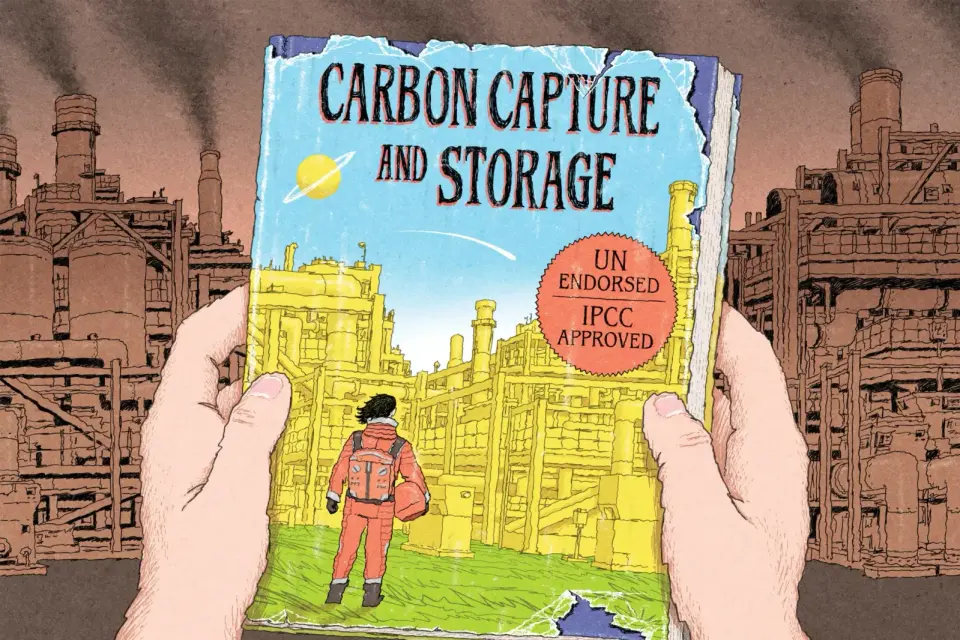
A 2005 U.N. report legitimized carbon capture and storage (CCS) despite minimal evidence, using a secret expert survey to claim 99% retention rates. This decision skewed global climate models and policy for two decades, allowing fossil fuel industries to maintain operations while CCS projects consistently underperformed. Today, the technology remains central to net-zero pledges despite a stark gap between theoretical promises and operational reality.
Key points
- In 2005, IPCC scientists in Oviedo, Spain, used an off-record 'expert elicitation' survey to assert that CCS could retain 99% of CO2 for 1,000 years, despite lacking empirical data.
- The resulting report legitimized CCS as a viable climate solution, influencing climate models, net-zero pledges, and billions in public subsidies for 'clean coal' and fossil fuel retention.
- Major CCS projects like In Salah, Snøhvit, and Gorgon have suffered technical failures, cost overruns, and significant leakage, contradicting the report’s optimistic projections.
- Fossil fuel companies, including ExxonMobil and BP, funded CCS research to preserve their business models, while scientists like Sally Benson championed the technology despite known setbacks.
- Scaling CCS to meet U.N. targets would require 2,000 new sites, 68,000 miles of pipelines, and tens of trillions of dollars, a feat deemed nearly impossible by experts.
Background
This investigation follows a series of reports on fossil fuel influence on climate science. Recent U.N. reports have declared the 1.5°C warming target lost, emphasizing the need for carbon removal technologies. Meanwhile, political shifts in the U.S. and EU have complicated climate policy, with some governments rolling back emissions rules while others push for carbon taxes. The reliance on CCS, despite its operational failures, reflects a broader trend of prioritizing technological fixes over immediate fossil fuel phase-outs.
Why it matters
The 2005 IPCC report’s endorsement of CCS, based on unproven assumptions, has shaped global climate policy for two decades. By legitimizing a technology that has consistently underperformed, the report allowed fossil fuel industries to delay necessary transitions to renewable energy. As the U.N. now declares 1.5°C warming inevitable, the reliance on CCS for carbon removal raises critical questions about the feasibility of meeting climate goals and the influence of industry interests on scientific consensus.
What to watch
California has launched one of the world’s largest CCS projects, aiming to bury 100 million tons of CO2 annually by 2045, though early operations have met only 7% of capacity. The U.S. government has expanded CCS subsidies, and over 100 storage site applications are pending. Experts warn that scaling CCS to meet climate targets is likely impossible, but policymakers continue to rely on it as a key tool for carbon removal.
Want the full story? Read the original reporting
Read on ProPublica