
AI Power Demand and Energy Crisis Reshape 2026 Climate Week Agenda
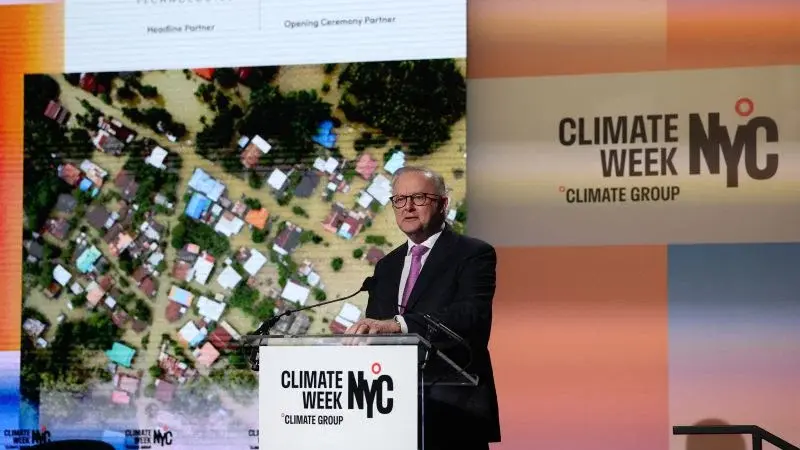
This year's Climate Week in New York shifted focus from traditional emissions targets to the urgent challenge of powering AI data centers and navigating energy security crises. The Iran war and soaring fossil fuel costs accelerated global adoption of renewables, while AI infrastructure demands sparked debates over grid resilience and fossil fuel reliance.
Key points
- Climate Week NYC (Sept 21-28) prioritized electricity grid expansion and AI data center power needs over traditional climate mitigation discussions.
- The Iran war and Strait of Hormuz blockade drove global energy costs up, accelerating renewable adoption in Europe, Asia, and Africa.
- AI data center expansion faces community backlash over water and power consumption, prompting calls for 'flexible' data centers and carbon capture.
- Amazon’s Kara Hurst acknowledged challenges to 2040 net-zero goals due to AI infrastructure but emphasized continued investment in 700 renewable projects.
- US President Trump dismissed climate warnings as 'doomsday' rhetoric, contrasting with global leaders advocating for energy independence through clean power.
Background
Recent developments, including Trump’s 'AI Force' initiative and US-China AI model distillation disputes, have intensified the race for AI infrastructure. Simultaneously, initiatives like Britain’s Operation Blue Skies highlight AI’s role in mitigating climate impacts, setting the stage for this year’s focus on balancing AI growth with energy sustainability.
How outlets are covering it
CNN and the Financial Times agree that AI power demand has overshadowed traditional climate discussions, with CNN noting a 'resigned acceptance' of missed 1.5°C targets. The Financial Times emphasizes the Iran war’s role in accelerating renewable adoption, while CNN highlights community backlash against data centers. Nasdaq focuses on technological solutions like nuclear and fusion, whereas GeekWire highlights corporate partnerships and optimism from Amazon and Earthshot Prize leaders. Trump’s dismissal of climate science contrasts sharply with UK and European leaders’ calls for energy independence.
Why it matters
The shift in Climate Week priorities reflects a broader global pivot from long-term climate goals to immediate energy security and AI infrastructure needs. This transition impacts policy, investment, and public discourse, with potential consequences for fossil fuel reliance, renewable adoption, and community resistance to data center expansion.
What to watch
Expect continued debates over AI data center power sources, including nuclear, fusion, and carbon capture. Global energy policies will likely accelerate renewable adoption in response to fossil fuel price volatility, while US-EU divergence on climate and AI may shape future international agreements.
- How AI took over a key climate event CNN
- Climate Week NYC: How Five Companies are Advancing the Energy Transition Nasdaq
- From AI data centers to NASA-beating wildfire tech: 5 lessons from Climate Week NYC GeekWire
- The AI boom took over Climate Week and not everyone is happy about it TechCrunch
- Energy costs and AI power demand reshape climate talks in New York Financial Times
Want the full story? Read the original reporting
Read on CNN