
Kyrgyzstan’s Hidden Bronze Age Gallery: A 4,000-Year-Old Archive in the Mountains
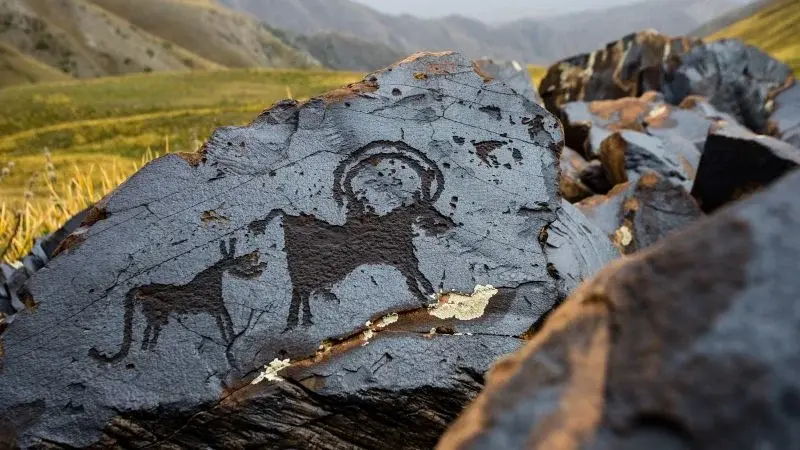
Saimaluu Tash in Kyrgyzstan is a massive, high-altitude petroglyph site featuring nearly 90,000 carvings on 10,000 boulders. Dating back 4,000 years, it preserves Bronze Age and later nomadic art. Access is limited to a six-week summer window due to snow bridges, and the site remains largely pristine due to its remoteness.
Key points
- The site contains approximately 90,000 petroglyphs carved into volcanic basalt boulders.
- Carvings date from the Bronze Age (approx. 3000 BC) through the early Turkic period (approx. 900 CE).
- The site was rediscovered in 1902 by Russian cartographer Nikolai Khludov and studied from the 1940s.
- Access is restricted to a six-week window (July-September) due to the necessity of crossing a melting snow bridge.
- The location serves as a preserved center for Tengrist religious rituals, predating Islam in the region.
Background
Recent archaeological interest in Bronze Age sites, such as the Akrotiri excavation in Santorini and metal-detector finds in England, highlights the value of preserving ancient artifacts. Saimaluu Tash offers a unique, large-scale outdoor example of this era in Central Asia, distinct from indoor museum collections.
Why it matters
Saimaluu Tash provides a rare, unspoiled record of pre-Islamic spiritual and daily life in Central Asia. Its preservation offers critical insights into nomadic cultures, while its vulnerability to modern tourism and infrastructure development underscores the tension between accessibility and heritage conservation.
What to watch
Tour operators in Bishkek and Osh are organizing trips to the site, and infrastructure improvements in Kyrgyzstan may increase visitor numbers. Conservation efforts will need to balance growing tourism with the protection of the ancient carvings from vandalism and environmental changes.
Want the full story? Read the original reporting
Read on CNN