Tag

Bronze Age

All articles tagged with #bronze age

Gigantic Underwater Cairn Stuns Archaeologists in the Sea of Galilee
science19 days ago

Gigantic Underwater Cairn Stuns Archaeologists in the Sea of Galilee

Divers found a 60,000-ton, cone-shaped cairn of unworked basalt stones beneath the Sea of Galilee, about 10 m tall and 70 m in diameter. First detected in 2003, the structure appears human-made with no signs of cutting or walls, suggesting a ceremonial site or ramp. Its age is uncertain, potentially dating to the Bronze Age (third millennium B.C.), and no underwater excavation has taken place due to cost and logistics, leaving researchers to debate its function and origin.

Barn Renovation in Czech Village Reveals Bronze Age Spearhead Mold
science28 days ago

Barn Renovation in Czech Village Reveals Bronze Age Spearhead Mold

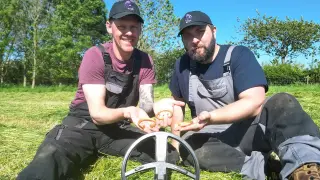
A man in Morkuvky, Czech Republic, during a barn renovation, found a nine-inch stone mold made of volcanic rhyolite tuff used to cast Bronze Age bronze spearheads over 3,000 years ago. Archaeologists from the Moravian Museum confirmed it as a matrix for hollow-based spearheads, highlighting advanced Bronze Age metallurgy and suggesting long-distance trade in raw materials (origin likely from northern Hungary or southeastern Slovakia). The artifact, linked to the Urnfield culture, appears to have been redeposited in the village long after its creation.

Backyard find reveals Bronze Age spearhead mold and ancient trade links
archaeology29 days ago

Backyard find reveals Bronze Age spearhead mold and ancient trade links

A Czech homeowner unearthed a nearly 9-inch stone mold used for casting Bronze Age spearheads, dating to about 1350 B.C. The rhyolite tuff mold, likely imported from northern Hungary, shows signs of repeated use and serial production, suggesting broader trade and production networks in Central Europe. The artifact was found in 2007, studied in detail by researchers and published in 2025, highlighting how such molds facilitated bronze casting and offering a glimpse into Urnfield-era metallurgy and exchange.

Meteoric Iron Rewrites Iberian Bronze Age Metalwork
science2 months ago

Meteoric Iron Rewrites Iberian Bronze Age Metalwork

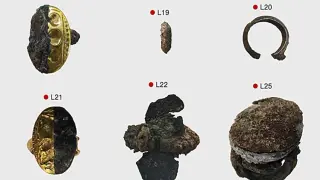
Testing two ferrous-looking items from the Villena Treasure—the hollow iron hemisphere and a bracelet—found evidence they are made of meteoritic iron, indicated by nickel content measured despite heavy corrosion. Dating places them around 1400–1200 BCE, earlier than the Iberian Iron Age’s terrestrial iron production (~850 BCE), suggesting advanced metallurgical skills in Iberia over 3,000 years ago. While the results are not conclusive due to corrosion, non-invasive methods could further confirm the meteoritic origin and timing.

3,800-Year-Old Nebra Disc: Europe’s Earliest Celestial Map
archaeology2 months ago

3,800-Year-Old Nebra Disc: Europe’s Earliest Celestial Map

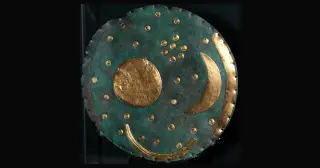
A 3,800-year-old bronze Nebra Sky Disc unearthed in Germany is thought to be the oldest known depiction of the cosmos, showing a crescent moon, a sun or full moon, and 32 stars including a Pleiades cluster. Likely used as a celestial map and ritual calendar to track solstices, the artifact was created in multiple phases—initially with moons and stars, later with gold arcs and a bottom arc, and finally with mounting holes. Geochemical analysis confirms local origin, and its alignment with nearby landmarks suggests an astronomical function and status as a sacred tool; it is now housed in Halle’s State Museum of Prehistory.

Bronze Age Nebra Disc May Depict the Pleiades, An Ancient Sky Atlas
archaeology2 months ago

Bronze Age Nebra Disc May Depict the Pleiades, An Ancient Sky Atlas

The Nebra Sky Disc, a Bronze Age bronze and gold disk found in Nebra, Germany and dated to around 1600–1800 BCE, is regarded as the world’s oldest depiction of astronomical phenomena. Its gold inlays illustrate celestial features, including a cluster some interpret as the Pleiades, and its arcs may mark horizons and solstices; when aligned with the hill where it was buried, it likely functioned as an ancient sky calendar, though questions about its exact origin persist.

Ireland's Largest Bronze Age Hillfort Settlement Redefines Ancient Society
archaeology3 months ago

Ireland's Largest Bronze Age Hillfort Settlement Redefines Ancient Society

Scientists have uncovered Ireland’s largest prehistoric hillfort settlement at Brusselstown Ring, revealing over 600 dwellings and challenging previous notions of Bronze Age social organization, suggesting a large, egalitarian community with sophisticated planning, which was gradually abandoned in the third century BCE.

Ancient DNA Unveils Unique Bronze Age Community and Incestuous Relationships in Calabria
science3 months ago

Ancient DNA Unveils Unique Bronze Age Community and Incestuous Relationships in Calabria

Archaeologists in Italy discovered the oldest known evidence of father-daughter incest from 3,700-year-old bones at Grotta della Monaca, revealing a rare case of first-degree inbreeding in ancient times, with genetic analysis showing the young male was the son of a buried adult male and his own daughter, though the reasons for this behavior remain uncertain.