
Bayeux Tapestry’s London Debut: A Diplomatic Triumph and Conservation Feat
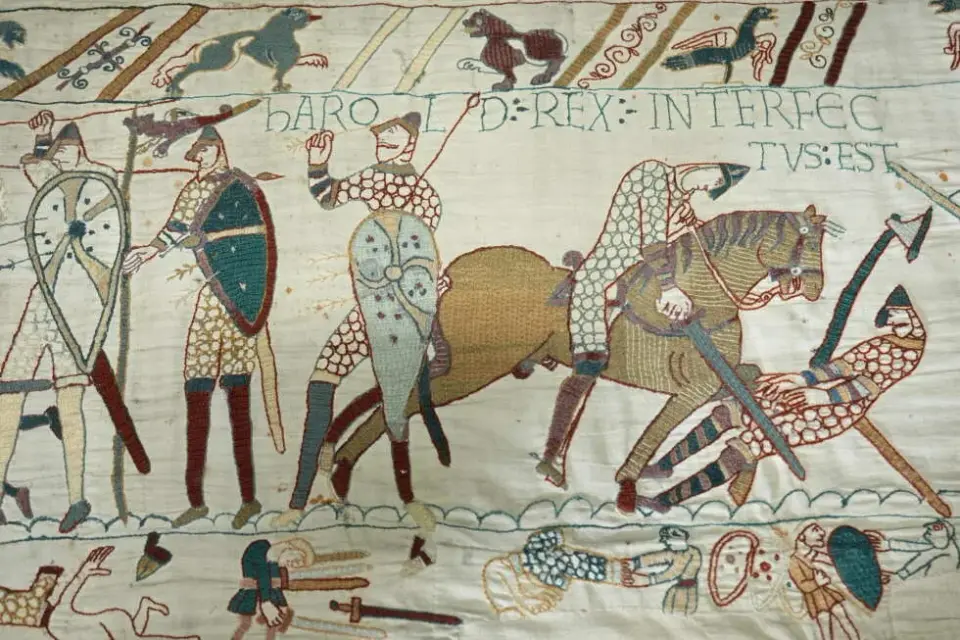
The Bayeux Tapestry, an 11th-century embroidery depicting the Norman conquest of England, is now on display at the British Museum. Insured for $1.1 billion, it is the most valuable traveling artwork in history. The exhibition, a symbol of Franco-British friendship, required complex engineering to transport the fragile 70-meter piece from France. While it offers unique insights into 1066, scholars debate its missing sections and 19th-century restorations.
Key points
- The tapestry, likely stitched in England in the 1070s, is displayed flat in a climate-controlled case at the British Museum, open to the public since September 10, 2026.
- Insured for 960 million euros ($1.1 billion), it is the highest-valued traveling artwork, comparable to the 1963 loan of the Mona Lisa.
- Transportation involved a custom 'folding screen' (paravent) to move the fragile textile without direct handling, requiring seven hours of precise coordination.
- The loan, finalized after years of diplomatic effort, was confirmed by French President Emmanuel Macron and UK King Charles III, symbolizing renewed Anglo-French ties.
- Scholars debate whether the arrow hitting Harold Godwinson was a 19th-century restoration addition, as the tapestry’s ending is missing.
Background
The tapestry has been in Bayeux, France, for nearly a millennium. Previous British attempts to borrow it failed, but Macron revived the idea in 2018. The loan was delayed by COVID-19 and Brexit tensions but confirmed during a state visit last year. It is the first time the artifact has been in England since the 11th century.
How outlets are covering it
AP News emphasizes the tapestry’s historical value and the diplomatic significance of the loan, noting the insurance cost and the careful transport. The Economist highlights the cultural mystery, such as the missing ending and the debate over the arrow, while comparing its value to the Mona Lisa. The New Yorker focuses on the engineering challenges, detailing the 'paravent' device and vibration controls used to protect the fragile textile. The Guardian offers a lighter, cultural commentary, noting the tapestry’s 'rock-star' status and public interest.
Why it matters
The exhibition underscores the power of cultural diplomacy in strengthening international relations. It also highlights the fragility of historical artifacts and the innovative methods required to preserve and display them. The tapestry’s visibility in London may reshape public understanding of the Norman conquest and medieval history.
What to watch
The tapestry will remain at the British Museum until July 2027. Tickets for 2027 are expected to go on sale in October. In exchange, British artifacts, including medieval chess pieces, will travel to France. The tapestry will return to Bayeux after the exhibition, with plans to redesign its display to prevent distortion.
- Tale of conquest and symbol of friendship, the Bayeux Tapestry is a hot ticket at the British Museum AP News
- The many mysteries and lessons of the Bayeux tapestry The Economist
- Top marks for the Bayeux tapestry | Brief letters The Guardian
- Decoding Britain’s Bayeux Tapestry Diplomacy Bloomberg.com
- The Bayeux Tapestry’s Long Journey Home newyorker.com
Want the full story? Read the original reporting
Read on AP News