
Recycled Parchment Reveals Medieval Guernsey’s Hidden Literary Culture
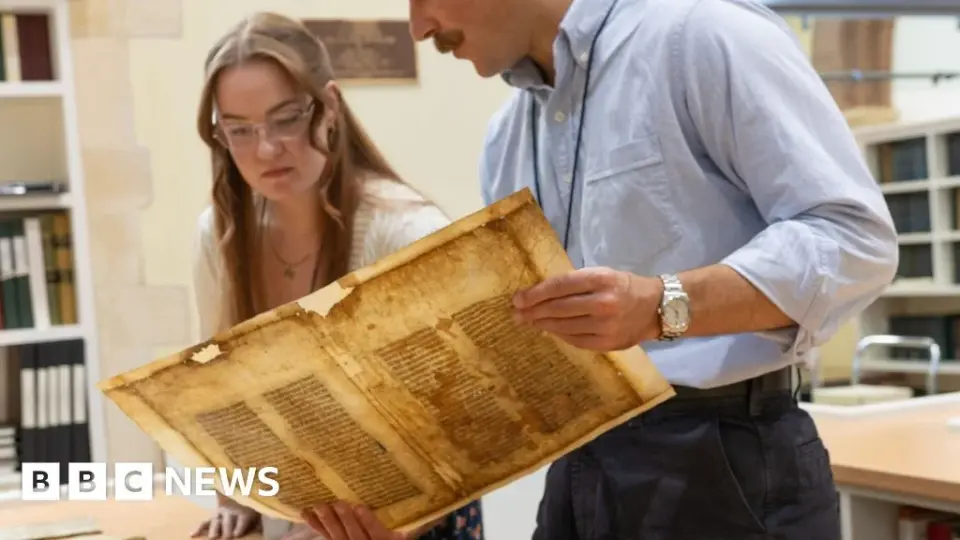
Seventeen medieval manuscript fragments dating from the 12th to 15th centuries have been identified in Guernsey archives, revealing the island’s previously unknown literary culture. The texts, repurposed as book covers, show that residents read in French and Latin, with a notable rare copy of a 1395 play.
Key points
- Seventeen fragments were found in the Island Archives and the Greffier’s strongroom, having been reused as covers for administrative records in the 16th and 17th centuries.
- The discovery, led by archival assistant Callum Tostevin-Hall and scholars from Oxford and Kent, provides the first substantial evidence of medieval book ownership and reading habits on the island.
- Most fragments are in Latin, but six are in French, indicating a preference for French literature during the late medieval period, even as its use declined in England.
- A particularly rare fragment from the secular play 'L’Estoire de Griseldis' (c. 1395) suggests the text circulated beyond French royal circles.
- Experts believe further fragments may exist in Guernsey collections, prompting a planned academic study day in September.
Background
This discovery adds to recent scholarly efforts to recover lost medieval texts, such as the 2026 study estimating that 95% of medieval manuscripts have vanished. It also follows the 2026 authentication of new Augustine sermons, highlighting ongoing interest in recovering and reinterpreting medieval literary and religious materials.
How outlets are covering it
All four sources agree on the core facts: 17 fragments, their reuse as bindings, and the involvement of Tostevin-Hall, Atkin, and Rundle. The BBC and Guernsey Press emphasize the 'hidden in plain sight' aspect and the practical recycling of parchment. The Guardian and UA.NEWS focus more on the linguistic shift, noting that French remained a significant literary language in Guernsey even as it declined in England. The Guardian specifically highlights the high proportion of non-religious texts compared to typical English collections, while the BBC notes the 'striking early examples of recycling' comment from archivist Vikki Hart. No source disputes the findings; differences lie only in emphasis—BBC on the surprise of the discovery, Guardian on the linguistic and cultural implications, and Guernsey Press on the rarity of the Griseldis fragment.
Why it matters
The find fills a major gap in the history of the Channel Islands, proving that medieval Guernsey had an active literary culture. It also offers a rare glimpse into the circulation of texts like 'L’Estoire de Griseldis' outside elite French circles, and demonstrates how accidental preservation through reuse can safeguard historical knowledge.
What to watch
The Island Archives will host an academic study day on September 10, featuring scholars from the UK and France. Researchers expect to identify more fragments in Guernsey collections, potentially expanding the understanding of medieval reading practices in the region.
Want the full story? Read the original reporting
Read on BBC