
Ukraine’s Sting S Interceptor Confirmed in Combat Trials Against Fast Geran-5 Drones
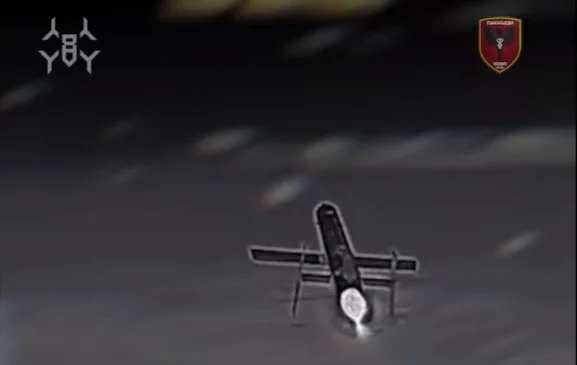
Ukraine’s Wild Hornets company confirmed its new Sting S interceptor drone successfully shot down a Russian Geran-5 jet-powered drone during combat trials. The 1020th Anti-Aircraft Missile Regiment released footage of the interception, marking the first public confirmation of the system’s effectiveness against high-speed targets. While the Sting S is currently in testing, Wild Hornets plans to begin mass production after trials conclude. This development is part of a broader Ukrainian effort to counter Russia’s increasing use of jet-powered drones, which have reduced interception rates compared to older propeller models.
Key points
- Wild Hornets’ Sting S interceptor, a 3D-printed quadcopter, successfully downed a Russian Geran-5 jet-powered drone during combat trials, as confirmed by the 1020th Anti-Aircraft Missile Regiment.
- The Sting S has an operational range of up to 37 kilometers and a top speed of 280 km/h, with earlier variants achieving 80-90% hit accuracy.
- Wild Hornets plans to begin mass production of the Sting S after completing combat trials, with remote control via 'Hornet Vision Ctrl' technology allowing operators to engage targets from distant locations.
- Russia launched 2,800 jet-powered drones in August 2026, up from 350 in June, with interception rates falling to 60% for jet models compared to 90% for propeller drones.
- Ukraine is testing multiple interceptor systems, including the SBU’s delta-wing interceptor and the Alexa Spatium, to address the growing threat of high-speed Russian drones.
Background
Ukraine has been developing interceptor drones to counter Russia’s jet-powered Geran series, which evolved from Iran’s Shahed-136 design. Earlier models like the Geran-4 used delta-wing designs, while the Geran-5 resembles a cruise missile with a Chinese TELEFLY TF-TJ2000A jet engine, reaching speeds of 450-600 km/h. Ukraine’s interception rates for jet-powered drones have dropped to 60%, prompting Kyiv to prioritize faster, cheaper interceptors. The DELTA combat management system and Brave1’s automated interception technologies are being integrated to improve response times in mass attacks.
How outlets are covering it
Kyiv Post and Business Insider both highlight Wild Hornets’ Sting S as a key development, with Kyiv Post emphasizing the 1020th Regiment’s video evidence and Business Insider noting the remote control capability via 'Hornet Vision Ctrl.' Air & Space Forces Magazine focuses on the broader challenge of air defense, noting that F-16 gun kills and interceptor drones are part of a larger effort to counter jet-powered threats. Ukrinform provides a systemic view, arguing that speed alone is insufficient and that automation, such as the DELTA system and MaXon Systems’ 95% automated interception technology, is critical to managing mass attacks. All sources agree that Russia’s increased use of jet-powered drones is a significant threat, but they differ in emphasis: Kyiv Post and Business Insider focus on specific systems, while Ukrinform stresses the need for integrated, automated defense networks.
Why it matters
The successful combat trial of the Sting S interceptor marks a critical step in Ukraine’s ability to counter Russia’s high-speed drones, which have reduced interception rates and increased the threat to Ukrainian cities. Mass production of the Sting S and other interceptors could improve Ukraine’s air defense capabilities, but the challenge remains in scaling production and integrating automated systems to handle mass attacks. The development of faster, cheaper interceptors is essential to maintaining Ukraine’s defensive posture against Russia’s evolving drone arsenal.
What to watch
Wild Hornets plans to begin mass production of the Sting S after completing combat trials, with deliveries to combat units expected to follow. Ukraine is also testing other interceptor systems, including the SBU’s delta-wing interceptor and the Alexa Spatium, with around 10 manufacturers developing their own designs. The integration of automated systems like DELTA and MaXon Systems’ technology will be crucial for managing mass attacks, and Ukraine will need to scale production to thousands of units to effectively counter Russia’s increasing use of jet-powered drones.
- Ukraine’s STING S Interceptor Takes Down Russian Geran-5 as Drone Threat Escalates Kyiv Post
- Jet-powered Russian drones strain Ukraine's air defences Reuters
- Ukraine's growing fleet of new high-speed interceptors is downing Russia's fastest attack drones Business Insider
- What F-16 Gun Kills Tell Us About the Future of Ukraine’s Air Force Air & Space Forces Magazine
- Intercepting the “Banderol” Ukrinform
Want the full story? Read the original reporting
Read on Kyiv Post