
Climate Action Tracker Warns 1.5°C Limit Is Irrecoverably Overshot
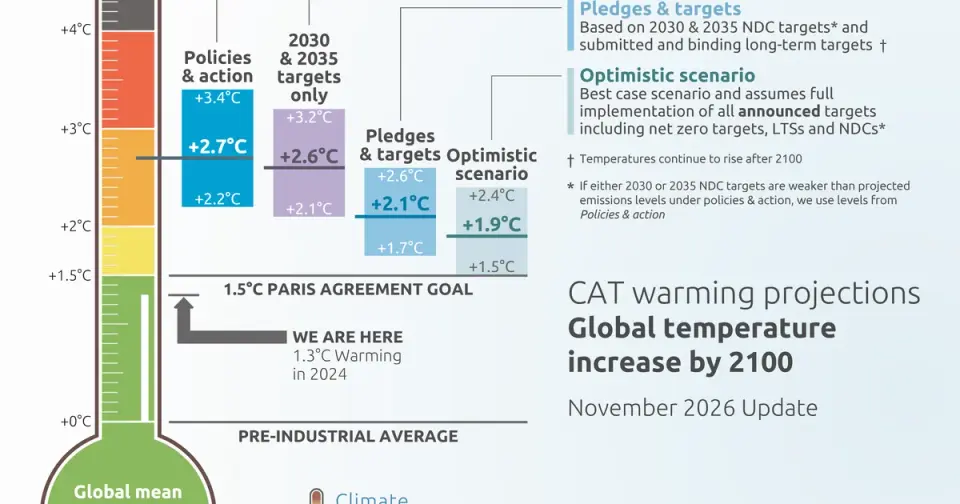
The Climate Action Tracker reports that global temperature projections indicate an irrecoverable overshoot of the 1.5°C limit, with current policies leading to 2.7°C warming by 2100. Despite record renewable deployment and clean electricity meeting new demand, collective climate action has stalled for five years as fossil fuel investment continues to outpace reductions. Even optimistic scenarios assuming full implementation of all pledges result in 1.9°C warming, necessitating rapid emissions cuts of 4% per year through 2030 to limit the magnitude of the overshoot.
Key points
- Current policies are projected to cause 2.7°C of warming by 2100, up from 2.6°C last year, while meeting 2030 and 2035 targets still results in 2.6°C warming.
- Even under the most optimistic scenario where all national pledges and net-zero commitments are fully implemented, warming is projected to reach 1.9°C by 2100, permanently exceeding the 1.5°C threshold.
- Collective climate action has effectively stalled for five consecutive years, with positive developments in renewables and electric vehicles being offset by continued fossil fuel infrastructure investment and energy demand.
- The report identifies five key levers to limit overshoot: transitioning away from fossil fuels, cutting methane emissions, accelerating renewables, using carbon dioxide removal, and ending deforestation.
- To bring warming back below 1.5°C by 2100, emissions reductions must accelerate to 4% per year through 2030, 7% per year in the early 2030s, and 9% per year between 2035 and 2050.
Background
This update follows the 2015 Paris Agreement, which set the 1.5°C limit as a central ambition. Recent archive coverage of unrelated events in Sudan and industrial accidents in the US does not provide relevant background for this climate policy analysis, but the current report marks a significant shift from previous years where 1.5°C was considered potentially attainable with rapid action.
How outlets are covering it
The Climate Action Tracker (CAT) emphasizes that while 1.5°C is now an 'irrecoverable overshoot,' the magnitude and duration of this overshoot remain within human control if governments accelerate emissions reductions. The Guardian highlights the 'crunch moment' for governments, noting that even optimistic scenarios fail to meet the 1.5°C target, and quotes UN Secretary-General António Guterres urging a phase-out of fossil fuels. The New York Times frames the situation as the death of the 'Keep 1.5 Alive' slogan, stating the target is effectively dead. Inside Climate News points to the EU’s Copernicus service finding that global warming has accelerated, with the 2.7°F threshold now expected to be crossed by 2029 rather than 2045. Greta Thunberg, attending COP31 in Antalya, criticized governments for being 'completely detached from reality,' while CAT lead author Sarah Heck noted that countries like the US, Canada, and New Zealand are slowing climate action. Niklas Höhne of The New Climate Institute criticized the lack of progress, comparing new oil and gas projects to 'turning up the stove' while food is burning, and noted that COP31 co-hosts Turkey and Australia opposed including 'clean' in electrification targets due to fossil fuel interests.
Why it matters
The finding that 1.5°C is now an irrecoverable overshoot signals a fundamental shift in climate policy goals, moving from preventing the threshold breach to limiting the extent and duration of the overshoot. This has significant implications for international negotiations at COP31, where governments must decide whether to prioritize fossil fuel interests or accelerate the transition to clean energy. The report underscores that every year of delay makes returning warming to below 1.5°C more difficult, increasing the risk of 'runaway climate change' and intolerable impacts such as storms, droughts, and heatwaves. The data also highlights the disconnect between technological progress in renewables and the continued rise in global emissions, indicating that policy and investment decisions are not yet aligned with the necessary pace of decarbonization.
What to watch
Governments are expected to negotiate stronger 2035 targets at COP31 in Antalya, Turkey, with a focus on the five levers identified by the CAT to limit overshoot. The next critical step is the implementation of these targets, with the report stressing that emissions reductions must accelerate significantly in the 2030s. The EU’s Copernicus service will continue to monitor global temperature trends, with the 2.7°F threshold expected to be crossed by 2029. Activists and scientists will likely press for more aggressive fossil fuel phase-out policies, while countries with significant fossil fuel interests may resist such measures. The outcome of these negotiations will determine whether the world can limit the magnitude of the overshoot and potentially bring temperatures back below 1.5°C by 2100.
- Without rapid action, the world is heading to irrecoverable overshoot Climate Action Tracker
- World heading for ‘irrevocable overshoot’ of global temperature thresholds, analysis warns The Guardian
- A Key Paris Agreement Goal Is Dead. What Now? The New York Times
- Global Warming Remains Unchecked, Experts Warn at UN’s COP31 Climate Summit Inside Climate News
- All IPCC AR6 regions are close to their 1.5 °C- and 2 °C-equivalent warming limits Nature
Want the full story? Read the original reporting
Read on Climate Action Tracker