
Delhi Air Quality Hits Hazardous 1,521 on Diwali Night Despite Green Firecracker Rules
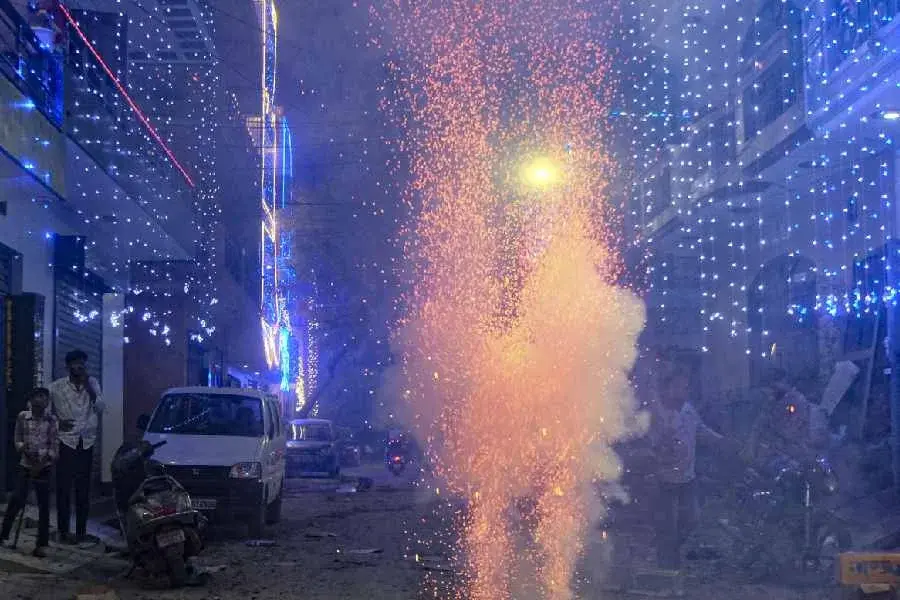
Delhi’s air quality deteriorated to hazardous levels on Diwali night, with one monitoring station recording an Air Quality Index (AQI) of 1,521. Despite restrictions limiting firecracker use to certified 'green' varieties during specific hours, widespread bursting in areas like Burari and Pitampura contributed to severe pollution. The city’s average AQI settled at 376, with experts attributing the spike to firecracker emissions, vehicular traffic, and unfavorable meteorological conditions that hindered pollutant dispersion.
Key points
- One monitoring station in Delhi recorded an AQI of 1,521, entering the 'hazardous' category before midnight on Diwali night.
- Twenty other stations recorded 'severe' air quality, while 33 stations were in the 'very poor' category at 10 pm.
- Sonia Vihar recorded the highest AQI at 463, followed by Jahangirpuri at 450, among the stations in the 'severe' category.
- The Delhi government had restricted firecracker use to green varieties between 6-7 am and 8-10 pm on November 7 and 8, but violations were reported in multiple neighborhoods.
- The Air Quality Early Warning System forecasts severe conditions to persist from November 9 due to low wind speeds and ongoing stubble burning in neighboring states.
Background
Delhi’s air quality had already been deteriorating prior to Diwali, with the city recording an AQI of 391 on November 6 during Dhanteras. The Supreme Court had previously mandated the use of certified green firecrackers to mitigate pollution during the festival. This event follows a broader pattern of severe air quality issues in northern India during the Diwali period, where festive celebrations coincide with peak stubble-burning seasons and unfavorable meteorological conditions that trap pollutants near the ground.
Why it matters
The spike to hazardous levels underscores the failure of regulatory measures to curb firecracker use despite Supreme Court directives. The prolonged severe air quality forecast poses significant health risks to residents, particularly those with respiratory conditions, and highlights the complex interplay between local emissions, traffic, and regional agricultural practices in determining urban air quality.
What to watch
The Air Quality Early Warning System predicts that Delhi will remain in the 'severe' category for several days following November 9. Authorities are expected to monitor compliance with firecracker restrictions closely, while public health advisories may be issued to mitigate the impact of prolonged exposure to high particulate matter levels.
- Delhi chokes on Diwali night as pollution hits hazardous levels, one station records AQI of 1,521 Telegraph India
- Delhi air quality deteriorates as revellers mark Diwali with illegal fireworks Reuters
- Thick smog shrouds New Delhi after Diwali firecrackers add to seasonal pollution The Hill
- India’s Capital Chokes on Diwali Smog as Data Blip Masks Crisis Bloomberg.com
- India: Delhi chokes on most polluted Diwali eve in 10 years DW.com
Want the full story? Read the original reporting
Read on Telegraph India