
Global conservation coverage likely near 27%, but ecological gaps persist
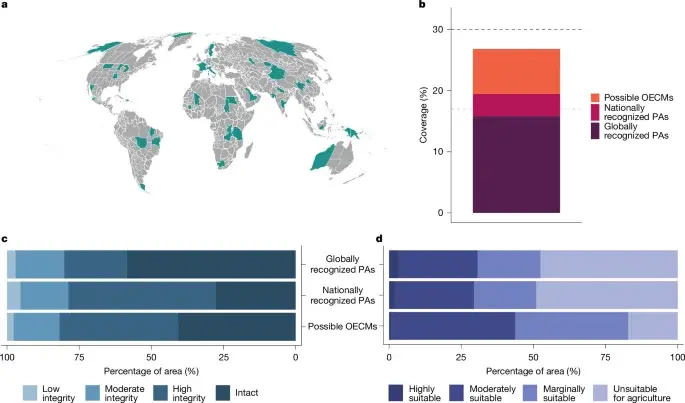
New research indicates that approximately 26.81% of Earth’s land is already under some form of conservation, significantly higher than the 18.5% officially reported. This finding suggests the world is closer to the 30% target set by the Kunming-Montreal Global Biodiversity Framework. However, the additional coverage does not resolve critical gaps in ecological representativeness, as many under-protected ecosystems remain vulnerable to biodiversity loss.
Key points
- A study published in Nature estimates that 26.81% of the terrestrial realm is conserved, including nationally recognized protected areas and potential Other Effective Area-based Conservation Measures (OECMs).
- The official global figure of 18.5% undercounts coverage because it primarily tracks state-governed protected areas, excluding many community- and Indigenous-governed lands.
- Despite higher coverage, ecological representativeness remains low; 51 out of 173 examined ecoregions have less than 10% protection, even when including unrecognized conservation areas.
- The Kunming-Montreal Global Biodiversity Framework Target 3 requires not just 30% coverage by 2030, but also effective management, equitable governance, and ecological representativeness.
- Critics argue that focusing solely on percentage coverage may dilute resources and fail to address biodiversity loss, especially in economically valuable or under-protected ecosystems.
Background
This development follows the 2022 adoption of the Kunming-Montreal Global Biodiversity Framework, which committed 195 nations to protect 30% of land and sea by 2030. Recent discoveries, such as the new wild cat species Leopardus tilcayo in Bolivia, underscore the urgency of conserving under-protected habitats. The current findings arrive ahead of the UN Biodiversity Conference (COP17) in Yerevan, Armenia, where progress on these targets will be reviewed.
How outlets are covering it
Nature and Florida International University emphasize that while coverage is higher than thought, it does not equate to effective protection, as many ecosystems remain underrepresented. Greenpeace highlights the need for community-led conservation and Indigenous rights, arguing that 30x30 must include equitable governance and direct financing. Mongabay and WWF stress that designating protected areas is insufficient without addressing threats like mining and oil extraction, which overlap with 62 million hectares of protected land in tropical regions. WWF’s Nadège Nzoyem notes that while some areas show recovery, funding gaps and weak enforcement remain critical barriers to meeting conservation goals.
Why it matters
Accurate assessment of conservation coverage is vital for meeting the 2030 biodiversity targets. If the world is closer to 30% coverage than believed, resources can be redirected to improve management effectiveness and fill ecological gaps. However, without addressing under-protected ecosystems and ensuring equitable governance, biodiversity loss may continue despite higher coverage figures. This also impacts Indigenous and local communities, whose lands are often conserved but not formally recognized or protected from industrial encroachment.
What to watch
Governments will review progress at COP17 in Yerevan, Armenia, in October 2026. Key discussions will focus on scaling up biodiversity finance, ensuring effective management of protected areas, and formally recognizing OECMs with the consent of Indigenous and local communities. Countries may also need to update national databases to include unrecognized conservation areas, improving global monitoring and accountability.
- Global conservation area coverage substantially exceeds current estimates Nature
- CBD COP17: What does it really mean to protect 30% of the planet? Greenpeace
- Protected areas are not for mining: Interview with WWF’s Nadège Nzoyem news - Mongabay
- Nearly 27% of Earth's land is managed for conservation, but critical ecosystems remain vulnerable Florida International University
- Earth May Already Be Far Closer to the 30x30 Conservation Goal Than We Bioengineer.org
Want the full story? Read the original reporting
Read on Nature