
Record El Niño rains trigger historic 'Desierto Florido' bloom in Chile's Atacama Desert
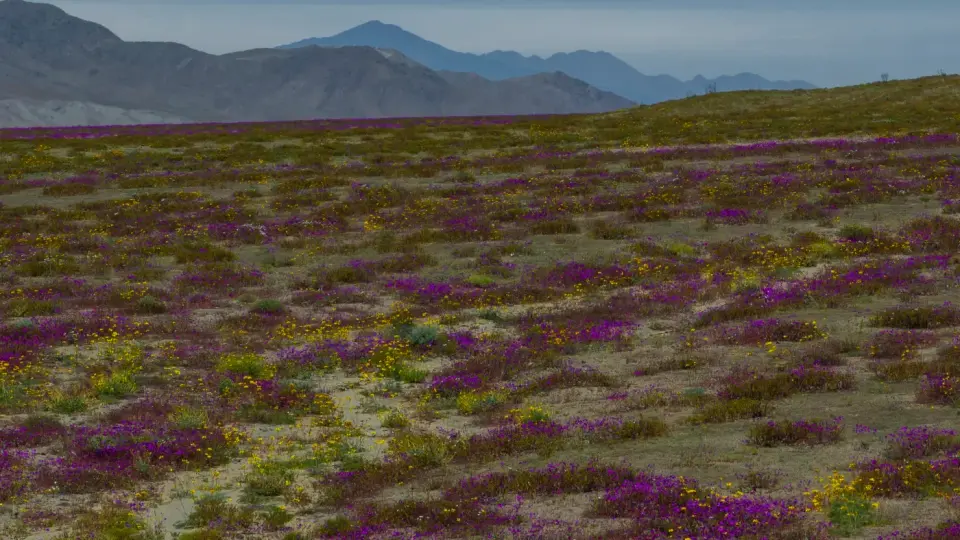
Unprecedented rainfall linked to a strong El Niño has triggered the largest and most colorful 'Desierto Florido' (Desert Bloom) in Chile's Atacama Desert in 30 years. Heavy rains in July and August caused flash floods and evacuations but also awakened dormant seeds, resulting in over 200 species of wildflowers blooming across the arid landscape. The event has drawn massive tourism, with 15,000 visitors to Llanos de Challe National Park in recent weeks, and is expected to generate 300,000 overnight trips. Scientists are racing to collect seeds before the brief bloom ends, while local officials pursue UNESCO World Heritage status to diversify the region's mining-dependent economy.
Key points
- The current bloom is described as the largest in 30 years, with rainwater penetrating deeper into the soil than in decades to activate dormant seeds.
- Over 200 plant species are flowering, including the endemic garra de león, which grows only in a few miles of the Atacama coastline.
- The bloom is expected to last until mid-November 2026, creating a transient ecosystem that supports insects, lizards, bats, and guanacos.
- Tourism has surged, with Llanos de Challe National Park seeing 15,000 visitors in a few weeks compared to its usual 10,000 annual total.
- Chile's Atacama region governor is seeking UNESCO World Heritage recognition for the phenomenon to boost tourism and reduce reliance on mining.
Background
The Atacama Desert, the world's driest non-polar desert, occasionally experiences a 'Desierto Florido' when rare rains trigger dormant seeds to sprout. Previous coverage in October 2026 noted that record El Niño rains had already triggered this massive bloom, drawing nearly 300,000 visitors. The phenomenon is distinct from the severe flooding and yellow alerts reported in central Chile, such as Santiago, during the same El Niño event.
Why it matters
This event highlights the complex impacts of climate change, where extreme weather events like El Niño can cause both destructive flooding and rare ecological booms. The economic potential of the bloom offers a pathway for Chile to diversify its economy away from mining, while the scientific urgency to preserve genetic material underscores the fragility of these ecosystems.
What to watch
The bloom is projected to end by mid-November 2026. Scientists will analyze collected seeds to determine if this was the largest event on record and if any new species were discovered. The UNESCO World Heritage application process will continue, aiming to designate the area as Chile's eighth such site.
Want the full story? Read the original reporting
Read on NPR