
Xi’s Cairo Visit Cements China’s Strategic Pivot in Egypt Amid Middle East Turmoil
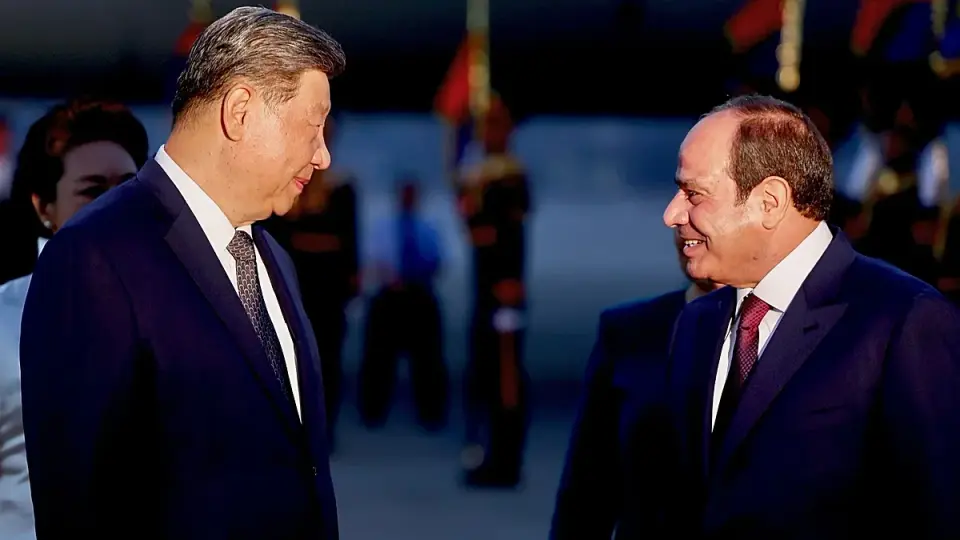
Chinese President Xi Jinping’s visit to Egypt marks a significant deepening of bilateral ties, shifting from infrastructure to advanced technology and military cooperation. While Beijing expands its footprint through the Suez Canal industrial zone and joint air drills, Cairo pursues strategic autonomy to diversify away from US reliance amid regional instability.
Key points
- Xi Jinping arrived in Cairo for his first visit since 2016, marking 70 years of diplomatic ties and a new 'comprehensive strategic partnership'.
- China has invested over $4.7 billion in Egypt, including the 385.8-metre Iconic Tower and a Suez Canal industrial zone hosting over 200 companies.
- Bilateral trade reached $11.3 billion in the first half of 2026, but remains heavily skewed, with Chinese imports to Egypt at $10.4 billion versus Egyptian exports of $840.8 million.
- The two nations held the second joint 'Eagles of Civilisation' air force exercise, featuring Chinese J-16 jets and French-made Rafales, signaling a shift in military partnerships.
- Xi urged Middle Eastern nations to oppose 'external interference' and reshape the regional security order, positioning China as an alternative to the US amid the Iran conflict.
Background
This visit follows a decade of infrastructure-focused cooperation, including the construction of Egypt’s New Administrative Capital. Earlier coverage highlighted Beijing’s growing influence in the Middle East, with Egypt serving as a strategic hub for Arab and African ties. The current visit occurs against the backdrop of a six-month US-Iran conflict that has disrupted global energy markets and raised questions about US reliability as a security partner.
How outlets are covering it
Euronews emphasizes the economic imbalance, noting that while trade has grown, Egypt imports far more from China than it exports, prompting Cairo to demand greater local manufacturing and technology transfer. Business Insider Africa highlights the military dimension, framing the joint air drills as a direct move to reduce US influence, while noting Egypt’s continued receipt of $1.3 billion in annual US military aid. France 24 focuses on the geopolitical messaging, with Xi calling for Middle Eastern nations to be 'masters of their own affairs' and opposing external interference, a stance that contrasts with US regional policies. Xinhua, the state agency, focuses on cultural and civilizational exchanges, highlighting Xi’s visit to the Grand Egyptian Museum and his promotion of the 'Global Civilization Initiative' to foster people-to-people ties.
Why it matters
The visit signals a structural shift in China-Egypt relations from infrastructure to high-tech and military cooperation, challenging US dominance in the region. For Egypt, it represents a strategic diversification to mitigate risks from US volatility and regional conflicts. For China, it secures a critical foothold in the Suez Canal zone, a vital artery for global trade and energy, while positioning Beijing as a key security and economic partner in the Middle East and Africa.
What to watch
The focus will be on the implementation of the five-year 2024-2028 programme for local production and technology transfer in electric vehicles, AI, and renewable energy. Further developments in the Suez Canal industrial zone and potential expansions in military cooperation will be closely watched. Additionally, the outcome of upcoming Xi-Trump talks may influence the trajectory of US-China-Egypt dynamics, particularly regarding sanctions and regional security.
- China deepens its footprint in Egypt as Xi visits Cairo after a decade Euronews.com
- China's Xi lands in Egypt as Iran war reshapes Middle East alliances Reuters
- Despite $1.3B in U.S. military aid, Africa’s strongest military welcomes China's Xi as Egypt deepens ties with Beijing and keeps Russia close Business Insider Africa
- Xi, Peng Liyuan visit Grand Egyptian Museum Xinhua
- Xi calls on Mideast nations to be ‘masters of their own affairs’ in rare Egypt visit France 24
Want the full story? Read the original reporting
Read on Euronews.com