
Pezeshkian Defies U.S. Pressure at BRICS Summit as Modi Pushes for Diplomatic Resolution
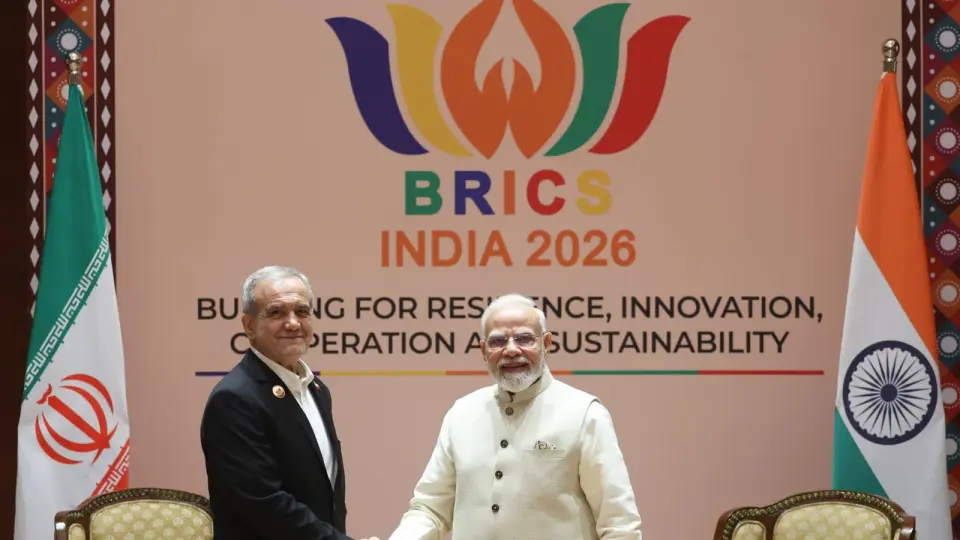
Iranian President Masoud Pezeshkian declared that Tehran will not surrender to U.S. pressure during his first visit to India for the 18th BRICS Summit. He met with Prime Minister Narendra Modi, who urged a diplomatic resolution to the Middle East conflict and emphasized the safety of seafarers in the Strait of Hormuz. While Pezeshkian advocated for using national currencies to counter U.S. financial dominance, Modi highlighted the need for global reform to address the economic vulnerabilities of the Global South.
Key points
- Pezeshkian stated Iran has successfully resisted U.S. and Israeli aggression and will not yield to bullying, responding to recent U.S. military actions.
- Modi and Pezeshkian held their second bilateral meeting in under two weeks, discussing trade expansion and the strengthening of India-Iran ties.
- Modi prioritized the safety of Indian seafarers and freedom of navigation through the Strait of Hormuz, which has seen slowed shipments since the conflict began in February.
- Pezeshkian urged BRICS members to use national currencies in trade to reduce reliance on the dollar and counter U.S. financial instruments.
- Modi criticized the current global order as a 'pyramid of privilege' and called for reforms in the UN Security Council and international financial institutions.
Background
This visit occurs amid ongoing tensions following the U.S. and Israel's military campaign against Iran, which began on February 28, 2026. Previous reports indicate that U.S. sanctions, including Operation Economic Outcast, have severely impacted Iran's economy, with inflation rising to approximately 66% and trade volumes dropping by 25-35%. Additionally, internal political tensions in Iran have been reported, with Pezeshkian describing communication with Supreme Leader Mojtaba Khamenei as 'very difficult' due to the leader's absence from public view since a recent strike.
How outlets are covering it
CNBC focuses on Pezeshkian's defiant rhetoric regarding U.S. and Israeli aggression, contrasting it with Trump's justification for military action. NDTV emphasizes the diplomatic and economic aspects, highlighting Modi's push for dialogue and the practical concerns of seafarer safety and energy security for India. Both outlets note the warm reception of Pezeshkian in India, but NDTV places greater weight on the BRICS economic agenda, such as the use of national currencies, while CNBC highlights the broader geopolitical stance against U.S. dominance.
Why it matters
The conflict in the Middle East has significantly disrupted global energy supplies, with crude oil prices surging due to the blockade of the Strait of Hormuz. India, which imports nearly 85% of its fuel needs, is particularly vulnerable to these supply disruptions. The diplomatic efforts between India and Iran, along with the broader BRICS push for financial independence from the U.S. dollar, could reshape global trade dynamics and energy security in the coming months.
What to watch
The 18th BRICS Summit in New Delhi will likely focus on economic resilience and reforms to international institutions. India and Iran may further expand their trade basket, while the U.S. and Iran continue their standoff. The safety of seafarers and the flow of oil through the Strait of Hormuz will remain critical issues for global energy markets.
- Tehran won’t surrender to the U.S., Iranian President Pezeshkian says, as India's Modi urges dialogue and peace cnbc.com
- India's Modi stresses need to protect navigation, seafarers in talks with Iran's Pezeshkian Reuters
- Iran Turns to BRICS Summit as US War Deepens Its Isolation Bloomberg.com
- Russia & Iran hit out at US 'aggression', pose a challenge for summit host India The Times of India
- PM Meets Iran's Pezeshkian, Reiterates Need For Dialogue, Open Sea Routes NDTV
Want the full story? Read the original reporting
Read on cnbc.com