
Ukraine's Drone War: From Welsh Factories to Deep Russian Strikes
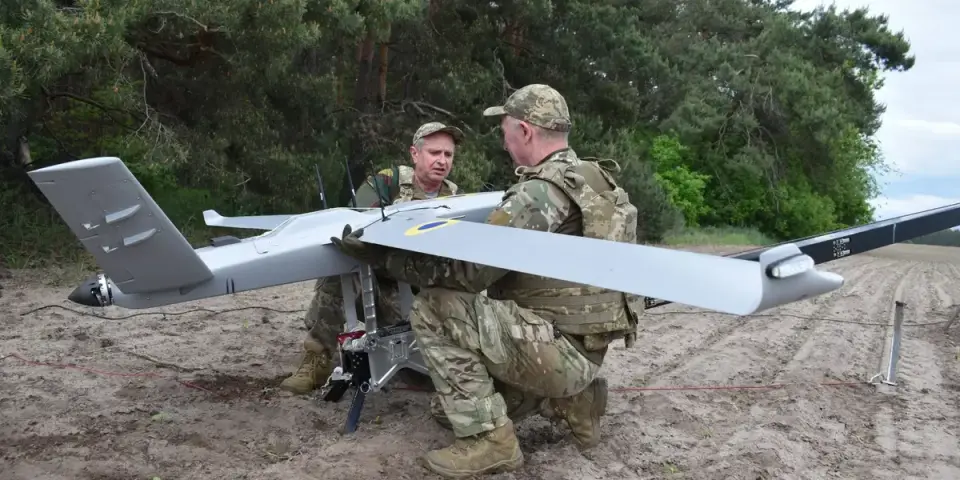
Ukraine’s military strategy increasingly relies on a hybrid model combining Western-supplied reconnaissance drones with domestically produced long-range strike aircraft. While Western manufacturers like Tekever provide advanced surveillance tools that require rapid feedback loops for adaptation, Ukrainian firms such as Fire Point have scaled production to execute deep strikes into Russian territory, targeting energy infrastructure and commercial hubs to exert economic pressure.
Key points
- Tekever’s AR3 surveillance drones are manufactured in Wales and transported to Ukraine, where they help locate high-value targets like air defenses and artillery for artillery crews.
- The 15th Artillery Reconnaissance 'Black Forest' Brigade uses these drones in southeastern Ukraine, relying on a secure hotline with Tekever to rapidly adjust technical specifications based on battlefield feedback.
- Ukrainian defense company Fire Point claims to facilitate over 60% of Ukraine’s deep-strike campaign, scaling from 200 drones in 2022 to a projected 100,000 by the end of 2026.
- Ukraine’s long-range strikes, dubbed 'long-range sanctions,' target Russian oil refineries and the Wildberries retail platform, aiming to inflict economic losses and psychological impact on the Russian population.
- Western procurement cycles are being challenged by the speed of Ukrainian innovation, with NATO officials noting that traditional multi-year development timelines are too slow for the current pace of technological obsolescence in the conflict.
Background
This development follows a broader shift in 2026 where Ukraine has transitioned from a recipient of Western aid to a key innovator in drone warfare. Previous reports highlighted how drone-dominated frontlines have slowed ground advances, requiring precise coordination to move even short distances. Additionally, Ukrainian commanders have previously urged faster Western funding to expand strikes into Crimea, emphasizing the critical need for timely international support to sustain these operations.
How outlets are covering it
Business Insider emphasizes the symbiotic relationship between Western manufacturers and Ukrainian troops, highlighting how Tekever’s AR3 drones are adapted in real-time based on feedback from the 'Black Forest' Brigade. This contrasts with CNBC’s focus on Fire Point’s domestic scale, where CEO Iryna Terekh criticizes European bureaucracy for hindering production speeds, arguing that Ukrainian agility is essential for survival. Al Jazeera frames the deep strikes as a strategic tool for 'long-range sanctions,' aiming to cause economic and psychological damage, while Vox notes that Ukraine’s nimbleness and improvisation are key to its ability to hold its own against Russia despite waning US support.
Why it matters
The integration of Western-made reconnaissance drones with Ukrainian long-range strike capabilities is reshaping modern warfare, forcing NATO to rethink procurement and development cycles. The ability to rapidly adapt technology based on front-line feedback is becoming a critical factor in maintaining military effectiveness, with implications for future conflicts and defense industry strategies.
What to watch
Ukraine is expected to continue expanding its deep-strike campaign, potentially targeting more Russian economic and military assets. Western nations may accelerate their own defense procurement processes to match the pace of Ukrainian innovation, while Fire Point aims to achieve production levels that were previously thought impossible within such a short timeframe.
- Factory to front lines: A Western spy drone’s journey to war in Ukraine businessinsider.com
- How Ukraine is holding its own against Russia — and changing warfare as we know it vox.com
- ‘Long-range sanctions’: Ukraine hopes strikes cause Russia fear and losses aljazeera.com
- Inside the startup drone maker powering Ukraine's deep-strike campaign CNBC
- Russia and Ukraine have stepped up their aerial war. Civilians are paying the price CNN
Want the full story? Read the original reporting
Read on businessinsider.com