
Pew Projects Islam to Surpass Christianity by 2035 as Africa Becomes Christian Hub
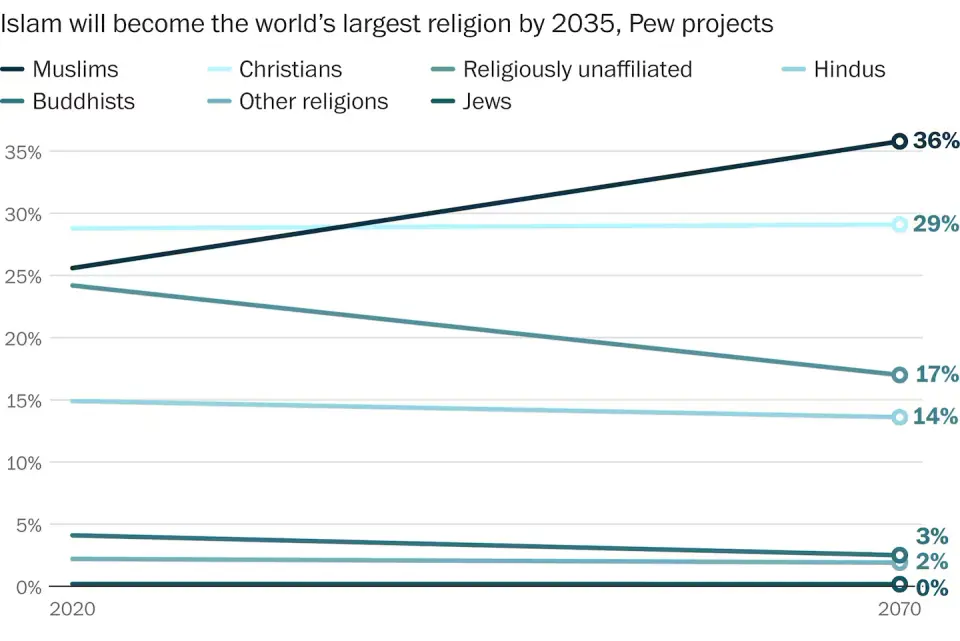
A new Pew Research Center study projects that Muslims will outnumber Christians globally by 2035, driven by higher fertility rates and younger age profiles. By 2070, the Democratic Republic of Congo is expected to replace the United States as the nation with the most Christians, while sub-Saharan Africa will host over half of the world’s Christian population. Conversely, North America is projected to lose its Christian majority, with unaffiliated individuals rising to 41% of the U.S. population.
Key points
- Muslims are projected to surpass Christians as the world’s largest religion by 2035, with 2.57 billion Muslims compared to 2.52 billion Christians at that time.
- By 2070, the global Muslim population is expected to reach 3.6 billion, while Christians will number just under 3 billion, despite both groups growing in absolute terms.
- The Democratic Republic of Congo will overtake the United States as the country with the largest Christian population by 2070, driven by rapid growth in sub-Saharan Africa.
- North America will no longer have a Christian majority by 2070, with Christians comprising 46% of the population, while religiously unaffiliated people will account for 41% in the U.S.
- Fertility rates are a primary driver, with Muslim women averaging 3.1 children per woman compared to 2.5 for Christian women, and Muslims having a median age of 24 versus 33 for non-Muslims.
Background
This projection builds on Pew’s earlier 2022 analysis of U.S. religious identity, which predicted a decline in the Christian share of the American population. Recent political shifts, such as the 2026 victories of progressive clergy in Texas and Kansas, highlight ongoing tensions between evangelical and mainline Christian voters, though these domestic political dynamics are distinct from the broader demographic trends outlined in the new global report.
How outlets are covering it
The Washington Post and South China Morning Post emphasize the headline finding that Islam will overtake Christianity by 2035, focusing on the numerical crossover. Christianity Today provides a more nuanced view, highlighting that while Christianity declines in the West, it is doubling in sub-Saharan Africa, with the DRC becoming the new center of gravity for the faith. Pew Research Center details the methodological drivers, noting that while Christians lose followers through religious switching in the U.S., global growth in Africa offsets these losses. All sources agree that fertility rates and age demographics are the primary factors behind these shifts, though Pew cautions that these projections do not account for potential wars, epidemics, or economic changes that could alter outcomes.
Why it matters
These demographic shifts will reshape global cultural, political, and economic landscapes. The rise of sub-Saharan Africa as the center of Christianity may alter the power dynamics within global denominations, as seen in recent tensions between Western and African church leaders. Meanwhile, the growing Muslim population will influence international relations and migration patterns, particularly in Europe and North America, where religious majorities are eroding. Understanding these trends is crucial for policymakers and religious institutions adapting to a changing global identity landscape.
What to watch
Pew Research Center has released a data explorer and sortable table allowing users to examine projections for specific countries and religious groups. The organization will likely update these projections as new census data and fertility rate trends emerge. Religious institutions, particularly in the U.S. and Europe, may adjust their strategies in response to the projected decline in Christian majorities and the rise of religiously unaffiliated populations. Global observers will monitor whether actual demographic trends align with these projections, particularly regarding fertility rate declines in high-fertility regions.
- Muslims to outnumber Christians worldwide by 2035, study finds The Washington Post
- The Future of World Religions: Population Growth Projections, 2020-2070 Pew Research Center
- Islam projected to surpass Christianity as world’s largest religion by 2035 South China Morning Post
- Pew: Christians Will Be Minority in North America by 2070, Will Double in Africa Christianity Today
- Muslims are projected to outnumber Christians by 2035 as the world’s largest religion AP News
Want the full story? Read the original reporting
Read on The Washington Post