
Black Sea Port Disruptions Trigger Global Wheat Price Spike and Supply Shifts
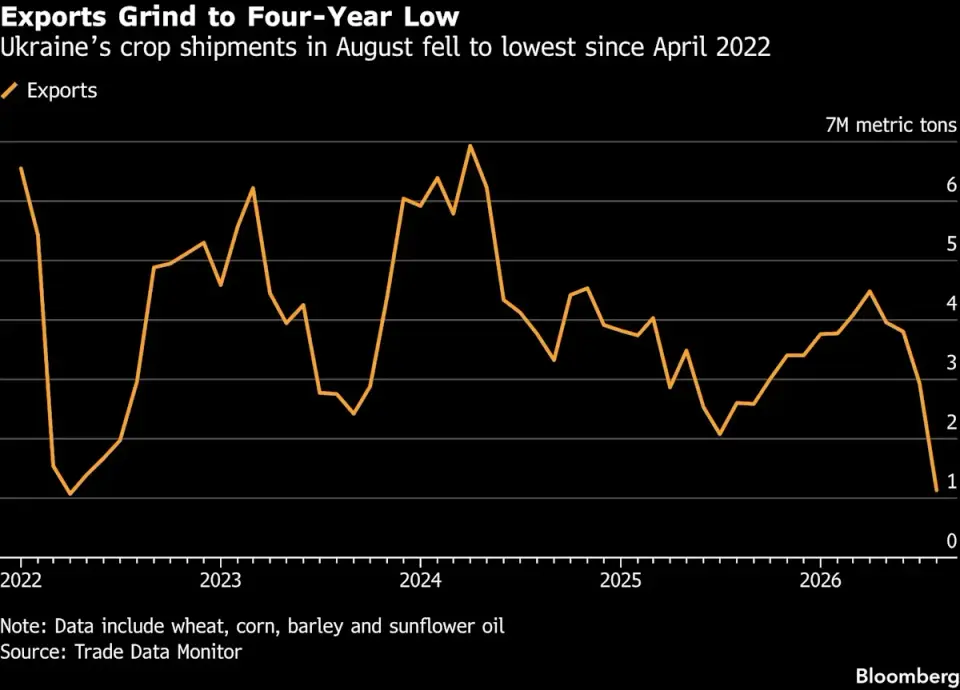
Russian strikes on Ukrainian Black Sea ports have severely disrupted grain exports, causing global wheat prices to hit a three-year high. While Ukraine attempts to reroute shipments via rail and the Danube, these alternatives cannot match the volume of sea transport, leading to shortages for major buyers like Egypt and forcing importers to seek supplies in Europe, the Americas, and Asia.
Key points
- Wheat prices have reached their highest level in three years due to supply disruptions in the Black Sea region.
- Combined wheat exports from Russia and Ukraine in July-September are estimated to be only half of last year's volume.
- Egypt, the world's largest wheat buyer, has not received grain from the Black Sea region for approximately one month.
- Ukraine's railway crossings with the EU can handle only about 10,000 tonnes of grain per day, insufficient to replace sea exports.
- Alternative routes via the Danube are hindered by low water levels and congestion, with about 80 vessels accumulating near Ukrainian ports.
Background
This situation follows a series of escalating disruptions in the Black Sea since mid-2026. Previous reports indicated that Russian strikes on Ukrainian ports had already reduced grain exports by roughly 75% year-on-year, straining storage capacity and threatening the 2026-27 harvest. The current escalation intensifies these concerns, with global markets already reacting to potential food security shocks and rising prices.
How outlets are covering it
The Japan Times and UA.News emphasize the immediate economic impact, noting that combined Russian and Ukrainian wheat exports have dropped to half of last year's levels, forcing buyers like Vietnam to seek more expensive alternatives in the US and Bulgaria. LIGA.net, through the analysis of Andrii Onistrat, highlights the strategic and technological challenges, stating that Ukrainian ports will no longer operate as before due to the threat of Russian jet drones, which current interceptors cannot effectively counter. Onistrat suggests that grain exports may shift to rail and river transport, but acknowledges these methods are far from ideal and cannot fully replace sea shipments. The EU, as noted by Kaja Kallas, supports alternative routes but warns that they cannot replace sea transport in terms of volume, raising the risk of a new global food security shock.
Why it matters
The disruption of Black Sea grain exports threatens global food security and could lead to a significant price shock, affecting millions of people worldwide. The inability of alternative routes to fully replace sea transport means that major wheat buyers, such as Egypt, are facing shortages, which could exacerbate food insecurity and economic instability in vulnerable regions. This situation also highlights the geopolitical leverage of food supplies and the potential for further escalation in the conflict, with implications for global trade and security.
What to watch
Global wheat prices may continue to rise as supply remains constrained. Importers will likely continue to seek alternative sources, potentially driving up costs for consumers. Ukraine and the EU may explore further measures to improve alternative export routes, but these are unlikely to fully compensate for the loss of sea transport. The situation could also influence diplomatic efforts, as the threat to global food security may pressure各方 to seek a ceasefire or other resolutions to the conflict.
- The Other Hormuz: Black Sea Blockade Threatens a Food Supply Shock Yahoo Finance
- World Bank Provides Ukraine With $250M to Support Agricultural Producers. ubn.news
- "The only way is to send it to China." Onistrat says ports will no longer operate as before news.liga.net
- Russia expands grain exports via the Baltic and Caspian routes UkrAgroConsult
- Disruption of Black Sea ports threatens food market — The Japan Times ua.news
Want the full story? Read the original reporting
Read on Yahoo Finance